
“Lord, just leave me my hands and give me strength to go to work”…
Every day for her begins with prayers for health. Fear and insecurity follow her everywhere, and loneliness is her constant companion. Exhausted by life and poor health, she must work to secure a basic livelihood. She also cares for her two brothers, both of whom have disabilities.
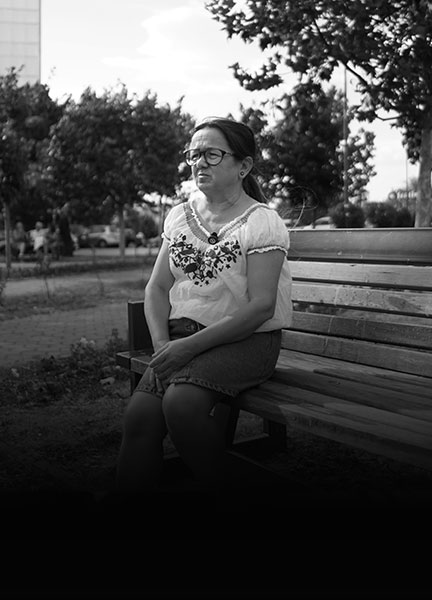
Short in stature, Xhevrije Burovci from Kamenica has spent years searching for a job. The 51-year-old has continuously faced challenges and prejudice because of her physical appearance.
“I went to school for 12 years, but of course the environment, society, the kids on the street bullied me. ‘Look how small she is, small like a pebble.’ It hurt me a lot, naturally. Besides that, when I went to apply for jobs, as soon as they saw me, they wouldn’t accept me. One woman even said: ‘You’re not the person I’m looking for.’ And I told her: ‘Are you looking for a model, or someone to do the work?’”
She has been living in Prishtina for five years now, initially working as a seamstress. Today, Xhevrije works at the “Freesia” tissue and paper packaging factory in Lipjan, a company that employs people with disabilities—around twenty kilometers from Prishtina.
Her story speaks about challenges, poor health, caring for her brothers, and the prejudice and insults she has faced.
Besides dwarfism, a condition that prevents normal physical growth, she also suffers from osteoporosis, which has weakened her bones and causes constant pain.
“My life has not been easy. As a person with disabilities, I have been mocked, bullied, looked down on by people. It’s been hard—at home too, with my sister-in-law, my brother… Hard. I have two brothers with disabilities who have been left alone at home. Because they left us, I had no choice but to come to Prishtina to work, to take care of myself and help my two brothers who are still in Kamenica. It’s very hard. I’m renting here, and besides having disabilities, I’m also sick with osteoporosis, my bones are very damaged, and I have high cholesterol and many other issues, including spinal problems. But I have to be strong and push through. I have to work, dress myself, feed myself, go to work and come back, and support myself and my brothers.”
Her childhood was extremely difficult, including harsh economic conditions as the tenth child in the family.
“We were 10 children… My brother lived with us with his wife and kids, and then they left us. So I had to come here, find an apartment on my own, look for a job and work to support myself and my brothers. They also need medicine, they need firewood for winter.”
“I pulled myself together. I knew I had to survive, to work, to live—there was no other choice.”
The short-statured woman still carries the regret of never being able to continue her education and become a doctor, her lifelong dream.
“I went to school for 12 years; after that I couldn’t continue even though I really wanted to. Four years ago, I tried to apply to university, but I missed admission by four points. And honestly, it would have been too hard—because even at work now, I see how much I get exhausted.”
She says she’s terrified even when walking on the street, because many times she loses strength in her legs.
“I manage with great difficulty, especially now with rent. Because of my bone disease, my legs can give out and I could fall in the street and not be able to get back up. It happens often, especially when crossing the street in front of cars—my leg gives me sharp pain. If I don’t slow down and walk carefully, I could break my leg. Who will notice me? Who will take care of me? I’m all alone.”
From the state, she receives only 120 euros in disability pension.
Through tears, she recounts her life alone in Prishtina, and the heavy burden of providing for her two disabled brothers in Kamenica. She visits them every week and brings food.
“It’s hard to manage—there’s the rent, transportation. One euro to go, one to return. Rent is 250 euros. Electricity, water, garbage, maintenance—very little is left for me. And I use medication. Just the medicine I take costs more than 100 euros. If I don’t take it, my body gives out… It’s difficult. People bully me even on the bus—they cause problems, mock me. It’s a very hard time, a hard life. People don’t understand.”
Xhevrije, the tenth child in her family, receives no help from anyone. She often stays awake at night worrying about how to pay the rent and who will take care of her in the future.
“I call on people to help me find a housing solution, so I don’t have the burden of worrying how to pay rent every month. I’m constantly stressed about fainting somewhere in the street, falling and staying there. Who will pay my rent? Who will look after me? Every day I am afraid, always stressed—especially when the landlord tells me, ‘Leave the apartment’. A month ago he told me, ‘Leave the apartment because I’m renovating it.’ How can I find a new place? How do I move my things? I’m sick, weak, alone.”
Her daily prayers are for good health and the strength to work. She asks the institutions and community to help her secure at least one room to live in.
“Just a roof over my head, one room. So I don’t have to worry whether I can afford rent. If I get sick, if I collapse, maybe I won’t be able to work for ten or even five years—it depends on my health. Just shelter, so I don’t carry the burden of rent. I keep saying: ‘Oh Lord, just leave me my hands and give me strength to go to work.’”
Xhevrije Burovci
July 2025