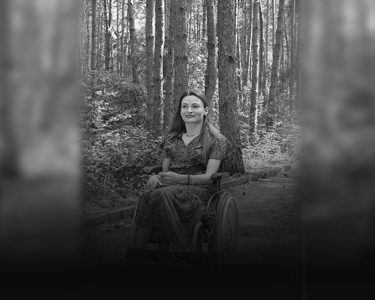

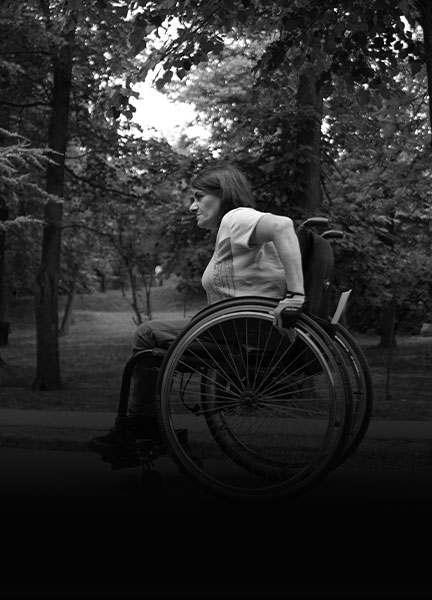
“Here, at Taukbahqe, I go out every morning for two hours; sometimes I even go out twice a day, in the morning and evening, and I train by exercising. I train here before competitions, but I also go out when there are no competitions, so that I’m not passive…”
With the help of her wheelchair wheels, every morning she moves toward great achievements. Despite her physical disability, she has accomplished every success.
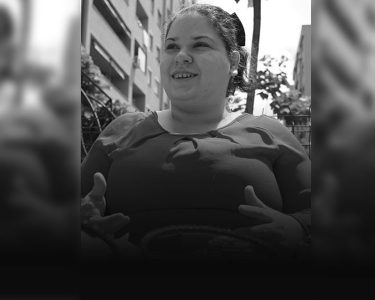
Twice a day, for two hours each time, Vjollca Hoxha walks and runs along the trail in Taukbahqe Park in Pristina. This is the closest space where she can train for athletics competitions.
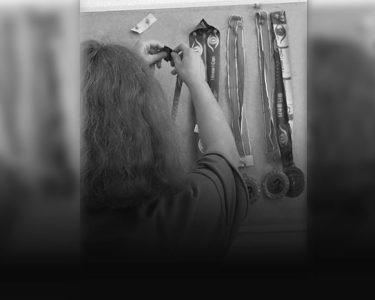
The extraordinary success of the 54-year-old is also demonstrated by dozens of Olympic medals. Sports have given the wheelchair athlete motivation and determination to continue, despite a difficult life and numerous discriminations.
She lives alone in Pristina, in a rented apartment, while her family is in Ferizaj. Vjollca wakes up alone, takes care of her home, and also prepares meals.
“When I was six years old, I ended up in a wheelchair due to a high fever. My childhood continued in hospitals, and then I returned home; the challenges were always there.”
Since then, she has faced limitations, discrimination, and bullying from the community where she lived.
“Especially before the war, I faced challenges, because when I went out, people would look at me badly. ‘Look at how she is going out with a wheelchair.’ These words made me feel… it was very hard. I had challenges, but my family also faced challenges. ‘Why do you let her go out?’ ‘Why do you allow it?’ They were told to mind their own business; this came from God, and we wouldn’t let our daughter stay locked up.”
Vjollca Hoxha, who has been in a wheelchair since childhood, did not have the opportunity to attend school. She explains that before the war, education was impossible for people with disabilities.
Her journey to becoming a champion began in 2000. Today, she is the winner of many marathons organized in the country.
“I couldn’t attend school, because before the war, people in wheelchairs weren’t allowed to enter. I started doing sports immediately after the war; my first race was in Gjakova. Later, when the marathon started, I continued with the marathon, including with the community that organized the police school. In the beginning, it was difficult, but later with training, because here in Kosovo it’s a bit hard since there is little space for training, especially for people with disabilities.”
Sports have helped Vjollca overcome almost every challenge, as well as difficult situations she has faced. Last year, she worked hard on herself to participate in the “Paris 2024” Olympic Games, where she almost didn’t make the list.
“My first prizes were in 2005, at the marathons in Pristina and Vushtrri. But for me, the prize was never the most important thing, which place I got; participation was what mattered. I have 20 awards so far; when I see them, I feel proud. Sports have helped me a lot, but the most support came from my family. The main thing is family and having their support.”
Through sports, she has overcome every barrier, but even today she faces difficulties accessing many institutions with her wheelchair.
“It’s very difficult; I get upset when I can’t complete a task, especially at the Center for Social Work; people with disabilities have more work there, but there is no access at all.”
The 54-year-old also faces financial difficulties. The state provides social assistance of 435 euros, but it is not enough to cover her monthly needs.
“The social assistance I currently receive is 435 euros; it’s not enough for anything, but thanks to family support, I rent an apartment in Pristina and pay 250 euros. Without my family, I wouldn’t have been able to achieve what I have now.”
The wheelchair athlete calls on institutions to support all people with disabilities, especially those who want to engage in sports.
“The state should provide more support for people with disabilities, for those whose pension is 150 euros, and also pay for an assistant. I tell the families of people with disabilities not to stop those who have the will to do sports.”
Vjollca Hoxha has opened the doors of the para-athletics club “Dardania,” which she leads, to everyone who has an interest in athletics.
Vjollca Hoxha
June 2025