
She keeps in her memory the last images in color.
They are the portraits of her family members, the house where she grew up, and the streets of the city that she always imagines. The last time she could see was in 2005, before finishing her studies.
“From a beautiful world full of colors, I entered a foreign soul,” this is how Fjolla Muhaxhiri Agusholli describes the period after losing her sight. She remembers herself as withdrawn and without the will to live, though this state did not last long. Losing her sight at the age of twenty did not stop her dreams, but instead gave a new meaning to her life.
She starts her day with gratitude that her feet touch the ground and her hands prepare food.
“Losing sight does not mean losing the world. I may not be able to see, but I am very grateful that my feet touch the ground, my hands take a glass of water or wash my face in the morning, and I have seen that there are more difficult things, so I am very grateful. That is how my day begins—being grateful and making a plan for what I will do today, starting from the chores, then breakfast, lunch, dinner, and not forgetting writing.”
Fjolla was diagnosed with diabetes at the age of three. This caused her blindness in 2005.
“I was born in Gjakova in 1985 and spent my childhood, schooling—everything—until the age of 20 in my hometown, Gjakova. After 2005, when my life changed, meaning from a beautiful world with full colors, I entered a foreign soul where I didn’t even feel like myself for some time. Everything went well until I was 20. The problem with my eyesight began and I lost my vision completely. I remained calm, but that calmness was not the kind a peaceful person has—it was simply that I felt worthless. But fortunately, my soul cried out and told me ‘get up’, ‘wake up’, ‘you must live’ and ‘life is worth living beyond all the challenges that struck me’.”
Her family, relatives, and society were a strong pillar for her to return to life. However, she did not feel equal due to the shock she experienced.
“I am a very active person and I value every second, let alone minutes, hours, and days. I have enjoyed every moment and worked to reach where I wanted to be. The blow of these challenges that pushed me into becoming a blind person made me undervalue myself and feel worthless.”
This state did not last more than six months, but for Fjolla almost everything began from scratch.
“I started from the beginning to learn something new. Often, inside me, the little Fjolla spoke and told me, ‘Here, a new life is being reborn in you,’ and ‘you are learning how to prepare food, how to do the things of life from now on.’”
She lost her sight after three years of studies and was unable to finish university.
“I left the life of the old Fjolla halfway at the age of 20—at the highest peak where I had so many dreams, ambitions, desires. I thought there were no limits to reaching them. That Fjolla died there—not that she was left halfway, but she died—and another Fjolla was reborn.”
Fjolla Muhaxhiri-Agusholli spends most of her time in a chair in the living room. She has written hundreds of pages so far, through which she motivates all blind individuals.
Despite many challenges, she returned to her old passion—writing. Five years ago, she participated in a book with 11 other co-authors titled “The Boundaries of Waiting.” A year later, she contributed with a poetic prose in the book “White Lines.”
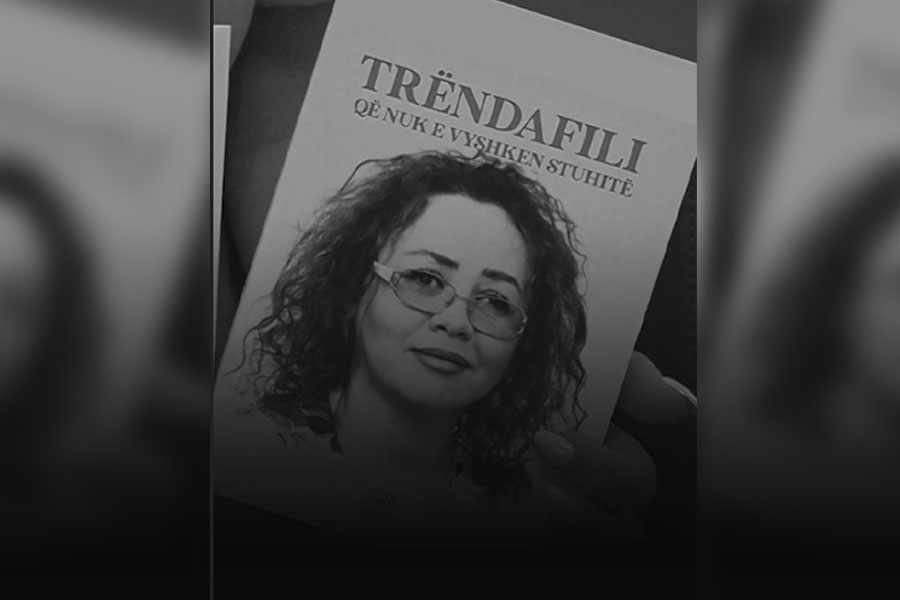
A few years after losing her sight, in an autobiographical account, Fjolla wrote her first novel “The Rose That Storms Do Not Wither.”
“I started writing part by part a book that I thought would be a collection of stories. After starting with ‘The Night of the Henna Ceremony’, I asked myself why I shouldn’t try writing my life before birth, before coming into life until marriage. I started with stories, but I wasn’t satisfied because I wanted everything—I wanted to quote it all in words. The words became lines, the lines became pages, even though I didn’t plan for it to become a motivational book for others after me. So it ended up as an autobiographical novel, which was promoted in 2023. Before that, I published a poetry book ‘The Queen of the Night’ in 2022. That was my first authorial book. Then came ‘The Rose That Storms Do Not Wither’, named so because my late grandmother never called me by my name but always ‘grandma’s rose’.”
She has also written two other story collections, “Forgive Me, Soul” and “Forgive Me, Soul II”, each with 12 stories, all based on real events.
“My inspiration in the early beginnings came at night because my life was a bit more active and I didn’t have the space I have now; I lived with many family members. So the night was my spiritual peace and the rise of my muse. Later, in my new home, I had the opportunity to write whenever I needed to and felt that inspiration reaching me.”
Her journey has been illuminated through writing, but she doesn’t feel as safe on the city streets. From family and relatives, she does not want pity, but respect.
“It’s useless to hold the white cane when I have no space to walk. I don’t feel safe going out alone—I never have. I have always walked with a family member beside me, or most often by taxi or with someone from my family. I don’t feel safe if I am alone in a street in the cities of Kosovo. I don’t know where to walk, even when I go to the bank, hospital, or clinical center—I don’t know where to orient myself because signs for the blind are missing, just as ramps and markers are missing for wheelchair users and many others. These should be primary things that make life easier for persons with disabilities so they can live freely, not always be dependent on parents or family—because even they have their own lives, and eventually, it becomes ‘enough.’”
Fjolla Muhaxhiri Agusholli does not want to fall behind in anything; therefore, she asks institutions for support so she can live like everyone else.
“Let the institutions support us with infrastructure, technology, and the equipment we need in life. There is so much—our country is far behind compared to what I have experienced in Switzerland or Italy…”
Fjolla Muhaxhiri Agusholli
July 2025