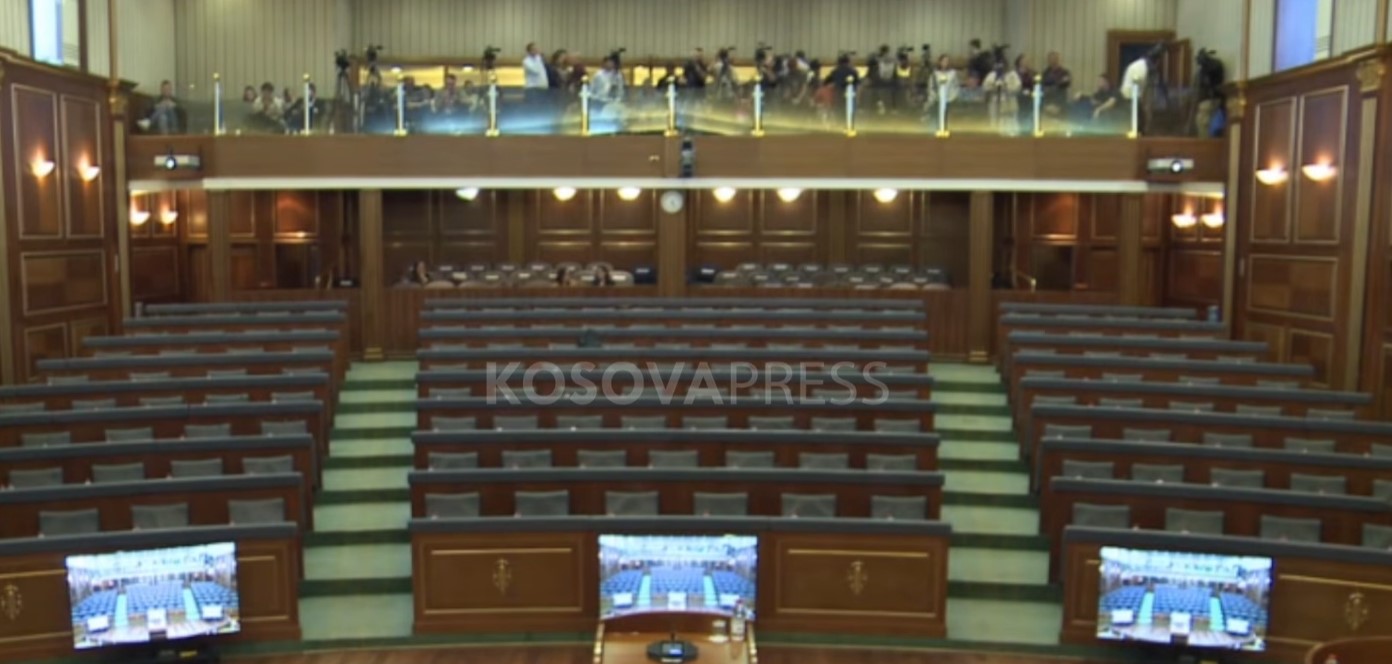
Kosovo Assembly constituent session: scenarios for forming new institutions
Vote counting of parliamentary candidates in the June 7 elections is nearing completion, while attention has already shifted to the steps that will lead to the formation of Kosovo’s new institutions. With less than half of the votes for MPs still to be counted, election monitoring experts say parties should begin negotiations as early as possible in order to avoid delays in forming institutions and the risk of a new political deadlock.
Preliminary results from the June 7 parliamentary elections show the Vetëvendosje Movement as the leading political force in the country with around 42.9 percent of the vote, currently translating into 48 seats in the Kosovo Assembly. However, these figures remain provisional, as they do not yet include conditional votes, votes of persons with special needs, and diaspora votes, which could still affect the final distribution of mandates.
According to the preliminary results, the Democratic Party of Kosovo ranks second with around 21.1 percent of the vote and 24 parliamentary seats, while the Democratic League of Kosovo has secured around 17.6 percent, giving it 20 seats in the Assembly.
Meanwhile, the Alliance for the Future of Kosovo has won around 7.2 percent of the vote and eight parliamentary seats. The Assembly composition also includes 20 guaranteed seats for non-majority communities, of which 10 belong to the Serb community and 10 to other communities.
Researcher at the Kosovo Institute of Justice, Naim Jakaj, told KosovaPress that based on the current pace of the process at the Central Election Commission, certification of the results could take place in the first days of July. After this process, he says, the phase of constituting the Assembly should begin immediately.
Jakaj stresses that although legislation provides that the constitutive session must be called within 30 days of certification of results, there is no reason to wait for the maximum deadline.
“Due to the speed of counting taking place at the Central Election Commission, it is possible, and there are real chances, that the results will be certified around July 4–6. Then the procedure for forming institutions should begin. It is known that according to the Constitution and regulations, the constitutive session must be called by the acting president within 30 days. However, such a session should not wait for the full 30-day deadline. It should be called immediately, the next day or two, or within the first 10 days of that 30-day period,” Jakaj said.
On the other hand, political analyst Jeton Kelmendi believes that the parliamentary arithmetic after the elections leaves several possibilities open for forming a government, although not all are equally realistic.
According to him, a coalition between the Vetëvendosje Movement and the Democratic Party of Kosovo would produce a numerically stable government, but he considers this scenario unlikely due to the long-standing political relations between the parties.
Kelmendi assesses that a more realistic option would be cooperation between the Vetëvendosje Movement, the Democratic League of Kosovo, and non-majority community parties.
Such an agreement, he says, could also include the distribution of key institutional posts, including the presidency, the prime minister’s office, and the speaker of the Assembly.
“Now there are two variants in which a stable government could be formed: one between LVV and PDK, but I don’t believe this will happen, because knowing Kurti’s political approach, he would lose support and be weakened since his political camp has traditionally been opposed to PDK and the wartime wing. Therefore, I don’t think this is likely. The second option is for LVV to go into a coalition with LDK and the minorities. In theory, this is possible, and the presidency could go to LDK, while the speaker of the Assembly and the prime minister would go to LVV as the winning party,” he said.
Meanwhile, Jakaj emphasizes that political parties should not wait for the constitution of the Assembly to start communicating with each other. He says the election result is already clear in its main outlines and that coalition talks should begin in advance.
According to him, the lack of a political agreement would make it difficult to form a new government and could push the country into another cycle of institutional uncertainty.
The parliamentary elections of June 7 were the third held in Kosovo within the last 16 months, indicating an ongoing political crisis and the inability of political parties to ensure long-term institutional stability.