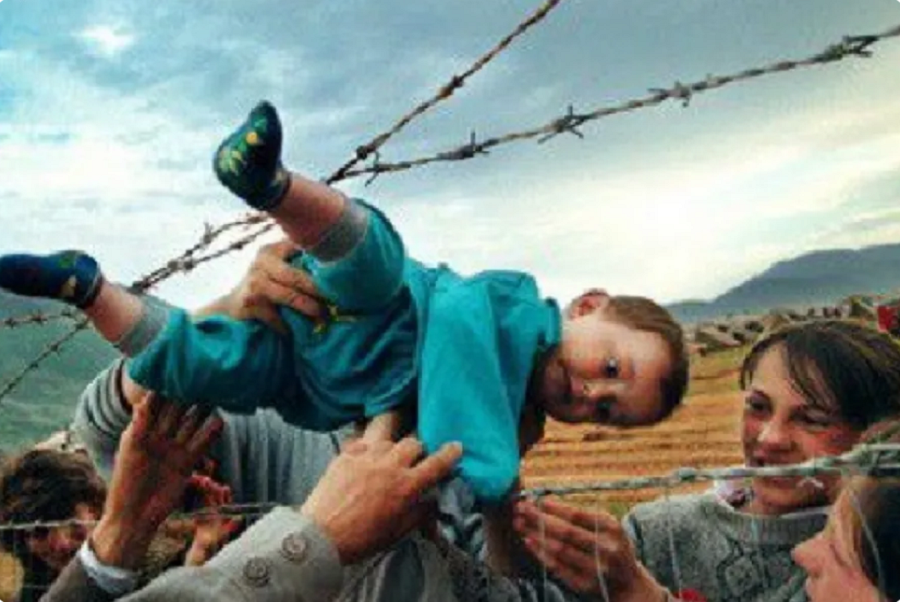
27 years since the exodus of Kosovo Albanians
Today marks 27 years since the exodus of Kosovo Albanians, when during the 1998–1999 war, around one million Albanians were forced by Serbian paramilitary forces to flee to Albania and North Macedonia.
In addition to those displaced to Albania and North Macedonia, thousands of Albanians also crossed the border into Montenegro, while hundreds of thousands were internally displaced, seeking shelter in the mountains of Kosovo, KosovaPress reports.
They were children, women, and the elderly—abused, tortured, and massacred. On every anniversary of the 1999 exodus, which reached biblical proportions, it is commemorated in Kukës, and in the past two years also symbolically due to the pandemic, as one of the most horrific human tragedies experienced by the people of this land.
The exodus, or the forced expulsion of Albanians from their homes, reached its peak after the start of NATO’s bombing of military and police targets of the former Yugoslavia (Serbia and Montenegro), reports KosovaPress.
On March 27 at 13:20, at the Vërmica/Morina border crossing, the first 187 refugees from Kosovo arrived in Kukës, most of them children and women, in a dire physical and psychological condition and injured with hard objects such as rifle butts, rubber sticks, etc. Immediate measures were taken by the Kukës Prefecture authorities to transport them using civilian and military vehicles. They were mainly residents of villages in Prizren, Krushë e Madhe, and Zym. Initially, these refugees were sheltered in the “Hasan Prishtina” Palace of Culture.
By midnight on March 27, 1999, a total of 12,721 Kosovars had arrived in Kukës. The first food aid came from Albania’s Ministry of Agriculture, which on March 27 sent supplies (oil, flour, sugar, pasta, rice, soap, etc.) sufficient for 2,500 people for a month.
On March 28, the flow of Kosovars forcibly expelled from their homes by Serbian forces continued toward Kukës, reaching 13,000 people. Refugees entered through the Vërmica/Morina crossing, where they had been abused, tortured, robbed, and stripped of money, jewelry, and valuables by Serbian police.
Their temporary shelter was the Hasan Prishtina Palace of Culture. Later, local authorities in Kukës opened schools, nurseries, kindergartens, warehouses, and storage facilities to accommodate the displaced. Other refugees were hosted by local families, who welcomed them into their homes. On average, each family in Kukës hosted around 14 Kosovars, who slept in every available space in the house.
At the beginning of the following week, a second wave of about 70,000 displaced Kosovars arrived. Of these, 40,000 were accommodated with local families, 10,000 in public facilities in the city, 6,000 in the communes of Bicaj, Kolsh, Tërthore, and Shtiqën, 12,000 in the town of Kruma, and 300 in the commune of Golaj. Sixteen vehicles arrived in Kukës to evacuate some refugees to other cities. The number of displaced people increased day by day. Despite being hosted by local families, many Kosovars were also housed in camps.
April 16 is marked in Kukës as the Day of the Exodus, as a sign of gratitude and respect for all those who opened their doors to welcome their Albanian brothers from Kosovo.
One of the main symbols of April 16 is the Obelisk. The tower was built as a sign of gratitude to the Albanian people. It stands on the site where tents once sheltered Kosovo refugees. The tower is 23.5 meters tall and filled with photographs depicting events from that time. It is one of the most visited tourist sites in Kukës, especially on April 16.
To commemorate the days of forced displacement and the suffering of Albanians under the Serbian regime, the “Bllaca ‘99” Memorial Center in Hani i Elezit features the “Wall of Memory” monument, as well as the “Hasan Prishtina” park.
The “Wall of Memory” monument is a mosaic symbolizing the sacrifice of the Albanian mother, along with the names of several prominent international figures who contributed to the liberation of Kosovo. It is a monumental artistic work that best expresses remembrance and respect for all those who brought the long-awaited freedom and independence.