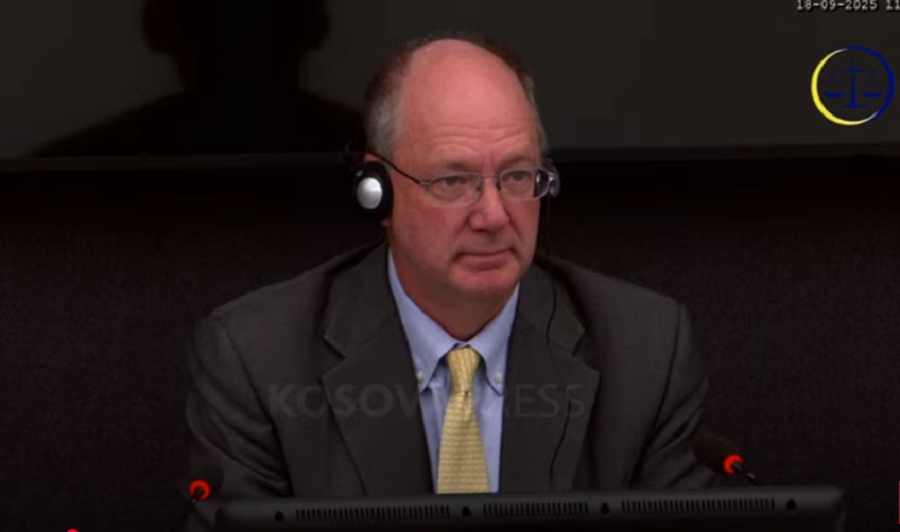
At the Kosovo Specialist Chambers in The Hague, the testimony of Paul Williams continues. Williams served as the legal advisor to the Kosovo delegation during the Rambouillet negotiations in 1999. Today, the questions from the judicial panel continued, during which Williams explained why Hashim Thaçi was chosen as the head of the Kosovo delegation at Rambouillet. Paul Williams, whose testimony is in defense of former President Hashim Thaçi, said it did not surprise him that Ibrahim Rugova was not the head of the delegation, as Rugova “was not a negotiator.” He stated that Thaçi and all other members from Kosovo were seeking independence.
The defense witness, Paul Williams, stated that the Kosovo delegation at Rambouillet consisted of 16 members but reiterated that he does not recall Kadri Veseli being part of the delegation.
During questions from Judge Barthe, Williams explained how Hashim Thaçi was elected head of the Rambouillet delegation.
Barthe: Do you know why Mr. Thaçi was chosen as the head? You said before that you were not present during the selection process. Was Mr. Thaçi, in February 1999, a prominent figure in Kosovo?
Williams: Your question has two parts, or actually two questions in one. As far as I know—and as I was advised by the presiding judge to speak based on my knowledge—three of them were chosen by consensus, according to the minutes of the February 7 meeting, which Edita Tahiri showed me. I was also given a document allowing me to enter the castle. The minutes of the meeting were the document that allowed me access. Ibrahim Rugova was from the LDK, Rexhep Qosja from LBD, and Thaçi from the KLA. The decision was made 2-1; Qosja voted for Thaçi, Thaçi voted for himself, and that’s how Mr. Thaçi was chosen. These were the votes: two for Thaçi and one against.
At the Specialist Chambers in The Hague, Williams said the Kosovo Liberation Army (KLA) was considered an important political component of Kosovo, while being asked whether it was surprising that President Ibrahim Rugova was not the head of the Kosovo delegation.
Barthe: What could be seen as surprising was that Mr. Rugova was not chosen as the head, even though he was a very prominent figure and still the elected president of Kosovo, correct?
Williams: Yes, that is correct. He was still the elected president of Kosovo. As for whether it was surprising, I would say no, it was not. President Rugova, the person I first offered my services to and advised through Bujar Bukoshi, was greatly respected. He admired every conversation that an international figure had with him, always concluding with two sentences: “independence and non-use of force,” and then let’s discuss other matters. Throughout, his main focus was independence and non-use of force. President Rugova played an important role at Rambouillet in representing the people of Kosovo. The international community would have been very concerned if they had to negotiate with him as the chief negotiator. His role was important; his pacifist ideas and aspirations for independence were significant, but he was not a negotiator.
At the Specialist Chambers, Williams also recounted an incident where, according to him, “a photographer almost ruined the Rambouillet negotiations.”
“I perceived the stress and tension that morning. The French sent a typical protocol photographer for standard protocol photos. This photographer almost disrupted the Rambouillet negotiations. He entered the room where the Kosovo delegation was and took photos of Hashim, Rugova, and others. Hashim became very nervous and stressed because these photos in the castle where negotiations were taking place could be used by Serbia,” he said.
Regarding Adem Demaçi’s role in the KLA, Williams said that “after Rambouillet, I did research on Google and, according to the internet, he was the spokesperson for the KLA.”
He also discussed Hashim Thaçi’s trip to Slovenia while the Kosovo delegation was at the castle, to meet with Adem Demaçi.
“It was necessary for signing the agreement, important for Thaçi to have a conversation with him. I did not get the impression that he needed approval, but the support was important, which is why Hashim Thaçi left the castle,” he said.
Paul Williams, who was the legal advisor to the Kosovo delegation during the Rambouillet negotiations in 1999, stated that it took him a long time to explain how independence could be achieved even if it was not part of the agreement.
“Hashim Thaçi and all the members of the Albanian Kosovo delegation and their experts sought independence. I spent a lot of time explaining how independence could be achieved even if the word was not in the Rambouillet agreement. It required a lot of energy, discussions, thoughts, and reflection. But if you said you were from Kosovo, independence was always the next sentence that came out of their mouths. Thaçi was in this situation like everyone else,” he added.
On the second day of his testimony, Williams said that Hashim Thaçi “was not a villager.”
He had been away from Kosovo, and I choose my words carefully: he was not from remote rural or mountainous areas. He had studied in Switzerland, knew how to interact with the international community, and had experience with stress and anxiety,” he said.
Previously, Judge Barthe asked the defense witness if Dino Asanaj had been a member of the KLA, to which Williams responded that, according to the law, an American citizen is prohibited from joining non-state armed movements.
He said that later Dino Asanaj was appointed as a representative of the Provisional Government of Kosovo in the United States.
“The Provisional Government was ready to have political representation in Washington DC so that unrecognized states or governments could gain political recognition. For this reason, they asked Dino, who was Albanian-American and did not need visas, to serve as a representative in Washington and for the Albanian community there,” he added.
Williams was also asked if he was aware that Dino Asanaj had problems as a representative of the Provisional Government of Kosovo in the U.S.
“Yes, tensions may have been related to the fact that NATO had just started its air campaign. They were seeking a base for international administration of Kosovo through UN Resolution 1244 and other mechanisms. The Kosovars were very active and had already appointed a representative in Washington DC. The U.S. government’s political response was, ‘Wait a moment; it is still early, things are not yet clarified.’
Paul Williams’ testimony began yesterday and is expected to conclude today.
Yesterday, Williams told the court that Hashim Thaçi reported to the zone commanders and was controlled externally. He also stated that during the delegation’s stay in Rambouillet, Hashim Thaçi experienced “ideological pressure and stress.”
This is the second defense witness in the case against former KLA leaders, who are accused of alleged war crimes. Thaçi’s defense stated that Williams’ testimony will show that “Thaçi did not have the authority to sign the Rambouillet agreement.”