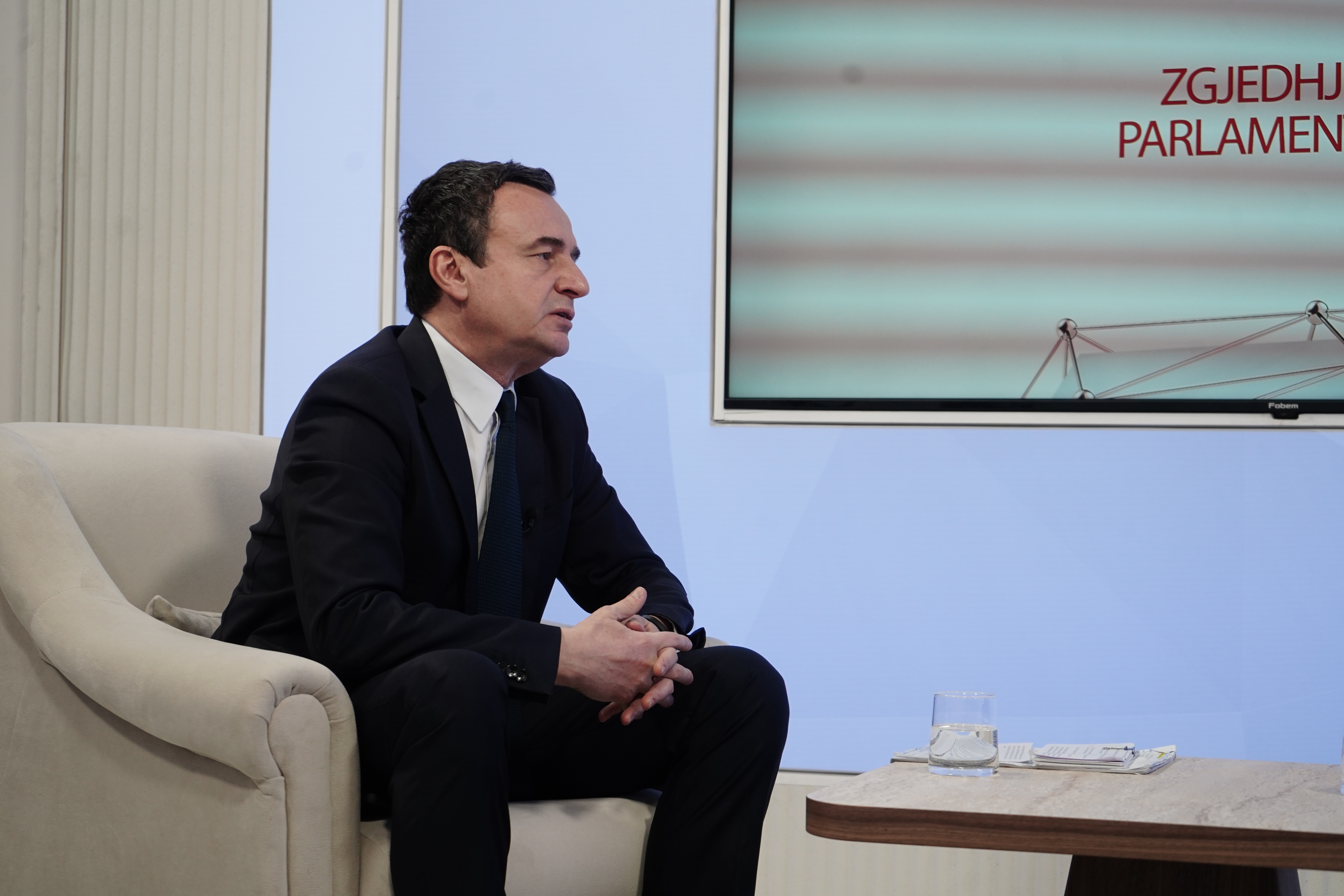
When will the 13th salary be paid to public sector workers? Kurti provides details
Acting Prime Minister Albin Kurti has stated that the next government aims to take important steps to improve Kosovo’s economic situation, including the introduction of a 13th salary for the state administration and measures to address the price of electricity.
In an exclusive interview for KosovaPress, which also coincides with the 27th anniversary of the establishment of this news agency, Kurti says that the new Law on the 2026 Budget provides for a 13th salary for all public workers.
According to him, under normal circumstances the 13th salary should be paid at the end of the year, but one of the first decisions of the new government will be for this salary to be paid at the beginning of the year, as soon as the government is formed and the budget law is approved. Kurti emphasized that the earlier the government is formed, the earlier the 13th salary will be paid.
He recalled that during his mandate, salaries in the state administration have increased overall by 47 percent, while the disparity between the highest and the lowest salary has been significantly reduced, from a ratio of 20 to 1 to 4 to 1.
When will the 13th salary be paid to public sector workers? Kurti provides details
“With the new law on the 2026 budget, we are also providing for a 13th salary in the state administration. Therefore, all public workers will receive a 13th salary. In other words, whoever works 12 months receives 13 salaries. Normally, the 13th salary would be paid toward the end of the year, somewhere around December. However, one of the first five decisions I will take, in addition to those I mentioned, will naturally be the payment of the 13th salary at the beginning of the year. Now, this depends on when the government is formed and when the budget law is voted on. As soon as these are completed, we will take the decision on the 13th salary as well, and it will be paid at the beginning of the month. Now, the chances are greater that we will form the government in February rather than January, but who knows, perhaps even in January. The earlier we form the government, the earlier the 13th salary can be paid, which will undoubtedly be at the beginning of the year for the state administration, whose salaries, in fact, have increased overall during my mandate by 47 percent, because that is how much the total wage budget for salaries in the state administration has increased, during which the gap between the highest and the lowest salary has also been reduced, from 20 to 1 as it was, to 4 to 1. So, salaries have increased overall by 47 percent in the state administration, among public workers, and at the same time inequality there has been reduced fivefold,” Kurti told KosovaPress.
Speaking about the issue of electricity and its price, Kurti said that the Government’s position will be made known in the spring, recalling that decisions on tariffs belong to independent institutions, such as the Energy Regulatory Office.
Nevertheless, he underlined that Kosovo continues to bear the consequences of the unfair and cheap privatization of electricity distribution and supply.
Electricity prices, Kurti: We will state our position this spring
“We will state our position this spring when the time comes, but keep in mind that these are independent state institutions, such as the Energy Regulatory Office, which deals with this issue. Meanwhile, we continue to live with a legacy we did not agree with, but it is a fact that Kosovo has privatized electricity distribution and supply far too cheaply and unfairly. On the other hand, among the first decisions we will take will also be a comprehensive package of €200 million to address inflation, for categories that are most in need and most affected: pensioners, children, sectors, namely the private sector, that is, workers and employees there, as well as students. In parallel with this, we will also restore the scheme whereby those who save electricity are rewarded. We had it three to four years ago and it was very successful. So, if someone proves, for example, that in February 2026 they saved electricity by consuming fewer kilowatt-hours than in February 2025, they will be rewarded immediately. In the coming mandate, we will allocate €150 million for electricity efficiency. Because the additional expenditure, let us call it that, but on the other hand existential, that we have with electricity is for heating. Now imagine this: lignite is burned as coal, generator turbines operate and convert thermal energy into electrical energy, which we then convert back into thermal energy in our homes and apartments. Therefore, cogeneration will be a solution. We will double cogeneration from power plants. We will also have the possibility of heating through solar panels, and we will examine the possibility of entering lignite gasification as soon as possible, that is, new energy capacities. I believe that the short-term and medium-term future will be very good in this regard as well,” Kurti said.