Three Serbs accused of terrorist attack on Ibër-Lepenc canal plead not guilty
The three people arrested in connection with the attack on the Ibër-Lepenc canal in Varage, Zubin Potok, on November 29, 2024, have pleaded not guilty to the charges related to the case.
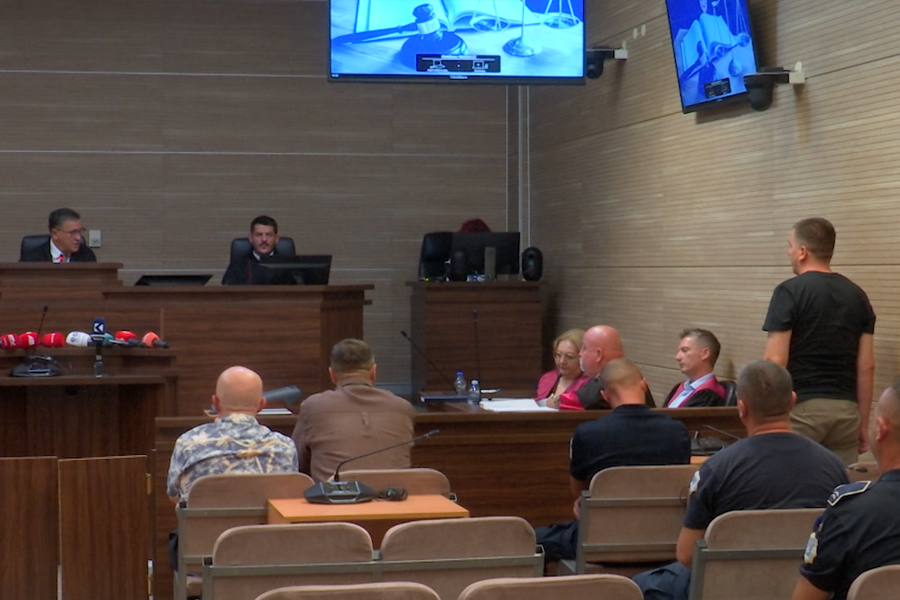
The two brothers accused of carrying out the attack, Jovan and Dragisha Vicentijevic, along with Igor Dimovic, denied responsibility during Thursday’s hearing at the Basic Court in Pristina for the damage caused to the canal, which prosecutors say was intended to seriously endanger water and electricity supplies for part of Kosovo. According to the indictment, the plan for the attack was prepared in Serbia.
In the presence of Judge Vesel Ismajli, they said they understood the charges against them but declared that they did not feel guilty.
Following their statements, case prosecutor Bekim Kodraliu said he has sufficient evidence to prove the opposite of what the Vicentijevic brothers and Dimovic stated.
In his opening statement, he presented material evidence, including footage, which he said supports the indictment and, according to him, indisputably proves the guilt of the three defendants.
“This indictment does not concern only an ordinary criminal offence. It concerns an organized and well-planned attack against the critical infrastructure of the Republic of Kosovo, infrastructure vital for supplying citizens with drinking water and for the functioning of the country’s energy system.
Based on the evidence that will be presented before you, it will be proven that on November 29, 2024, defendants Jovan and Dragisha Vicentijevic, together with other unidentified persons, after a prior agreement, placed a significant amount of military explosive, around 20 kilograms of TNT, in the Ibër-Lepenc canal, causing serious material damage, interruption of water supply and seriously endangering electricity supply in part of the country.
Therefore, the prosecution charges the defendants with the criminal offence of endangering the constitutional order, destruction or damage to public installations and equipment, related to the criminal offence of committing a terrorist act, in co-perpetration.
Also, during searches carried out at the defendants’ properties, a large quantity of weapons, ammunition, grenades, military communication equipment, military uniforms and other equipment were found and seized, the possession of which was contrary to the law in force. As a result, they are also charged with the criminal offence of unauthorized ownership, control or possession of weapons,” Kodraliu said, KosovaPress reports.
Kodraliu further stated that the prosecution will present evidence from investigations conducted in cooperation with the United States Federal Bureau of Investigation (FBI), as well as scientific evidence provided by the Italian police.
He said the prosecution will prove that the attack on the Ibër-Lepenc canal was not a spontaneous or isolated act, but part of an organized, planned and well-coordinated activity aimed at damaging critical infrastructure and Kosovo’s national security. He added that training for the attack was conducted in Serbia, specifically at a location known as “Livadhet e Fasuleve”.
The Ibër-Lepenc canal was damaged by explosives on November 29, 2024, near the village of Varage in Zubin Potok. The explosion caused significant damage to the canal’s structure, threatening water supplies and the functioning of the energy sector.
Following the attack, Kosovo’s institutions took emergency measures to repair the damage and managed to stabilize the water flow within a short period, avoiding prolonged disruptions in supply.
Kosovo authorities described the incident as a terrorist attack against critical infrastructure. Immediately afterwards, the Kosovo Police, in cooperation with the Special Prosecution and international partners, launched investigations to identify those responsible and determine the motives behind the attack. The incident was also condemned by Kosovo’s international partners, who called for a full investigation and for those responsible to be brought to justice.
A day after the attack, the Kosovo Police arrested eight people during raids at 10 locations in northern Kosovo, where weapons, ammunition, explosives, military uniforms and other equipment were seized. On December 1, 2024, the now-accused Jovan Viqentijeviq was also arrested.