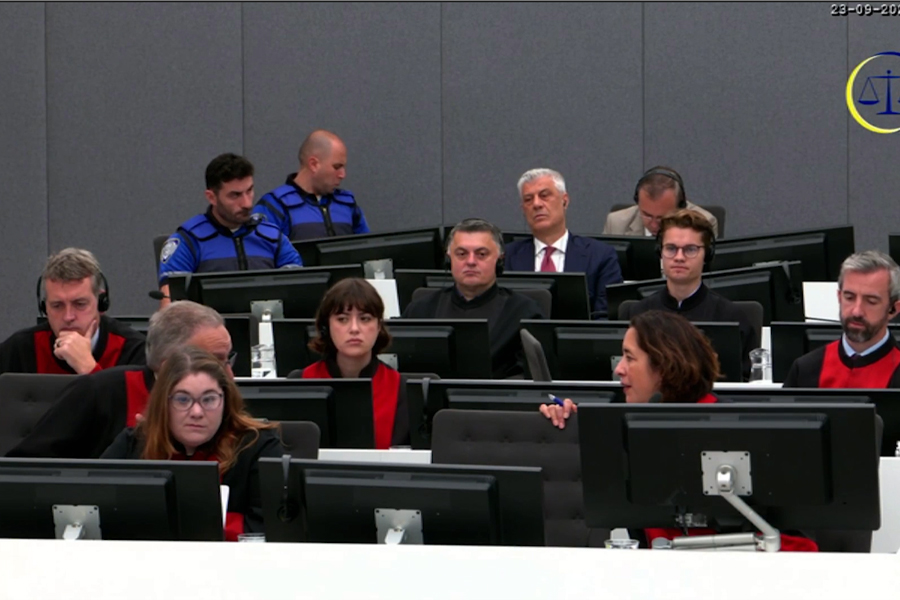
The Hague: General Jackson had said there is no evidence that the KLA had a practice of ethnic cleansing of Serbs
Former British diplomat, John Stewart Duncan, called by the defense of former president Hashim Thaçi in the trial of the former KLA leaders, continues today, September 23, his testimony before the Specialist Chambers in The Hague. On the second day of his testimony, he answered questions from the Prosecution, additional questions from the defense, and continues to be interviewed by the panel of judges.
Duncan, who during the 1990s was political advisor to Wesley Clark, then NATO commander, said that in Kosovo there was no organized army.
“In Kosovo there was no organized army, but nevertheless, the organized part or the only realistic part that stood behind the self-proclaimed government was the military wing, and we disbanded this, we fulfilled their aspirations, and they understood that it was in their interest to do such a thing. By doing this successfully, we convinced them to achieve what we wanted, which was disarmament,” he said.
Answering questions from Judge Bratthe, the witness said that the situation after June 21 in Kosovo was not a situation of fighting but rather “civil disturbances that appeared.”
“There was a self-declared government and it had appointed bodies or institutions in its composition. On the other hand, it was not a state because there was no architecture on which the appointed bodies relied. It was a true dichotomy. As I said earlier in my testimony, the United Nations Security Council was speaking on the one hand with Serbia — Serbia was one party — but Serbia had a complete state architecture, it had institutions, it had a public service, a police service, it had a Ministry of Justice, while in the case of the Provisional Government of Kosovo there was no supporting infrastructure, neither legally nor practically. This was the main problem, and another problem was that there was no structure that could bring into effect, that could implement instructions, because Mr. Thaçi could issue an instruction but on the other hand he had no democratic legitimacy, the state he claimed to represent did not exist in fact, it had no public service, it was not recognized by anyone, it had a geographical limitation, that was all, nothing more,” he said.
In this session, a previous statement of the former KFOR commander in Kosovo, General Mike Jackson, given in London, was presented. Thaçi’s lawyer, Nina Tavakoli, quoted him as saying that there is no evidence that the KLA carried out violence against Serbs.
Excerpt from the session:
Defense: General Jackson says I am telling you that I have no evidence that from an institutional perspective the KLA had a practice of ethnic cleansing of the Serbs who remained there. Do you agree with his assessment?
Duncan: Yes, I agree.
Defense: As far as you know, did General Jackson ever report to NATO command that Hashim Thaçi directed or committed acts of violence against civilians?
Duncan: No, not as far as I am aware.
Earlier, for a few minutes, Rexhep Selimi’s defense also posed questions to Duncan, but in private session.