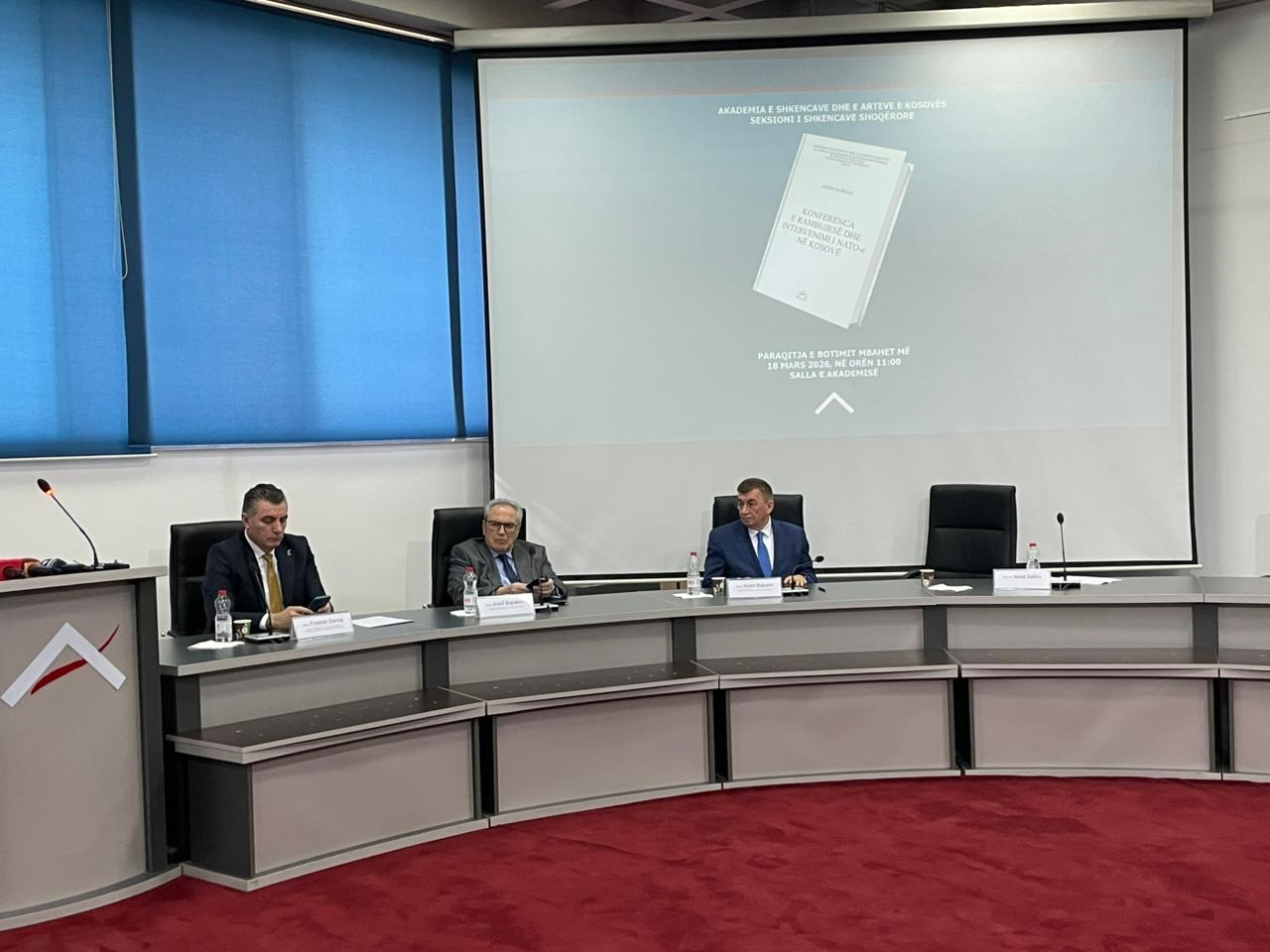
Rambouillet and NATO intervention: Arsim Bajrami’s new book reveals historical behind-the-scenes
“The Rambouillet Conference and NATO’s Intervention in Kosovo” is the title of the new publication by Professor Arsim Bajrami. This scientific work was promoted at the Academy of Sciences and Arts of Kosovo, among many academics and professors.
Arsim Bajrami, who has published 40 books, was also a participant in the Rambouillet negotiations in Paris, serving as the legal advisor to the Kosovo delegation.
In this book of more than 500 pages, he presents the behind-the-scenes developments, challenges, and dilemmas faced by the delegation in deciding whether to accept or reject the content of the Kosovo document.
Professor Arsim Bajrami stated that in Kosovo’s political history after February 17, there is no date more important than the Rambouillet Conference and NATO’s intervention in Kosovo.
“In the political history of Kosovo, after February 17 – the declaration of Independence – there is no brighter date or more important historical moment than the Rambouillet Conference and NATO’s intervention. This event represents the realization of the century-long dream of the people of Kosovo, the realization of the doctrine of President Ibrahim Rugova, who lived and worked for the day of Independence and who dreamed of an international conference being held to decide on Kosovo’s independence. It was a direct result of the Kosovo Liberation Army, of the political leadership that knew how to lead Kosovo and turn it into an international issue,” he said.
Regarding the Rambouillet Conference, Bajrami noted that Albanians were united at the time, unlike today.
“This conference is a political and diplomatic victory for the Albanians of Kosovo. It is a political victory because Albanians defeated Serbia—by accepting an imperfect agreement but opening the path for Kosovo to first be liberated and then gain independence, with the entire process supported by the international community. At this conference, Albanians—as a political class and leadership—were united, a unity that we lack today,” he expressed.
Academician Jusuf Bajraktari, in presenting his review, explained the contents of Bajrami’s book.
“Eleven chapters in which the main subject is elaborated, a summary in two languages, and it concludes with a register of literature and historical sources used by the author. The subject of this work is the Rambouillet Conference, which represents a historic event where the international community, through the Contact Group, sought to find a solution for Kosovo’s status. The Rambouillet Conference was the first time that Kosovo Albanians were invited to an international conference to decide their own fate,” said Bajraktari.
Professor Ismet Salihu also highly գնահատed this publication, stating that it covers the most important periods of Kosovo’s state-building.
“In scientific terms, author Bajrami presents this very important topic in 512 pages, organized into 11 chapters. In these chapters, the author presents the historical events that preceded the Rambouillet Conference, particularly the active, peaceful resistance from the 1990s until 1997. He also presents the emergence of the Kosovo Liberation Army and its war, the organization and challenges, the developments and complexities of the Rambouillet Conference. Furthermore, he highlights the behind-the-scenes aspects, followed by a legal analysis of the Rambouillet Agreement, as well as its military, political, legal, and international effects,” Salihu concluded.
On February 6, 1999, the Rambouillet Conference began its proceedings. This meeting, held near Paris, France, aimed to resolve the crisis in Kosovo.
On March 24, 1999, NATO began bombing Serbian military and paramilitary forces. The bombing ended on June 6, 1999, with the signing of the Kumanovo Agreement, which provided for the withdrawal of Yugoslav forces from Kosovo and the deployment of international peacekeeping troops.