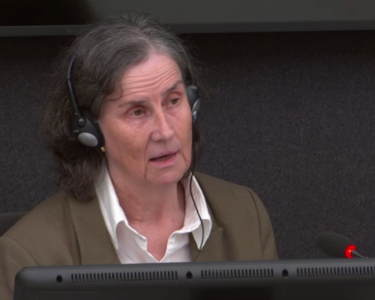
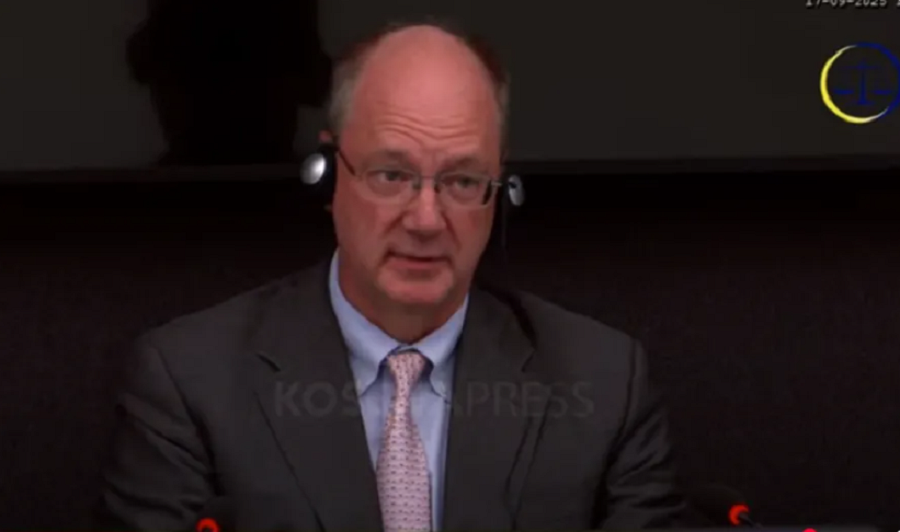
At the Kosovo Specialist Chambers in The Hague, the testimony of Paul Williams has begun. He was an advisor to Kosovo’s delegation at Rambouillet. Williams is the second defense witness in the case of former KLA leaders, who are accused of alleged war crimes.
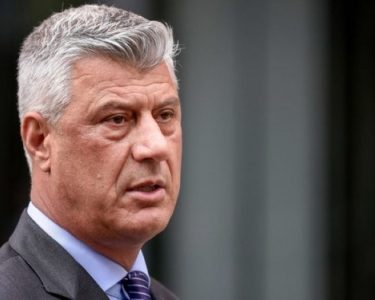
Thaçi’s defense argued that Williams’ testimony will show that “Thaçi did not have the authority to sign the Rambouillet agreement.”
His testimony is expected to last a day and a half. Thaçi’s defense has scheduled two hours, the other defense teams together requested two and a half hours, and the SPO also requested two and a half hours.
Thaçi’s lawyer, Luka Misetić, said that witness Paul Williams served as an unpaid advisor to the Kosovo delegation at Rambouillet.
“American Paul Williams was an unpaid advisor to the Kosovo delegation at Rambouillet in February and March 1999. He helped the delegation draft their proposal and negotiate the Rambouillet agreement. He also attended meetings with the Kosovo delegation, international figures, and the Kosovo diaspora. Williams will testify about the decision-making process within the delegation, as well as discussions regarding the need for demilitarization and transformation of the KLA. He will also testify about his communications with all members of the Kosovo delegation, including Hashim Thaçi. Based on these communications, he concluded that Thaçi did not have the authority to sign the Rambouillet agreement without the approval of the zone commanders,” Misetić said.
During questioning by Thaçi’s lawyer, Williams said he had served as an unpaid legal advisor to Kosovo’s delegation at Rambouillet, chosen on the proposal of then-Prime Minister Bujar Bukoshi.
“Officially, I was selected about 10 days before the Rambouillet negotiations began. Earlier, Bukoshi had told me that if peace talks were to take place in Rambouillet, he would seek my presence. This was because of the work I had done in earlier negotiations – the so-called Hill talks and the Holbrooke negotiations in October.”
Misetić: “When were you first involved in Kosovo? You mentioned the summer and autumn talks, but specifically when?”
Williams: “To clarify, during the summer and autumn of 1998 I worked with Bujar Bukoshi and, through him, with Rugova. To some extent also with Veton Surroi, coordinating closely with the Albanian diaspora in America, who had ties with these figures. They sought my pro bono assistance and legal guidance regarding the issues to be negotiated. I did not travel anywhere physically; I remained in Washington and New York, participating in negotiations from there – unlike Rambouillet, where I was physically present.”
Misetić: “Who selected you as advisor to the delegation?”
Williams: “Bujar Bukoshi invited me, in the name of President Rugova, to travel to Rambouillet and take part in the talks. On February 7, the Kosovo delegation at Rambouillet reached a consensus decision formally inviting me to the château where the negotiations were held, to serve as their legal advisor. Edita Tahiri and Bajram Kosumi signed this official declaration,” he said.
From Thaçi’s defense, the witness was asked who Edita Tahiri was. Williams said she was the Foreign Minister of Bujar Bukoshi’s government.
He stated that he had a close relationship with Bukoshi, the Prime Minister of the government-in-exile, noting that Bukoshi often traveled to the United States and, “When he was in Washington, he also met with me, and I spent all my time with him as his lawyer.”
Williams said he worked intensively with members of the delegation during the Rambouillet negotiations and was asked to draft inclusive legal language “to ensure that the ICTY would be able to exercise its responsibilities under its mandate.”
“Regarding Rambouillet, I was tasked with drafting language that was as inclusive as possible to ensure that the International Criminal Tribunal for the former Yugoslavia could fully exercise its responsibilities and competences under its mandate. On my first day at the château, I was invited to brief the Kosovo delegation on four points. The fourth point dealt with jurisdiction, activities, and indictments of the Tribunal for the former Yugoslavia. All members of the delegation were present, including Thaçi. My presentation also reflected the lessons learned from my earlier work as a legal advisor to the Bosniaks during the Dayton negotiations,” Williams said.
During Thaçi’s defense questioning, Williams testified that he, together with Mark Weller, an international legal advisor, drafted the Kosovo delegation’s proposal at Rambouillet regarding the investigation and prosecution of war crimes.
The defense witness also testified that he worked for two years at the U.S. State Department and had served as a lawyer for European affairs.
Earlier today, the testimony of James Rubin concluded. Rubin, who during the war was U.S. Assistant Secretary of State, testified in defense of former President Hashim Thaçi over three days.