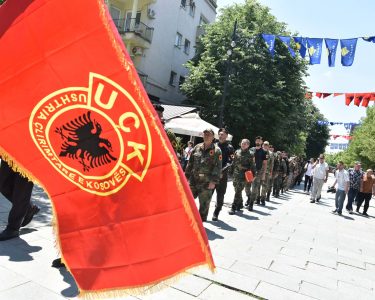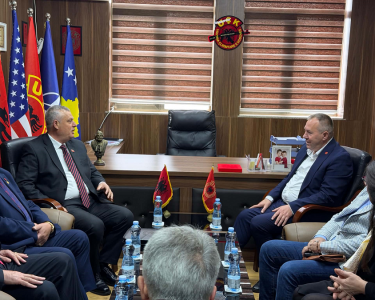

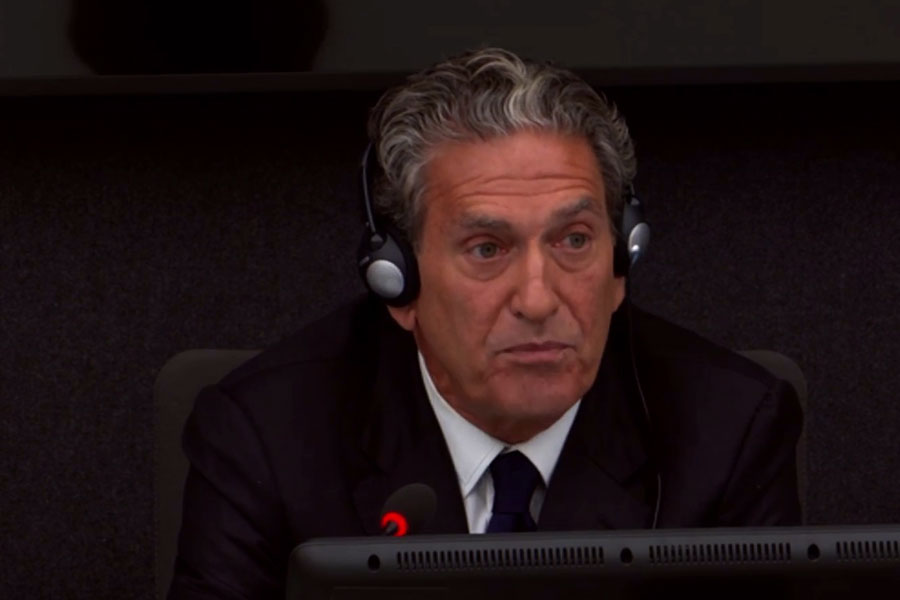
Former U.S. Assistant Secretary of State James Rubin has stated that the Kosovo Liberation Army (KLA) did not have effective control and command, while emphasizing that an assessment of its organizational structure had been made. During the second day of his testimony at the Specialist Chambers in The Hague, Rubin said that Hashim Thaçi was not the military leader of the KLA and that he realized this himself during the three days he spent in Kosovo.
At the Specialist Chambers, Rubin was asked by Judge Barthe, “How do you know it was the military wing that had to make decisions?” Rubin did not say that Thaçi had told him this. Rubin was also asked what kind of threats Thaçi was facing.
“I never personally saw proof from any specific source that he was threatened, but Rambouillet was a kind of tension… some things were true, others were not. He was a new person to me and it was clear to me that other members of the American delegation were saying things about the KLA or the Kosovars. That was my experience of being immersed in this internal functioning. I try to remember that someone from my team told me he was threatened, or someone told me he was scared, and in those cases I would talk to him and try to understand whether it was true or not. He never told me directly that he was threatened… I remember he told me once that it was difficult for him to enter and leave Kosovo through the mountains for safety reasons. There was a general fear, and the threats mostly came from Serbian forces,” Rubin said, adding that Thaçi had told him he was moving in and out of Kosovo through the mountains.
Earlier, in follow-up questions from Thaçi’s lawyer Luka Misetić, Rubin was also asked about Secretary Albright’s statement that “one of the reasons for not arming the KLA was to maintain NATO unity.” On this, Rubin said, “We did not tell them that we could not give them weapons.”
“The answer is about context. We didn’t want to tell them that there was no proper organization and we didn’t want to tell them that the reason we didn’t want to arm them was because it takes years to develop into a proper military structure and obtain effective weapons. Because if you said that to people who were fighting for their lives on the battlefield every day, it was offensive, it was humiliating. Sometimes you choose a reason that is simpler to convey and easier to swallow or accept than to tell them bluntly that we could not give them weapons, while people were being killed, because they were not organized. We couldn’t say that… We made our best judgment, we made an assessment as best we could, taking into account the KLA’s organizational structure and the issue of control and command, which we believed the KLA did not have. One of the main reasons was that there was no effective control and command in the KLA,” Rubin declared.
Rubin said he was convinced that Thaçi was not the military leader of the KLA, adding that he had personally observed how the hierarchy functioned during his three days in Kosovo.
“The reason I am so convinced that he was not the military leader of the KLA is that I observed this myself for three full days. It wasn’t an impression formed in a moment, or from reading an article or a cable, but something I continuously saw over those three days. I witnessed the power dynamics between him and the other commanders — I mean the relationship he had with the sector commanders. Seeing it with my own eyes showed me what position or hierarchy he held in the system,” Rubin said in The Hague.
In questions from Thaçi’s defense lawyer, Rubin also stated that “the court was established at the request of European and American leaders.”
Misetić: “Are you aware of the reason why this court was created, on what basis, what were the initial allegations for which this court was requested?”
Rubin: “Yes.”
Misetić: “Do you know what happened with Mr. Marty’s allegations in the end?”
Rubin: “I think they went nowhere, there was no development of his indictments,” Rubin replied.
On the second day of testimony in The Hague, Rubin said, “Hashim Thaçi was an important person and the Kosovars had chosen him.”
“[Secretary Albright] told me that Thaçi was the person I needed to work with. That doesn’t mean he was the only important person, but he was the main one I had to work with, because they thought the others would not oppose it. But you can never predict these things. It was just an impression. The process wasn’t very formal. What I was trying to say was that he was important, necessary, but not the only one. We needed everyone. And the Kosovars had chosen him as the particular person. People need to understand this — that’s why we worked with him, why we considered him a leader there, because they had chosen him,” he said.
During the day, the Office of the Specialist Prosecutor also completed its questioning of former U.S. Assistant Secretary of State James Rubin.
Rubin expressed his concern about the trial process in The Hague.
“This is an unusual way to treat a statesman who surrendered voluntarily,” Rubin stated in court, testifying in defense of former president Hashim Thaçi.
On the second day of testimony, Rubin shared his views on the five-year trial against former KLA leaders, saying he was troubled that the KLA Four have been held in detention for so long. “This is not justice,” Rubin emphasized, while noting that he knew developments within the KLA because he had seen its leaders closely during the war.