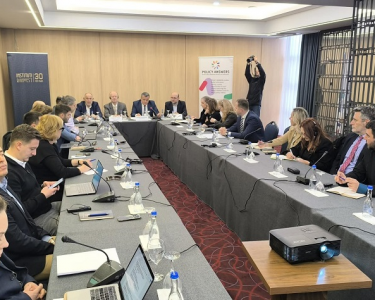
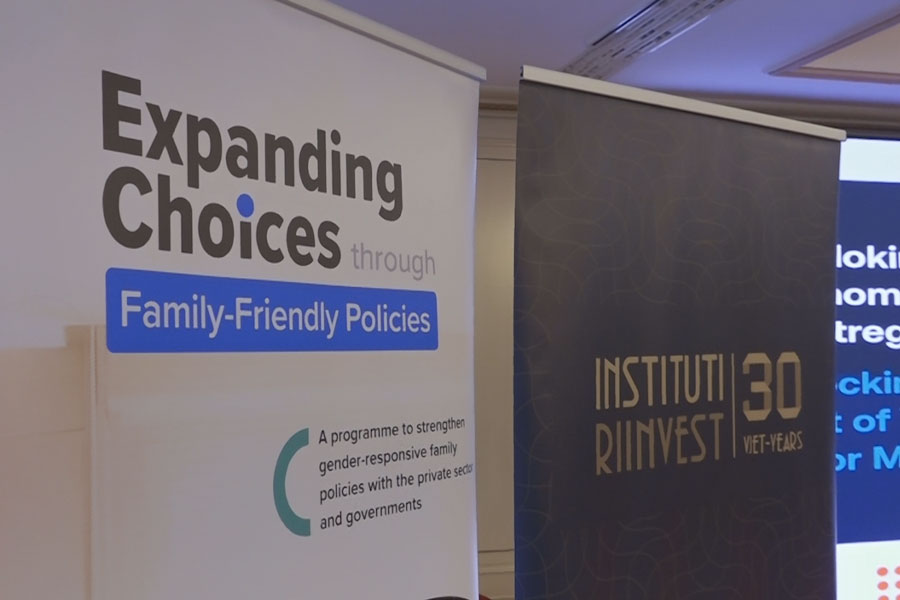
The participation rate of women in the labor market in Kosovo is around 25 percent. This statistic must be addressed urgently, requiring immediate and coordinated action by institutions, the private sector, and individuals themselves, it was stated during a discussion organized by the Riinvest Institute under the theme “Unlocking Potential: The Economic Cost of Unused Female Potential.”
During the presentation of the report, it was noted that the main obstacles preventing women from entering the labor market include gender norms and stereotypes, caregiving responsibilities, gender gaps in labor legislation, and the low representation of women in decision-making positions.
The Executive Director of the Riinvest Institute, Alban Hashani, said that gender gaps in labor market participation and employment constitute one of the country’s most significant structural challenges.
Although Kosovo has the youngest population in Europe, women’s labor market participation remains low, Hashani noted.
“The gender gap in employment and workforce participation is one of Kosovo’s most important structural problems, despite women representing half of the population. They are underrepresented in the labor market, with the lowest participation rate in Europe, and they also have a disproportionate role in the economy overall… While we are aware of systemic problems keeping women out of the labor market, it was important for us to quantify the cost associated with this unbalanced participation. Our results suggest that if the gap were closed in Kosovo, the value of GDP per capita could increase by between 19 and 21 percent… Narrowing the participation gap is one key element highlighted in this report,” Hashani said.
Meanwhile, the UN Development Coordinator, Stephen O’Malley, noted that women excel in higher education and other areas of life, yet only one in four participates in the labor market, the lowest rate in Europe.
Regarding the Riinvest report, O’Malley said it clearly shows how structural exclusion is holding back the entire economy.
“And I think this is, in fact, an issue that this report highlights so well – the paradox where we see women excelling in higher education and other fields, yet only one in four participates in the labor market, the lowest rate in Europe. What the report does is clearly show how structural exclusion is holding back the economy. It’s not only about women not participating; it’s about the entire economy. Positively, we should consider the energy that could be unleashed through their inclusion. One real strength of this report, as the Director mentioned, is that we have quantified the effect on GDP. Therefore, it is very clear that we need coordinated action through policies, social norms, and business practices to fully benefit from Kosovo’s demographic dividend and to bring youth and women fully into the workforce.”
The Head of the UN Population Fund Office, Visare Mujku, said the current rate of women’s participation in Kosovo’s workforce is only 25 percent.
She emphasized that this statistic requires urgent attention and immediate, coordinated action by institutions, the private sector, and individuals themselves.
Mujku added that the main obstacles to this low level of female labor force participation are social, cultural, and structural factors.
“Kosovo ranks first in Europe and fifth in the world for low female labor market participation. Despite women making up half of the population, only 25 percent, or one in four women in Kosovo, participate in the labor market… The gender gap in Kosovo is 34.7 percent compared to 11.4 percent for the European Union average and 13.95 percent for the Western Balkans average. There are many barriers preventing women from entering the labor market… Gender norms are the main obstacle, as women have primary caregiving responsibilities for children and the elderly, while men have taken on the primary financial role in the family,” Kallaba-Krasniqi said.
She also noted that the main barriers influencing women’s participation in the labor market include gender norms and stereotypes, caregiving responsibilities, gaps in labor legislation, low representation in decision-making positions, and a mismatch between skills and education choices.