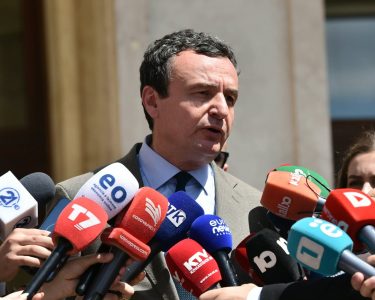
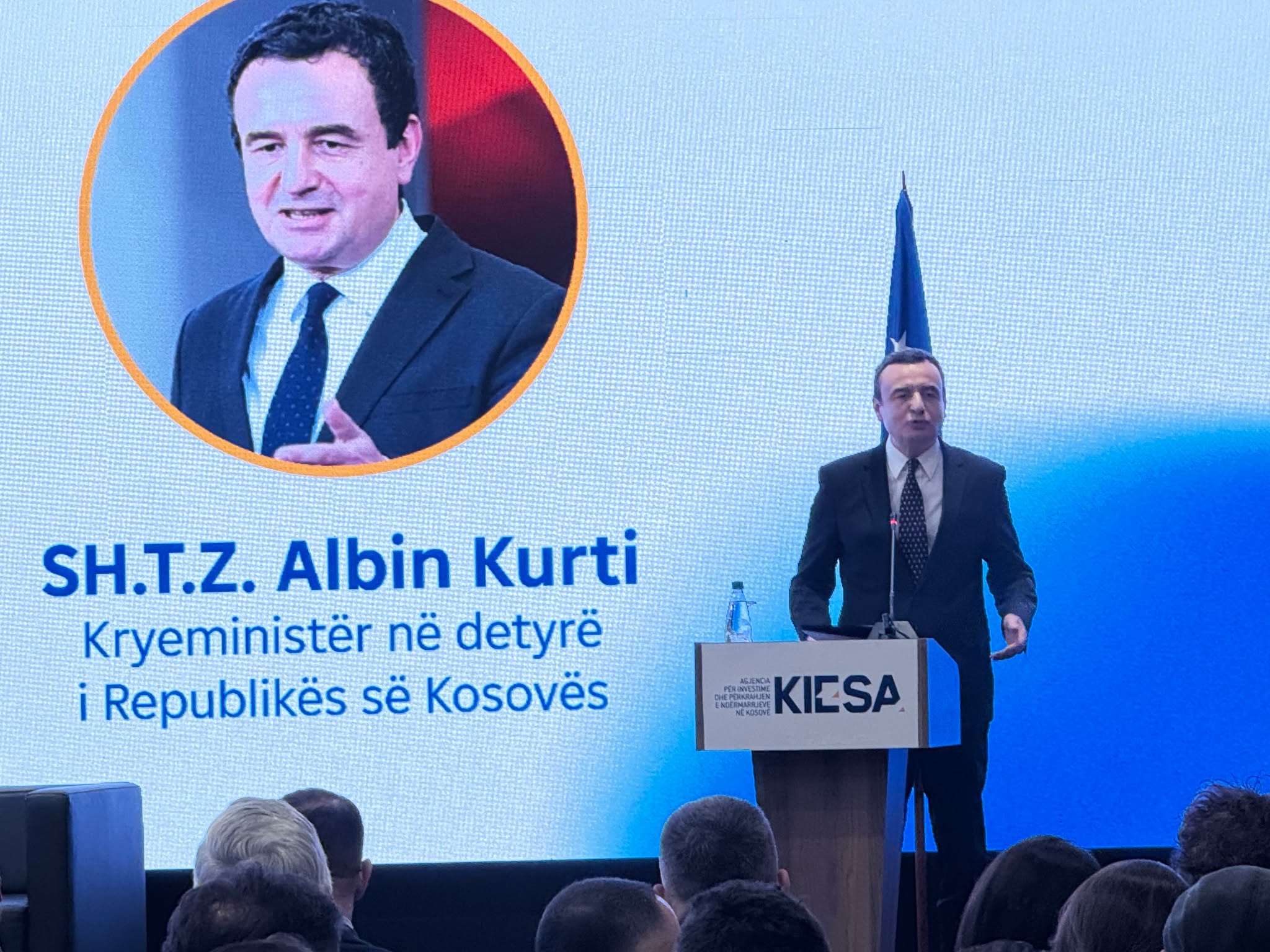
Acting Prime Minister Albin Kurti said that Kosovo is safer and economically stronger than it was five years ago. According to him, Kosovo has the lowest public debt in Europe and international indicators show less organized crime and less corruption.
Kurti made these remarks before representatives of more than 200 businesses at the annual conference organized by the Kosovo Investment and Enterprise Support Agency (KIESA), where industrial performance for this year and support plans for the coming year were presented.
Kurti said that Kosovo has confirmed itself as one of the region’s best success stories.
“A safer country, more democratic and financially more stable. International indicators show less organized crime, far less corruption, more rule of law and a democracy that strengthens year after year. Our public debt is the lowest in Europe, around 16 percent of gross domestic product, which has enabled the Government of Kosovo to pursue sovereign policies. Then there is economic growth of over four percent. An improved sovereign credit rating. A generally well-capitalized banking sector. These are not just numbers for reports, but guarantees for you, investors and entrepreneurs, that Kosovo is a serious address for long-term investment. This stability and this democracy are not a political luxury; they are the foundation upon which economic development is built. When citizens feel safe at night, when courts are more independent, when the administration is more professional, then an investor from Switzerland, Germany or our diaspora no longer sees Kosovo as a risk, but as an opportunity. And what is important to emphasize is that this progress is for all citizens,” Kurti said.
At the annual conference, Kurti said that the country’s economy has grown by an average of around six percent over five years. He added that budget revenues have exceeded 3 billion euros.
“Unemployment has been more than halved. More than 85,000 new jobs have been registered, exports have doubled, while foreign direct investment has increased by more than double compared to previous governments. The government can create the conditions, but these results have been produced by you through your work, risk-taking and innovation. We have tried not to hinder you, and often to help you. But this success belongs above all to you. You carry the burden of employment and are the main driver of development. During our governance, we have reduced the administrative burden, digitized services, reformed legislation on investment, competition, trade and consumer protection, all in line with EU standards. We have supported more than 1,000 manufacturing and exporting businesses with tens of millions of euros, credit guarantees and export programs, and supported hundreds of women- and youth-led businesses,” Kurti added.
According to him, every year more foreign investors are coming to Kosovo.
“Companies from the region, from our diaspora, and even those that a few years ago did not even know where Kosovo was on the map. Now they not only know, but often complain about airplane tickets, which hinder them more because of price than trade rules because of scope, and this is a good sign. When complaints change, it is a signal of progress,” Kurti said.
Acting Minister of Industry, Entrepreneurship and Trade, Rozeta Hajdari, said that the lack of a qualified workforce remains a challenge. She emphasized that manufacturing industry represents a key pillar of economic development.
“In 2024, Kosovo’s economy recorded real growth of 4.4 percent, with the manufacturing industry playing an important role in this positive result. The main contribution of manufacturing value added to gross domestic product reached 13.1 percent, a level above the Western Balkans average. This shows that Kosovo’s industry is gradually consolidating as a key sector for economic development and as an important foundation for the country’s industrialization. This year alone, studies and analyses carried out by the Ministry of Industry, such as identifying needs for a qualified workforce in industry, studying natural resources, analyzing circular industries and support schemes for industry, as well as harmonizing legislation with European directives in the field of sustainable and responsible investment, provide a basis for further industrial investment,” she said.
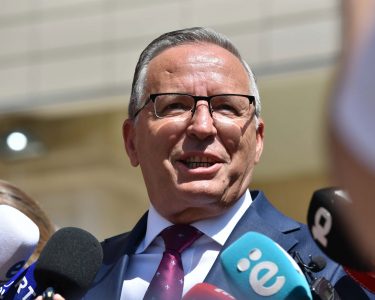
Meanwhile, the acting director general of KIESA, Zef Dedaj, said that the agency’s budget has increased over the years.“We have managed to increase KIESA’s total budget from around 3 million euros until 2021 to 18.2 million euros this year, all spent on the private sector. Likewise, from a single scheme that existed for production protection of only 15 million euros, we have reached 17.3 million euros, and added at least five other schemes,” he said.