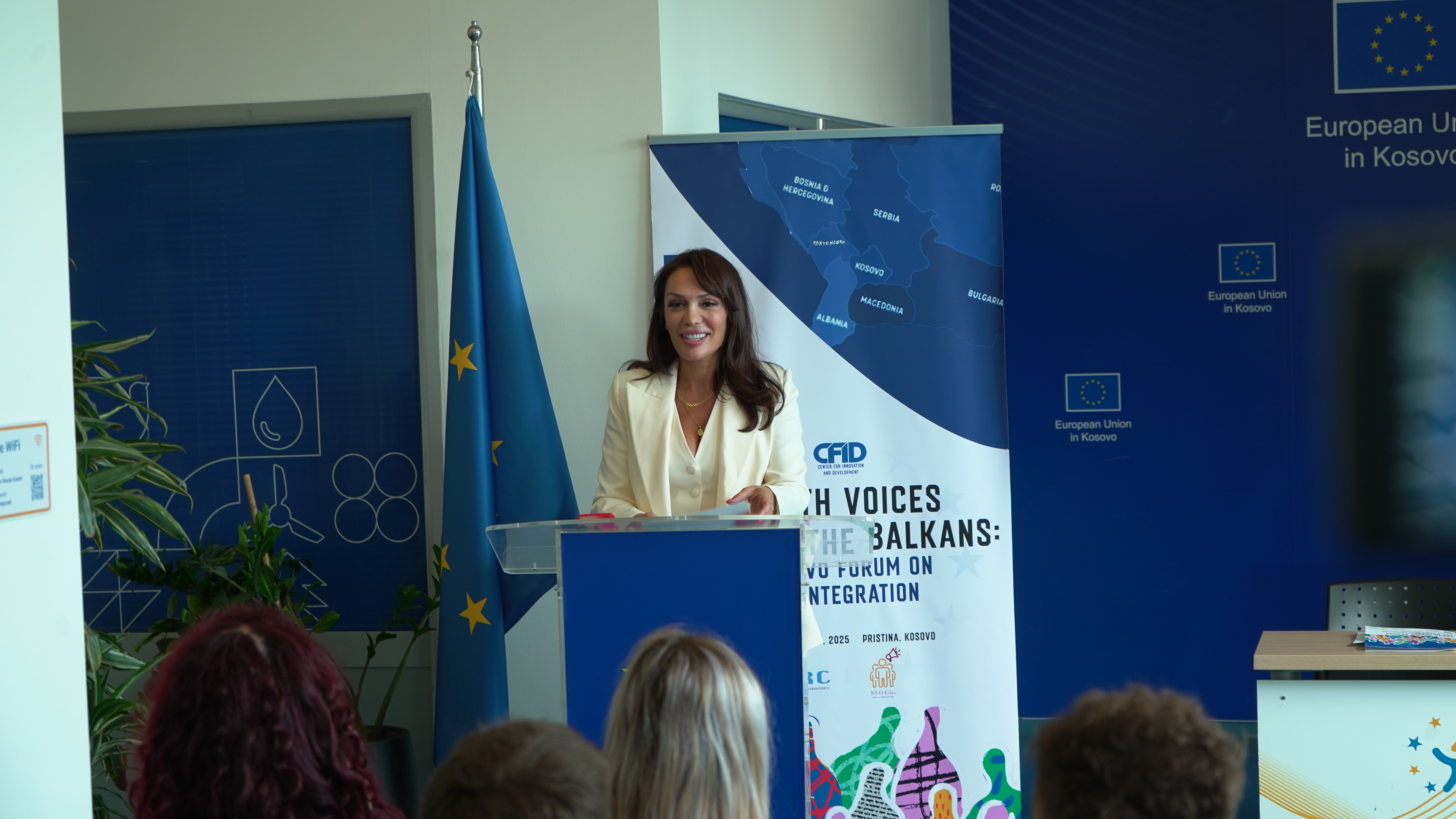
In Prishtina, the thematic forum "Voices of Youth in the Balkans: Kosovo Forum on European Union Integration" is being held. This forum is organized by the Center for Innovation and Development within the framework of the project "Youth Engagement for the Europeanization of the Balkans."
On Monday, at the "Europe House" venue, young people from Kosovo, North Macedonia, and Montenegro, along with institutional representatives and members of civil society, discussed European integration.
This project is funded by the Western Balkans Fund and is implemented by the Balkan Institute for Regional Cooperation (BIRC) from North Macedonia, the Center for Innovation and Development (CFID) from Kosovo, and the NGO "NVO Glas" from Montenegro.
At the opening of the forum, the General Coordinator of the Center for Innovation and Development (CFID), Drenusha Latifi, said that the aim remains to help citizens understand the values of the European Union.
"Our goal is to support democracy, fight fake news, and help people understand the values of the European Union. As our country gets closer to the EU, it is more important than ever to stand for truth, freedom, and responsibility. Unfortunately, we see a lot of fake information that makes people feel confused or scared. That’s why we are here – to work together, share real stories, and build trust. The media has a big role in this. Good journalism helps people stay informed, ask questions, and participate in democracy. It helps us understand each other and move forward as a society," she said.
The Executive Director of the NGO "NVO Glas" in Montenegro, Milica Dediq, emphasized that European integration is a political, cultural, and social transformation.
"The role of journalism and communication is decisive. Media shape our perspectives, provide space for dialogue, and can either weaken or strengthen trust. If we want to get closer to the European Union, we must foster media education, fight disinformation, and encourage transparent and constructive debate. Only in this way can European values such as freedom, democracy, solidarity, and respect for diversity become reality. European integration is often seen as a complex process, but at its core, it is a political, cultural, and social transformation. For the Western Balkans, it is not only a political aspiration – it is also a generational obligation. This regional project and today’s forum remind us that Europeanization and integration cannot be achieved in isolation. They require regional cooperation, mutual learning, and the courage to face challenges together. By working side by side, we show that there are no limits to cooperation – we build new bridges," she said.
The Program Director of the Balkan Institute for Regional Cooperation (BIRC), Lorik Idrizi, said that the project aims to combat disinformation.
"The main goal of the project is to fight disinformation, because we know that many speeches and narratives are such; for example, we do a lot, but Europe does not seem to want to bring results to us. We have Ukraine, which is at war, but they are moving forward with the integration process. Bulgaria is not as advanced as North Macedonia, but still is part of the European Union. But all these are just excuses because some Balkan countries have not done their 'homework' for the integration process. For example, we also prepared the latest research report in North Macedonia and saw key findings where we have major losses related to young people and their engagement, but implementation is still far from reality. We want to create our own narratives and I think we have done a good job with the project," he said.
The Project Coordinator from the Center for Innovation and Development (CFID), Andi Krasniqi, listed the challenges and concerns of youth regarding employment.
"The latest data show overall unemployment at around 10.8%, and youth unemployment at around 16%. But there is a clarification to be made. Officially, the Kosovo Agency of Statistics follows Eurostat’s methodology and laws. On paper, the statistics make it look like everything is fine. But in reality, they are misleading. Why? Because in Kosovo unemployment brings no support. In the EU, unemployment often means you receive 70–80% of your salary until you find work again. In Kosovo, you get nothing. Even after many years of work, losing your job brings no benefits. Many young people don’t even register as unemployed, because there is no reason. Instead, they withdraw from the labor market. This is where the NEET indicator is important. In Kosovo, more than 33% of young people are NEET — not in employment, education, or training," said Krasniqi.
According to him, this reality pushes young people to leave Kosovo, highlighting that 72 percent of those surveyed see emigration as an opportunity.
Meanwhile, MP of the Democratic Party of Kosovo and former Minister of European Integration, Vlora Çitaku, said that today’s youth are less "enthusiastic for Europe than my generation once was."
"Even the mechanisms set up through IPA or other European mechanisms have failed to deliver results. In the last decade, I can speak, for example, about Kosovo – Dua Lipa with Sunny Hill and Dokufest in Prizren have done much more than any government to bring together young people from the region and beyond. So, there is a lack of political will in the government, but at the same time, there is a lack of clarity from the European Union itself on what the roadmap for European integration for the Western Balkans will look like. Unfortunately, we have seen very few steps forward. Everyone expected, including myself, that after Russia’s unprovoked aggression against Ukraine, we would see a rebirth of a strategic Europe that would be more ready for enlargement. Unfortunately, very little of this has been realized," she said.
This thematic forum continued with a panel of young people: Rron Ukimeraj from Kosovo, Hamza Nuhiu from North Macedonia, and Mojash Kaščellan from Montenegro, who discussed the topic
"Youth pushing forward European integration: challenges and opportunities."
This project will last six months, with the first activity starting in Podgorica, continuing in Prishtina, and then in Skopje, as the capitals of the three countries involved in the project.
The target group included in the project will consist of 60 young professionals, representatives of civil society and the media involved in the EU membership negotiation process in the three countries. Also, 15 journalists and other media professionals, 10 representatives of state institutions responsible for EU integration, and 15 civil society organizations.