Young people in the Balkans join forces for a European future
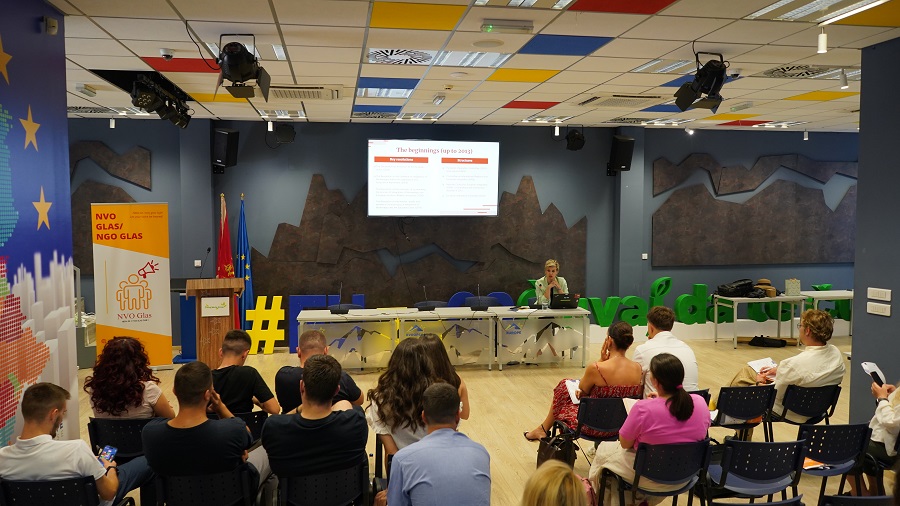
In Podgorica, the official launch of the project “Youth Engagement for the Europeanization of the Balkans” took place. This project is funded by the Western Balkans Fund and implemented by the Balkan Institute for Regional Cooperation (BIRC) from North Macedonia, the Center for Innovation and Development (CFID) from Kosovo, and a non-governmental organization from Montenegro.
The executive director of the Montenegrin organization “NVO Glas,” Milica Dedić, said the aim is to empower young people and engage them in the European integration processes.
“Such projects, which empower young people to be actively engaged in the processes of European integration, are very important to us. As I mentioned, one of our organization’s goals is international cooperation, because we believe that through regional cooperation, networking, and joint promotion of key European values—such as rule of law, solidarity, intercultural understanding, and civic activism—we can contribute to something that is increasingly necessary nowadays due to many challenges, especially as our country, Montenegro, is firmly on the path toward the European Union and will soon become an EU member state,” she said.
Following this activity, she said they would begin conducting a survey on young people's opinions about the European Union.
At today's event in Podgorica, young people had the opportunity to express their perspectives on Europeanization. In one of the panels, they also discussed the challenges and barriers they face in their respective countries.
The program director of the Balkan Institute for Regional Cooperation (BIRC), Lorik Idrizi, said the project aims to ensure youth inclusion.
“The overarching aim of the project is to confront Western Balkan youth with the idea of Europe. It is known that euroscepticism has recently increased significantly across the Western Balkans. In North Macedonia, due to the political context with Bulgaria; in other countries, because of the prolonged integration process or due to the perception of Europeanization as a distant incentive rather than an everyday reality. By involving Balkan youth, we aim to create stronger interaction among them, and in this way, combat euroscepticism,” he stated.
Drenusha Latifi, representing the Center for Innovation and Development (CFID) from Kosovo, said that the role of the media, civil society, and other actors remains essential in fostering democratic values.
“In a time when an anti-European narrative is being fueled by disinformation, fake news, and various forms of propaganda—leading to increased euroscepticism among citizens—it is essential to deconstruct this narrative and promote an alternative one that embraces European values and best practices that bring us closer to EU standards. Media plays a decisive role in affirming these values and strengthening democratic capacities within the broader process of integration and adoption of European values,” she said.
This project will last six months, with activities to be held in Skopje, Prishtina, and Podgorica—the capitals of the three countries involved.The target group for the project includes 60 young professionals, representatives of civil society and media working on the EU accession process in all three countries. In addition, 15 journalists and other media professionals, 10 representatives from state institutions responsible for EU integration, and 15 civil society organizations will also take part.