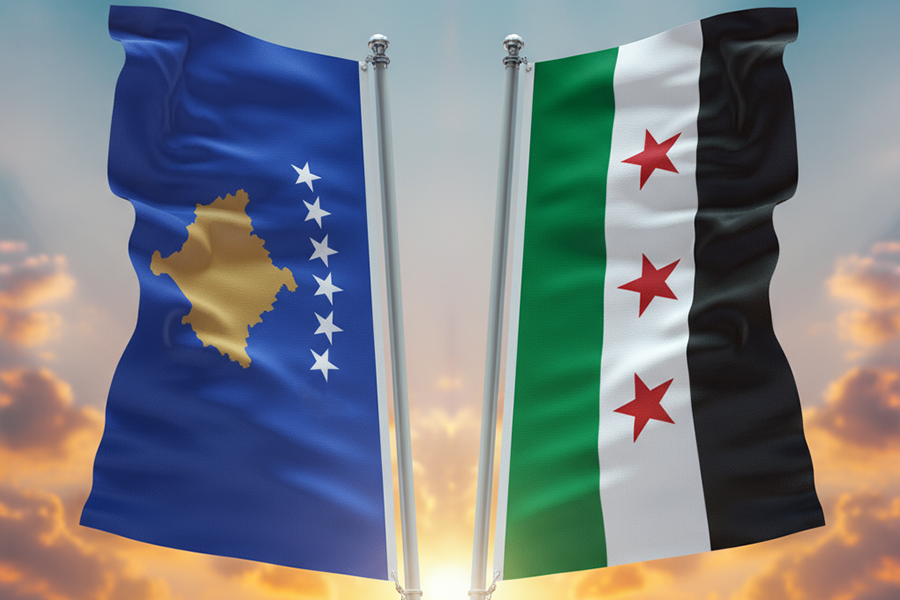
Why is Syria’s recognition of Kosovo important?
The recognition of Kosovo by Syria is being seen as an important development, as well as an indicator that other countries might take similar steps.
This recognition had been expected since the fall of the Assad dynasty, says Nehat Islami, who served as a correspondent covering Kosovo from the Middle East, based in Beirut.
He expects Lebanon — where he lived for four years — to be the next to recognize Kosovo. Islami told
KosovaPress that the number of countries recognizing Kosovo’s independence could soon increase.
“This is a recognition that has been expected since the fall of the Assad dynasty — a regime that for 40 years was the greatest enemy of its own people. They did not recognize Kosovo, like many other Arab states, because they were close allies of Russia. After the fall of that dynasty and the rise of a new government, I predicted that Syria would be among the first in that part of the world to recognize Kosovo. I also believe Lebanon will follow, as it did not dare to recognize Kosovo due to Syria’s influence — Lebanon was, politically speaking, a kind of Syrian colony. I also think that Iraq and several Caucasus countries could follow suit, now that the issues that once prevented them from recognizing Kosovo are no longer obstacles. I see no longer any political barriers for Azerbaijan to recognize Kosovo,” he stated.
Syria, a Middle Eastern country, recognized Kosovo on October 29, becoming the 120th country to do so. President Vjosa Osmani announced that the agreement was reached with the support of Saudi Arabia’s Crown Prince Mohammed bin Salman Al Saud in Riyadh.
“With the support of His Royal Highness, the Crown Prince of Saudi Arabia, Mohammed bin Salman Al Saud, today in Riyadh we reached an agreement through which the Arab Republic of Syria recognizes the Republic of Kosovo. I thank President Al Sharaa for the decision to recognize Kosovo and for his support for our people. The people of Kosovo and Syria have both suffered and sacrificed greatly to achieve freedom. Therefore, this mutual recognition today is not only about state sovereignty but also about honoring the sacrifices of generations who fought to live freely,” wrote Osmani.
The Syrian Ministry of Foreign Affairs also confirmed the recognition, stating that the decision aims to expand cooperation and openness with countries around the world.
Nehat Islami, who worked as a correspondent in the Middle East during the 1970s, told KosovaPress that Syria’s position toward Kosovo had long depended on Moscow.
“This is very significant because Syria, under the Assad dynasty, was part of the chain of resistance states aligned with Iran. Iran, for political reasons, never wanted to recognize Kosovo. Since Syria was effectively a colony of Iran — dependent on its army and economy — it neither dared nor wanted to recognize Kosovo. But with the new government, as it became clear that the Syrian people had nothing against the people of Kosovo and were interested in recognizing it, the new leadership moved in that direction. It should also be noted that Saudi Arabia and Turkey play major roles in that part of the world. These two friendly states are working more and more with countries that have not yet recognized Kosovo,” Islami explained.
Expert on European integration and former diplomat Alma Lama said Syria’s recognition comes as a result of geopolitical shifts and the new political alignment of official Damascus.
“This recognition is important because Syria is a key country in the region. These new alignments, in a time of major geopolitical changes, could lead to further recognitions. Let’s not forget Armenia, which seems to be distancing itself from the Russian sphere of influence. We’re not there yet, but more changes could come. I’m convinced that the outcome of the war in Ukraine will bring one of the biggest shifts on the international scene — if Russia loses, its influence across South Asia will decline, and that could lead to new recognitions of Kosovo,” Lama said.
She added that Kosovo must review its recognition strategy, in cooperation with the United States, and strengthen ties with both the U.S. and the European Union.
“Kosovo needs as many recognitions as possible to strengthen its international standing and escape the ‘black hole’ status of being outside the UN. While recognitions alone don’t make Kosovo a UN member — since that’s up to the Security Council — they do reinforce its international legitimacy. This is especially important when recognitions come from significant states. There haven’t been many in recent years — only two in the last two years — but this is good news. The government should continue working to encourage even hesitant countries to recognize Kosovo. Since recognitions are coordinated with the U.S., and as the influence of both the U.S. and Russia changes globally — especially in Africa — there is still space to act. A full review of Kosovo’s recognition strategy is needed, in cooperation with the U.S. and friendly nations,” Lama concluded.
Kosovo’s Acting Prime Minister Albin Kurti expressed gratitude for President Vjosa Osmani’s successful efforts and Saudi Arabia’s support. Albania’s President Bajram Begaj also welcomed Syria’s decision, saying it supports the state of Kosovo and peace and stability in the Balkans.