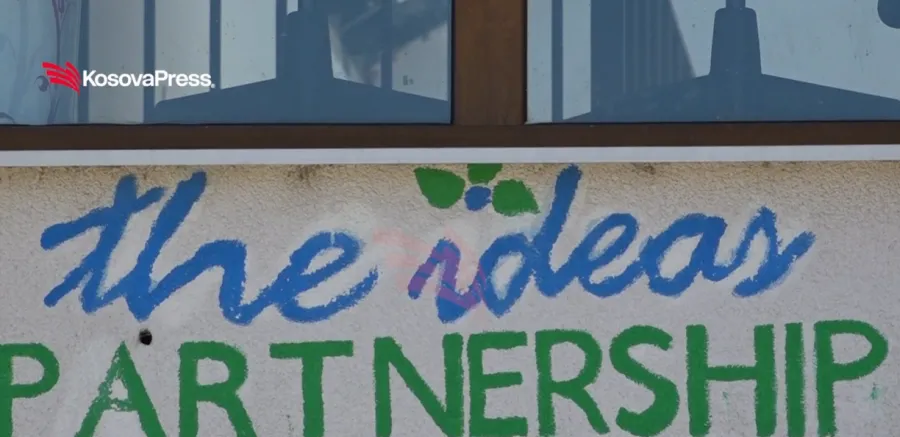
For the past 13 years, Arjeta Islami has been part of The Ideas Partnership organization in Fushë Kosovë. Today, she serves as the coordinator of the center, working every day with colleagues and beneficiaries from various minority communities, primarily Roma, Egyptian, and Ashkali.
As a member of the Ashkali community herself, Islami says that working at the organization has provided her not only with professional opportunities but also with experiences that have helped build bridges between different ethnic communities.
Arjeta Islami, Coordinator of the Fushë Kosova’s Center, The Ideas Partnership
Islami: We Always Work Together and Support One Another
"Coming to work here is truly a wonderful feeling because, besides helping communities and people in need, we also have excellent cooperation and mutual understanding among colleagues. We always work together and help each other whenever needed... (13:52)... We don't really face challenges with one another, and even when we do, we solve them by supporting each other and finding solutions together... (14:50)... Regardless of the challenges that arise, when your goal is to help someone, you never look at which community they belong to or judge them because of it... (15:15)... It doesn't matter which community someone belongs to or what position they hold. What matters is having genuine cooperation so that our work can be successful," she said.
Her fellow Ashkali colleague,
Hysni Hasani, who also serves as a coordinator at the center, shares the same experience. He says that working alongside colleagues from different communities is characterized by continuous communication.
Beyond their differences, the shared goal of helping people has created a common language among them.
Hysni Hasani, Coordinator of the Fushë Kosova’s Center, The Ideas Partnership
Hasani: We Have Found Common Ground in Helping Communities
"The cooperation is excellent. I have worked here for 15 years, and throughout that time there have been many employees from different communities. Our cooperation has always been very good. We communicate well, and whenever there are challenges or problems, we sit together—as we are doing now in meetings—and discuss how to solve them or how to approach different projects... (18:08)... By seeing our different experiences but recognizing our shared needs and common goal of helping others, we have found common ground in supporting the communities here," he said.
This cooperation is reflected in the organization's daily activities, where young people from different communities engage in supporting children and students. They serve as assistants in preschool and primary school programs, creating an environment where cooperation and mutual understanding are nurtured from an early age.
For the organization's Executive Director,
Arbon Osmani, this inclusive approach has been part of The Ideas Partnership since its very beginning.
He says that involving members of different communities in the staff has not only helped build trust among citizens but has also enabled the organization to better understand their needs.
Arbon Osmani, Executive Director, The Ideas Partnership
Osmani: Strong Staff Cooperation Has Led to Better Cooperation with Beneficiaries
"Our organization currently has 20 active employees, and around 45% of our staff come from minority communities. Besides Albanian staff, we employ members of the Ashkali, Egyptian, Roma, and other communities. We have always tried to ensure inclusion because the work carried out in our centers mainly serves these communities. Staff members from these communities understand the needs and concerns of the people better than anyone else. Through them, citizens have developed greater trust in our organization, and that is how we have continued operating all these years... (01:52)... Cooperation among staff is excellent. Naturally, during our daily work and meetings, teamwork is very strong, and this has also greatly improved our cooperation with beneficiaries from different communities," he said.
Yet this success story did not begin with a carefully designed project or strategy.
According to
Elizabeth Gowing, co-founder of the organization, everything started 15 years ago after a chance encounter with a nine-year-old Ashkali girl who wanted to attend school but had been denied enrollment.
Elizabeth Gowing, Co-founder of The Ideas Partnership
Gowing: The Entire Vision of the Organization Changed After Meeting a Nine-Year-Old Ashkali Girl
"The organization initially had a range of goals. We worked—and continue to work—on environmental issues and cultural heritage. As a teacher by profession, my greatest passion has always been education, though not specifically minority communities when we founded the organization... (03:26)... Everything changed when I happened to meet a nine-year-old Ashkali girl named Xhelanja. She told me she wanted to go to school, but the school had refused to admit her... (04:00)... As a teacher, I told her I could help her prepare so she could pass the test the school had imposed as a barrier to enrollment. Her response was remarkable. When I invited her to study with me every day, she asked, 'Can my friends come too?' That deeply impressed me because it showed the most transformative way to respond to an opportunity—not just to take it for yourself, but to ask whether your friends could benefit too. What started with one child soon grew into a broader activity," she said.
According to Gowing, prejudice is broken down most effectively when people get to know one another and work together.
She believes that through volunteering, education, and employment, people from different communities build relationships that reduce discrimination and strengthen understanding throughout society.
Elizabeth Gowing, Co-founder of The Ideas Partnership
Gowing: Communities Unite When They Work Toward a Common Goal
"Yes, the cooperation is excellent, and I like the fact that we don't make inter-community cooperation into a project in itself... (06:30)... Instead, it happens naturally through shared activities where people with common goals meet while working together. Cooperation isn't the objective—it develops along the way. This happens especially through volunteering. We have Roma, Ashkali, and Egyptian volunteers from this neighborhood and surrounding areas, as well as volunteers from the majority community. They come to our centers, socialize with each other, young people with young people, or university students who volunteer in our preschool every week. In this way, they get to know individuals rather than seeing communities as unfamiliar groups," she explained.
In addition to educational programs for children, the center also organizes activities that bring together girls, young people, and families from different communities.
One of its unique initiatives is the Free Shop, where citizens donate clothes, shoes, and other items for families in need. Through this model, assistance becomes a tangible expression of solidarity among people from different communities.
Elizabeth Gowing, Co-founder of The Ideas Partnership
Gowing: Free Shop – When a Pair of Shoes Becomes an Opportunity
"Another example of how we promote community integration is through our Free Shop. It's something very practical. When a family—whether Albanian or from any other community—has clothes, school bags, shoes, or other items they no longer need but are still in good condition, they donate them to our Free Shop. Families who are genuinely in need come here and choose with dignity the items they really need. Those shoes then walk alongside children all the way to their school desks. We are also deeply committed to showing donors the impact of their generosity, often sending them photos of the shoes or baby blankets they donated being put to good use," she said.
Alongside educational support and community activities, the organization also provides services focused on family health and well-being.
Every Saturday,
Mirnie Gujnovci, an Albanian health counselor, provides health consultations for women and girls from different communities in Fushë Kosovë, addressing issues related to their own health and that of their children.
Mirnie Gujnovci, Health Counselor, The Ideas Partnership
Gujnovci: Acceptance and Cooperation Came Naturally
"I have never had any problems. I have worked extensively within different communities, visiting families in their homes, providing home visits for pregnant women, newborns, children up to three years old, and conducting vaccination visits. I have never encountered hesitation—neither from them nor from me. I get along very well with my colleagues. Honestly, I don't even think about whether someone belongs to one community or another... (08:32)... They welcome us warmly. We conduct the visits, provide counseling for mothers, explain treatments for babies depending on their age, and offer whatever advice is needed," she said.
The Ideas Partnership is supported by humanitarian organizations, foundations, and international development agencies. Its principal supporters include UNDP, UNICEF, UN Volunteers, Save the Children, the Rockefeller Brothers Foundation, as well as the Embassies of the United Kingdom, the United States, Finland, and Austria.
The organization was founded by Elizabeth Gowing, Ardian Arifaj, and Robert Wilton, and is overseen by both a local and an international board.
(This story was produced by the Center for Innovation and Development (CFID) and Kosovapress as part of a joint project with UNMIK aimed at building trust among communities in Kosovo).