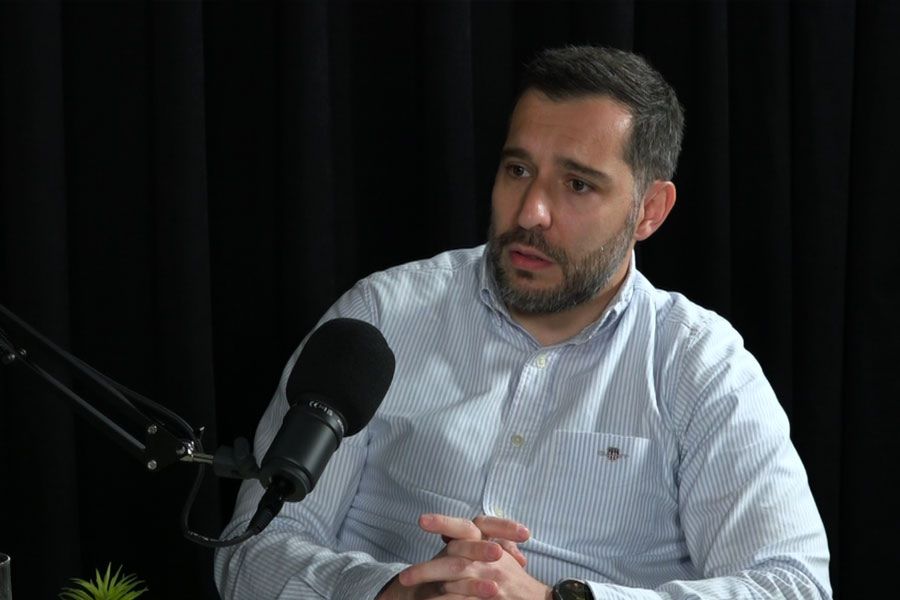
“Time is running out” – Aliti’s urgent call for unity ahead of the major 2030 sports challenge
The Secretary General of the Kosovo Olympic Committee, Besim Aliti, speaking on the SportCast show, discussed the challenges, deadlines, and urgency facing Kosovo on its path toward organizing the Prishtina 2030 Mediterranean Games. He stressed the need for institutional cooperation, accelerated processes, and serious infrastructure preparations within a very limited timeframe for major projects, according to him.
Speaking about the time available, Aliti underlined that the next four years are insufficient to complete major sports infrastructure projects, given the complexity of building facilities such as the national stadium, national sports centers, and renovating existing venues.
He emphasized the importance of adopting the draft law on the Mediterranean Games as a key step that would directly speed up procurement procedures and the start of infrastructure works.
“There is movement, but not as much concrete progress as needed, and I believe the key moment now is the adoption of the draft law on the Mediterranean Games, which should precisely accelerate the procurement process and how we should begin infrastructure development as soon as possible. I have full confidence, but we do not have much time. Anyone involved in construction knows how little four years or four and a half years is to build a national stadium, a national swimming center, a national tennis center, or any other sports hall. Even the renovation of the Palace of Youth alone would take at least four years. So we do not have time, we do not have the luxury to debate anymore,” Aliti said on SportCast.
Furthermore, Aliti stressed the need for institutional unity, calling for an end to unnecessary debates and a focus on concrete work. According to him, cooperation between key institutions such as the Government of Kosovo, the Municipality of Prishtina, and the Kosovo Olympic Committee is essential for a successful organization. He praised recent signals of inter-institutional coordination, describing them as a positive step toward a strong joint effort.
“I am making a clear call to all institutions: we do not have the luxury for debates. Let us sit down, work together, respect the hierarchy, respect what we have signed, meaning each stakeholder has its own role. The Olympic Committee has its role, the capital city Prishtina has its role, and the Government of Kosovo has its role. Everyone knows very well their responsibilities and obligations as agreed. I am pleased to see this institutional cooperation now emerging. I saw that the Municipality of Prishtina has also held meetings with the Ministry of Sport. This makes me extremely happy. The Minister of Sport, Blerim Gashani, is showing a very proactive approach toward unity, and so is Mayor Përparim Rama. I am convinced that now is the moment for a strong unification to show the world, Europe, and the Mediterranean countries that we Albanians can work together and be very strong when united,” he added.
Aliti also spoke about alternative scenarios in case of delays in infrastructure development, stressing that organizers must be prepared with multiple backup plans. He highlighted the importance of flexibility in organization, including the possibility of building temporary infrastructure for certain sports disciplines to ensure full program coverage even under challenging conditions.
“I find it very difficult to imagine such a scenario. It is truly a dark scenario, as you said, but I believe that as an organizing committee we must always have Plan A, B, C, D—not just A and B. That is not enough. Mike Tyson once said, ‘Everybody has a plan B until they get punched in the face.’ I do not want that to happen to us. Plan A is everything going according to the approved master plan of the Organizing Committee. If we are not on schedule, Plan B must be the creation of temporary infrastructure to cover as many sports as possible for which we do not have permanent facilities,” Aliti said.
The 2030 Mediterranean Games represent one of the largest sports and infrastructure projects in Kosovo’s history. The event is expected to have a wide impact on the development of sport, tourism, and the country’s international image. However, its success remains closely tied to the pace of construction, institutional coordination, and commitment to meeting international standards within the set deadlines.