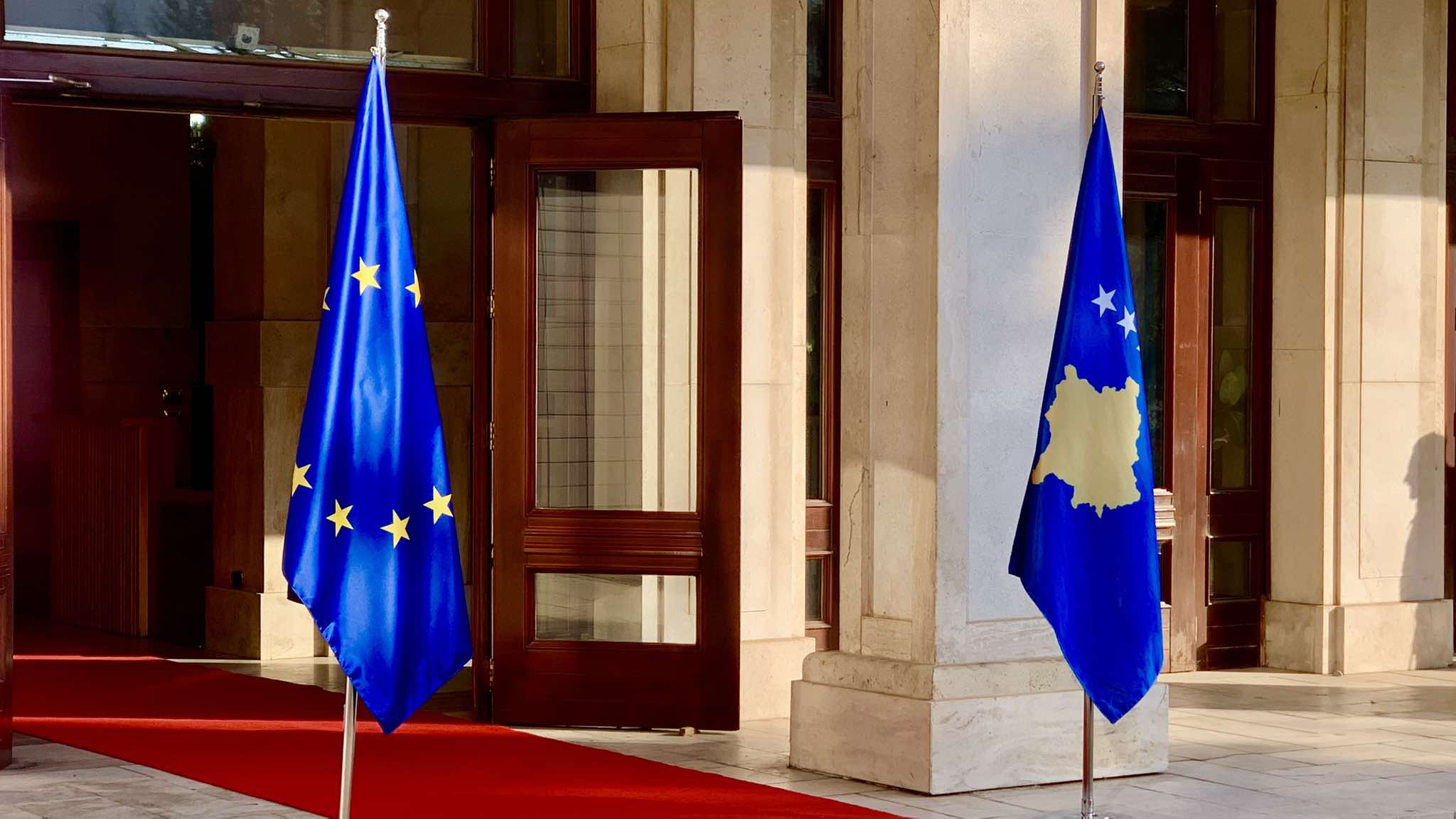
Kosovo is facing severe financial and political consequences due to measures imposed by the European Union since June 2023. According to an analysis by the GAP Institute, over €613 million has been suspended during this period through two main instruments: IPA and the Western Balkans Investment Framework (WBIF).
The EU imposed sanctions on Kosovo in response to government actions in northern municipalities, where the situation escalated following elections boycotted by local Serbs. Measures include the temporary suspension of certain funds, the prohibition of high-level visits, and Kosovo’s exclusion from EU regional meetings.
Rrona Zhuri, research coordinator at GAP, stated in the recent “Shtylla” program (produced by KosovaPress) that €7.1 million has been permanently lost because some IPA 2020 projects could not be contracted before their deadlines. She noted that the most affected projects are in the environment, energy, digitalization, and culture sectors.
“Since June 2023, the EU has imposed several measures on Kosovo, including the suspension of funds under two main instruments: IPA and the Western Balkans Investment Framework. According to our calculations, the total value of projects suspended over this two-year period, up to May 2025, was €613.4 million—€218 million from IPA and €395 million from WBIF. Around €7.1 million of this has been completely lost. These €7.1 million include several IPA 2020 projects that expired before they could be contracted. Of these, about €3 million were in competitiveness and innovation, around €1.3 million in rule of law, and three projects worth €2.8 million in agriculture and rural tourism. Among the suspended funds, energy is heavily affected, while the environment sector saw the highest impact at €350 million, energy €117 million, digitalization €56 million, and culture €15 million.”
Beyond financial losses, the measures and political deadlock also damage Kosovo’s legitimacy on the international stage.
Besar Gërgi, researcher at GLPS, emphasizes that the risk is not only economic but also institutional and strategic.
“The EU measures against our country have an undeniable financial cost, but they also bring political and diplomatic costs. Our country appears de facto under EU sanctions, which Serbia uses in its campaigns against us. Another damage affects Kosovo’s European integration. At the end of 2022, we submitted an EU membership application, and we already know the path is difficult due to five non-recognizing countries. With these measures in place, discussion of the application is impossible until the measures are lifted. These measures act as an additional barrier to Kosovo’s EU integration. The damage is strategic, long-term, and these measures should be removed as soon as possible.”
Meanwhile, Klisman Kadiu, advisor to the acting Deputy Prime Minister for European Integration Besnik Bislimi, stated in writing to “Shtylla” that Kosovo fulfilled the conditions for lifting the measures early on, citing the Bratislava Agreement.
“Kosovo has implemented the steps required by the EU for lifting the measures (Bratislava Agreement), and the recommendation to lift them came last year through EU High Representative Josep Borrell. From the moment they were imposed, the EU specified that the measures are reversible and not permanent. Therefore, even the funds still suspended are recoverable and are expected to be released gradually, as since July, gradual lifting has begun. So far, MSA subcommittee meetings have resumed, and Kosovo’s projects and applications under the WBIF have also been released,” the response states.
He emphasized that tensions in the north were not caused by Kosovo.
“In your question about whether this is due to tensions in the north, it must be specified that Kosovo has never initiated tensions, in the north or anywhere else. Instances when our institutions were attacked (attacks on municipal buildings in May 2023, abduction of our police officers, Banjska, several barricades in the north in 2022) were produced and organized by Serbia through criminal groups directed by Belgrade,” Kadiu said.
The “Shtylla” program also asked the European Commission about which measures have begun to be lifted and how much Kosovo has lost, but no response was provided. However, EU diplomat Kaja Kallas previously stated that the gradual lifting of measures against Kosovo, imposed in June 2023, has begun, without specifying when or which measures have been removed so far.
Skënder Krasniqi, chairman of the Kosovo Chamber of Commerce and Industry, also said the measures have hurt the private sector and national development.
“For over two years, we have suffered due to sanctions and lack of these urgently needed funds. This has seriously affected the country, especially large and regional projects, as well as projects for the state to adapt to the European market and legal infrastructure. The lack of these funds has left Kosovo in a severe revenue crisis, also due to poor government policies. This is causing huge damage to businesses and the state, as it is unknown when funds will be available in the future.”
Besides the lack of funds, the absence of a functional government remains a problem. Kosovo has the lowest debt in the region, unlike countries like Montenegro and North Macedonia, which have 3–4 times higher levels. Krasniqi criticized the lack of cooperation from the Kurti government, failure to fulfill promises, and the absence of supportive policies during crises like the pandemic and inflation.
“Unfortunately, in recent years, especially under the Kurti government, we face a lack of communication and cooperation, even when the government had a full mandate. Their arrival brought hope, but most promises were not realized. During COVID, Kosovo and the world needed policy adjustments to help businesses survive inflation. Citizens also suffered due to high expenses and low income. Even with salaries increasing from €500 to €800, it is insufficient due to inflation and lack of government investment. Meanwhile, the country reduced public debt. Now, with nearly a year without a government, funds are unallocated, investments stalled, and businesses don’t know when changes will occur, prolonging the political deadlock.”
He also warned that while Kosovo faces political instability, economic consequences are accumulating, worsening the trade deficit.
“From 2020 to the end of 2024, imports have doubled, which is a national tragedy. This raises prices, increases household and business expenses, and reduces profits, discouraging foreign investors. We have gone from €3.2 billion to €6.5 billion in imports. Exports remain very low in comparison, worsening the situation for citizens.”
Krasniqi urged state institutions to reform fiscal policies to support business.
“The request is for the leading party to urgently form institutions, take citizens’ and businesses’ situations seriously, improve cooperation with stakeholders generating revenue, and create a real development strategy. We need a domestic trade law to prevent oversaturation of businesses like gas stations and cafes, so money is directed toward production and export growth. The government is harming citizens by failing to regulate investment locations. Immediate action is needed to stop inappropriate construction and facilitate profitable investments.”
Klisman Kadiu also mentioned that the EU will soon resume MSA subcommittee meetings with Kosovo and WBIF technical assistance projects in sectors like energy and infrastructure.