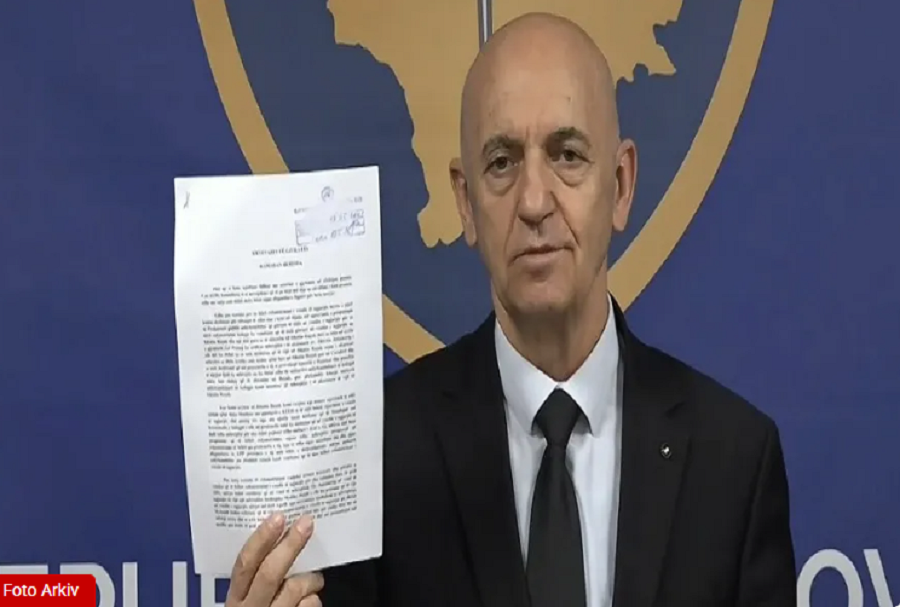
Supreme Court issues ruling in the case of Besim Kelmendi
The Supreme Court has upheld the appeal filed by Besim Kelmendi, Acting Chief Prosecutor of the State, and annulled KPK decision no. 1056/2025, dated November 20, 2025, declaring it unlawful.
According to the announcement, the case has been returned to the Kosovo Prosecutorial Council (KPC) for reconsideration and re-decision.
“The Supreme Court of Kosovo, after assessing the claims in the appeal regarding the challenged decision, based on Article 15 of the Law on Disciplinary Responsibility of Judges and Prosecutors, has found that the appeal is well-founded,” the statement reads.
“Since the dismissal decision was based on claims that the Acting Chief Prosecutor, through statements in the Council and to the media, expressed a biased position—which allegedly denigrated his role and undermined public and prosecutorial trust—these elements fall under disciplinary responsibility according to the Law on Disciplinary Responsibility of Judges and Prosecutors. The Supreme Court of Kosovo, considering the circumstances of the case, considers that the position and legal conclusion of the Kosovo Prosecutorial Council were neither fair nor lawful. This is because the challenged decision contains fundamental violations of procedural provisions of the Law on Disciplinary Responsibility of Judges and Prosecutors and the Code of Professional Ethics for Prosecutors,” the Supreme Court announced.
According to the Supreme Court, the challenged decision is unlawful, arbitrary, and unfounded, as it is contradictory in itself regarding the legal basis it relied upon, creating uncertainty about how such a body could make decisions without specific legal grounds or authorization to act in the manner it did.
“Thus, it is a procedure not supported by law, from the agenda setting, changes to the agenda, voting, proceedings, conclusion, reopening, or new meeting up to the challenged dismissal decision,” the statement added.
Kelmendi’s dismissal had occurred one day after he held an extraordinary press conference, in which he denied reports that he had collaborated with Serbian judge Danica Marinkoviq in 1999, who had handled the Reçak massacre case.
At that time, Marinkoviq worked as a judge in the District Court in Pristina and had characterized the massacre as a “fabricated event.” During the massacre, 45 Albanian civilians were killed.
Kelmendi confirmed that he had appeared as a witness before the Kosovo Special Prosecution regarding his work in the court at the time of the massacre.
He stated that during that period he was employed at the District Court in Pristina as a professional collaborator, performing duties of a court clerk, and denied accusations that he was an assistant to Marinkoviq.
According to Kelmendi, Marinkoviq was the judge who “destroyed the evidence of the Reçak massacre.”
The proposal for Kelmendi’s dismissal was made by KPC member Jehona Grantolli.
The chair of the meeting, Ardian Hajdaraj, stated that there was a sufficient quorum for voting and that Kelmendi’s presence was not necessary as he should have been excluded from the process since the discussions concerned him.
Kelmendi had left the room a few minutes before the vote, after evaluating during discussions with other KPC members that the proposal for his dismissal was an attempt to undermine the system.
Besim Kelmendi, who was dismissed from the position of Acting Chief Prosecutor of the State at the Kosovo Prosecutorial Council meeting on November 20, 2025, filed a lawsuit against the KPC, seeking annulment of the Council’s decision.
Kelmendi also proposed the temporary security measure of suspending the implementation of the KPC decision and continuing to exercise the position of Acting Chief Prosecutor until a final merit-based decision is made in this administrative matter.