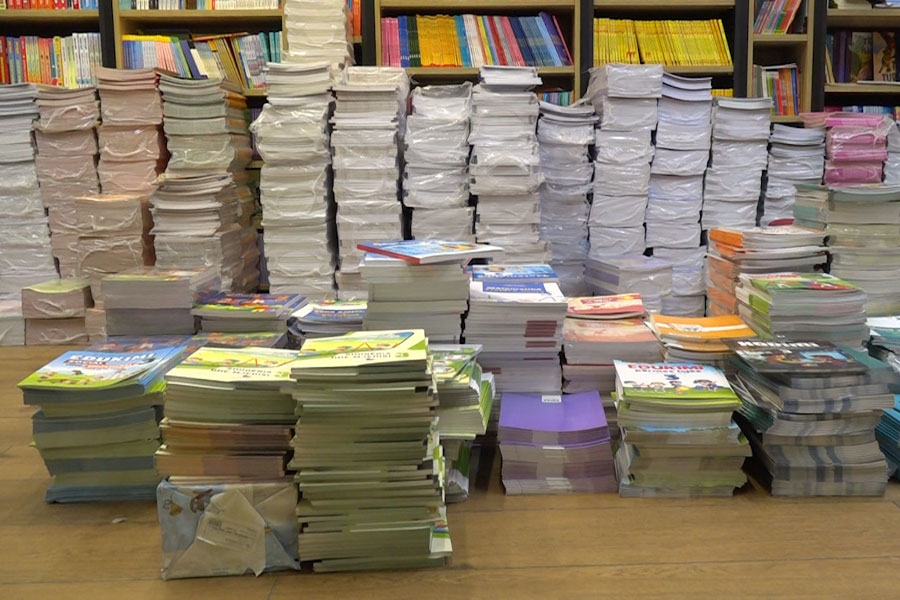
Although the new school year is expected to start on Monday, many parents still have not received the financial aid for textbook subsidies from the Ministry of Education, even though today is August 31. They say they applied on time to benefit from this subsidy, but the execution of the funds is being delayed. According to parents, textbooks have already been purchased with their own money.
Some also express that the allocated amount for purchasing books is not sufficient, forcing them to cover the remaining costs from their personal budgets.
Zejnie Fejzulla, mother of a fourth-grade student, says she is not satisfied at all with the textbook subsidy process. She explains that she bought her daughter’s textbooks with her own funds, emphasizing that she still has not received the money.
According to Fejzulla, the cost of purchasing textbooks and other school supplies has already exceeded 80 euros.
“Not satisfied at all, we can’t even buy the books with those 80 euros. For which grade? Fourth grade. Have you received the funds? No, I haven’t received them yet. I was forced to buy the books myself. But it’s not enough. With 80 euros, we can’t get the books. I don’t know how they calculated that amount. How much did your daughter’s books cost? I’ve been running around for two or three days trying to find books, I don’t know the exact bills…Did it exceed 80 euros? Yes, of course. With notebooks and other supplies, definitely. Just the books alone, did they exceed 80 euros? I think so. The cheapest book was 3 euros. Prices started from 3 euros and up. Have you applied for the subsidy? Yes, I applied, but the money hasn’t come yet. This is not right at all. There are families who cannot buy books until they receive the funds,” Fejzulla said.
Likewise, Lia Rudi, mother of a third-grade student, states that the execution of funds for textbook purchases is delayed. According to her, for parents with two or more children in school, it is difficult to buy the books without the subsidies.
“I came today to buy the books for my daughter who is starting the third grade. To be honest, I think the execution of funds is a bit late. If we consider that some families have two or three children and the value of 80 euros is not always sufficient, and keeping in mind the timeline since we are sending children to school on Monday, this is poorly managed and delayed. We have 2–3 days left, the book lists have been distributed, but the subsidies have not been executed yet,” Rudi said.
Jetmira Haxhimushoviq, mother of two children, one in fifth grade and the other in fourth grade, says that applications for this subsidy should have opened earlier, so that the funds would be released sooner.
She adds that even when the subsidies are executed, “we are still in deficit,” since the cost of books is higher than the value of the subsidy.
“My daughter is in fifth grade, my son in fourth…We applied for the textbook subsidy right when applications opened, but the money still hasn’t been executed… Even last year, when they released the funds, we still had to add from our own pockets to buy the books. The funds haven’t come yet. Maybe it should have been different—applications should have opened earlier, so that students would be ready with books by the time school starts. Not to wait until the last moment or for parents to pay with their own money. Even if the funds are executed now, we are still in deficit,” Haxhimushoviq said.
Regarding this process, former Deputy Minister of Education, Dukagjin Popovci, says that if it was known more time would be needed for payment execution, then applications should have started earlier.
According to him, the most efficient and secure method would be the direct distribution of books in schools, which would also help prevent misuse.
Popovci adds that if someone intends to buy both textbooks and school supplies with the subsidy amount, it is not sufficient.
“The application process was on time. But if more time was needed to execute the payments, then logically applications should have started earlier. This depends on ministry procedures. The legal obligation is to provide textbooks for grades 1 to 9. The best way to ensure this is to deliver the books directly to schools, eliminating all kinds of misuse… If someone thinks they can buy both textbooks and school materials with this amount, it’s not enough. For textbooks alone, it might be sufficient and maybe leave a little extra for supplies… But in this situation, when people need to buy books, they only find out which ones to buy on September 1 when school starts, because publishers and schools differ and not everyone uses the same textbooks. On September 1, 2, and 3, when parents need to purchase books, some families in a tougher financial situation may not have the funds yet and must wait,” Popovci said.
Meanwhile, regarding the textbook purchasing process, Elvim Blakaj from “Dukagjini” bookstore says that this year parents are better prepared with the book lists for their children. He explains that this time, the sale of textbooks started earlier compared to last year, to avoid crowding.
“Sales are going well. Parents are interested as every year, it’s routine now, we’re expecting them to complete their purchases. This year we started selling books earlier, on the 18th. We tried to give parents more time to spread out their purchases, so it won’t be too crowded in the last 3–4 days… Parents are much more prepared this year to buy textbooks. They have their lists, they’re organized,” Blakaj said.
KosovaPress tried to get a response from the Ministry of Education regarding the execution of funds for textbooks, but there was no answer by the time this article was published.
On August 27, according to the Ministry’s public notice, since applications opened on August 15, more than 183,000 applications have been received for textbooks and school materials.
According to the Ministry, on August 27 the first payments began, totaling over 9.6 million euros, for more than 120,000 applicants.
This is the third year in a row that textbook purchases are subsidized through such financial support.
In June this year, the National Audit Office published its “Audit Report on the annual financial statements of the Ministry of Education, Science, Technology, and Innovation for 2024.” Among other things, the report highlighted irregularities in the textbook subsidy process for grades 1–9, noting that some beneficiaries did not meet the criteria, with costs exceeding 60,000 euros.
From 22 schools selected for audit in five municipalities of Kosovo, the NAO has identified more than 300 preschool beneficiaries who received subsidies worth over 24,000 euros, even though this group was not eligible under the criteria.
It also showed that 154 applicants residing abroad benefited from subsidies worth over 14,000 euros, while over 20,000 euros went to 183 high school beneficiaries, who likewise were not part of the eligible category.
There were also 18 cases of school dropouts for which nearly 2,000 euros were allocated.
For these irregularities, the National Audit Office recommended that the Ministry of Education strengthen control and oversight mechanisms, so that public funds are distributed in line with the set criteria and government decision.
This year, the Ministry will allocate 80 euros per student from grades 1 to 5 for textbooks and learning materials. Meanwhile, another 80 euros will be allocated per student from grades 6 to 9, for workbooks and learning materials.
Textbooks for grades 6 to 9, according to the administrative instruction for their provision, use, and preservation, will be reused from the previous generation. /Z. Zeneli/