Serbian drills near the border, Kurti calls for international punishment
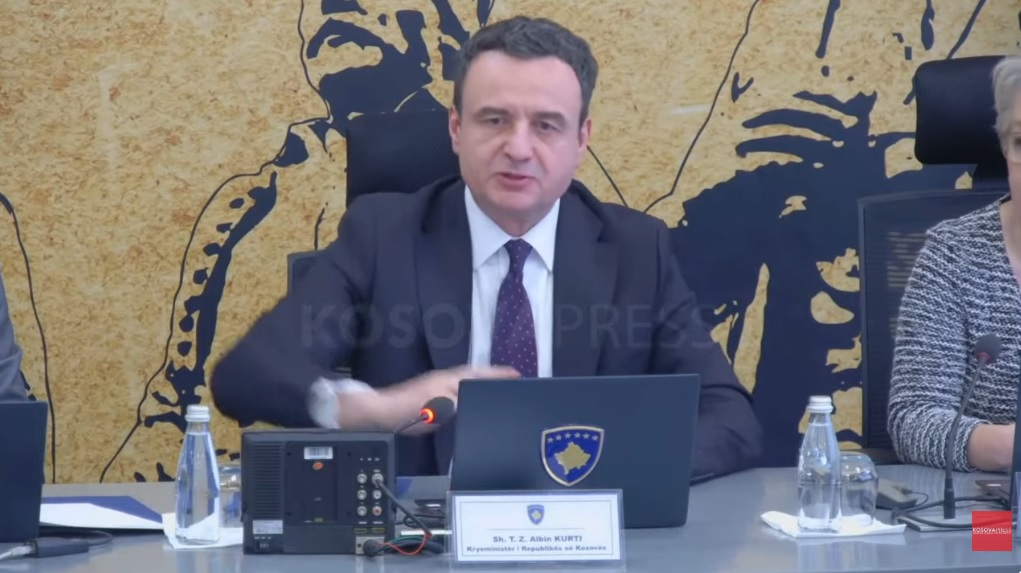
The Prime Minister of Kosovo, Albin Kurti, reacted to what he described as an unjustified military demonstration by Serbia in its southern region near the border with Kosovo, calling it an open provocation and a threat to regional stability.
Kurti said that the display of military force, with helicopters and paratroopers in areas inhabited by Albanians in the municipality of Bujanovac, constitutes pressure and an attempt to intimidate the local population. According to him, these actions are even more concerning given the past of the units involved in violent incidents in northern Kosovo.
Kurti also called on the international community to condemn and take concrete measures against what he called Serbia’s destabilizing approach, aiming to maintain peace and security in the region.
“We are deeply concerned about Serbia’s unjustified military demonstration with helicopters and paratroopers in Albanian-inhabited areas of the Bujanovac municipality, right near the border with the Republic of Kosovo. Such a display of military force over homes, schools, and medical centers constitutes not only pressure, the creation of tension, and an attempt to intimidate the residents, who for years have faced administrative ethnic cleansing from the autocratic regime in Serbia, but also represents an open provocation against our independent state, the Republic of Kosovo. These provocations near the border area in Karaceve by Serbia’s 63rd Paratrooper Brigade, through helicopter H-145 M exercises and parachute drops just meters from the Kosovo border, represent a dangerous display of aggression. This display becomes even more alarming when we remember that the same unit trained and supported the criminal group of Milan Radoicic, who carried out an aggressive and terrorist attack in the village of Bajnska in Zvecan, killing the Kosovo police officer, Afrim Bunjaku, a hero of Kosovo,” Kurti said.
He emphasized that Serbia’s military movements, accompanied by provocative statements from Serbian President Aleksandar Vucic, as well as armaments from Russia and China, indicate a deliberate strategy to maintain tensions in the region.
Kurti added that, at a time of global insecurity due to the war in Ukraine and tensions in the Middle East, Serbia is trying to challenge stability in the Western Balkans in line with the interests of its allies.
“These military movements, combined with the provocative rhetoric of Serbian President Vucic, claiming that Serbia is preparing for a possible attack by a Croatia-Albania-Kosovo alliance, as well as the purchase of Chinese and Russian weaponry, confirm that Serbia is using the military as a tool of blackmail to keep the Balkans under continuous tension. At a time when global security is extremely fragile due to ongoing Russian aggression in Ukraine and rising tensions in the Middle East, with Iran increasingly aggressive toward its neighbors, Belgrade is exploiting this moment to challenge the readiness of local and international security institutions and, more broadly, the stability of the Western Balkans according to the interests of Serbia and its allies, Russia and Iran, who seek unrest, conflicts, and instability everywhere,” Kurti said.
At the same time, he assessed that Serbia’s actions stem from, as he said, “desperation,” emphasizing that Belgrade no longer has the influence in Kosovo it once wielded through illegal structures.
The Prime Minister called on Albanians in Presevo, Medveda, and Bujanovac not to fall for destabilizing policies, while assuring that Kosovo’s institutions remain vigilant against any threat.
“On the other hand, we must note that Serbia is acting out of desperation. Firstly, it no longer has illegal parallel structures in Kosovo to destabilize or undermine us internally, so it moves around the border instead. Secondly, Serbia can no longer hold our region in Southeastern Europe hostage. It ranks last in international indices of democracy, human rights, and the rule of law. The rest of us desire the European Union, while Serbia is aligned with the Russian Federation. In this context, our call to Albanians in Presevo, Medveda, and Bujanovac is not to fall for provocative and destabilizing, autocratic, and oppressive policies. Kosovo’s institutions remain vigilant and ready to confront any threat. It is time for the international community to punish this destabilizing approach by Serbia, which directly threatens regional peace and security. It is high time for the democratic world to condemn Serbia’s repeated actions and take concrete steps to protect the rights and freedoms of Albanians in Presevo, Medveda, and Bujanovac,” Kurti emphasized.