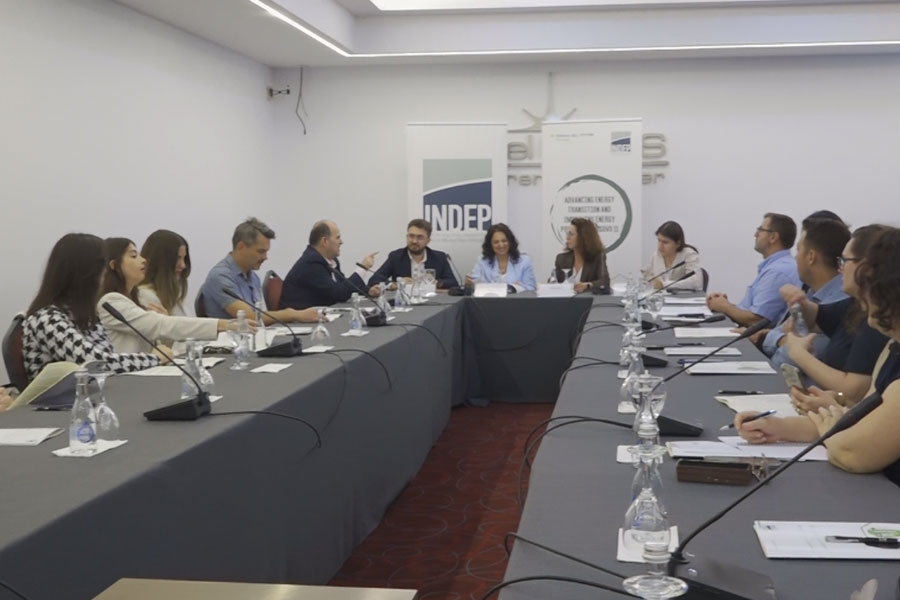
Rising energy prices, INDEP: Kosovo on the edge of energy poverty
If electricity prices continue to rise while wages remain unchanged, the country could face energy poverty, a discussion panel under the project “Energy Poverty in Kosovo II” organized by the Institute for Development Policy (INDEP) reported to KosovaPress.
INDEP Executive Director Burim Ejupi said that Kosovo is on the edge of energy poverty due to rising electricity tariffs. He noted that if electricity prices keep increasing while wages stay stagnant, the country could reach the level of energy poverty seen in 2007.
“This is the third or fourth time electricity prices have increased. Five to six years ago, we conducted some work suggesting investments in energy efficiency or renewable energy sources, but electricity costs were affordable and it was not a priority. In 2007, electricity prices peaked, the average wage in Kosovo was 200–300 euros, while energy bills for a family reached up to 30% of income. Now, with these new electricity price increases and the current average family wage, energy bills—including heating—have already reached 15–20%. We are in energy poverty or on its edge. If electricity prices rise further and wages do not, we will return to the situation we had in 2007,” Ejupi said.
Granit Gashi, representing Heinrich-Böll-Stiftung, stated that the foundation usually works with left-leaning or social-democratic governments, but in Kosovo the absence of such partners has led them to collaborate with civil society.
He emphasized that there is a trend toward proposing measures to strengthen social cohesion during the transition to green energy. This transition should include a much stronger social component than currently exists.
“[Heinrich-Böll-Stiftung] typically works with governments that are left-leaning or social-democratic. Since we have no such partner in Kosovo, we continue to work with civil society. Our goal is to propose measures to strengthen cohesion during the transition to green energy. There must be a much stronger social component than exists today, otherwise deeper crises could arise, especially for communities in Obiliq. We don’t know what will happen to KEK workers, miners, and their families, who rely on their employment,” Gashi said.
During the discussion panel on “Energy Communities for Poverty Alleviation and Inclusive Transition,” Besiana Qorraj Berisha from the Ministry of Economy said that energy communities are specifically addressed in the Law on Renewable Energy Sources, recognized as a key instrument for promoting clean energy and citizen participation.
Qorraj-Berisha stressed that the Ministry of Economy plays a crucial role in policymaking and creating the legal framework for these energy communities.
“The Law on Renewable Energy Sources was adopted at the beginning of 2024. It is the first law to focus solely on renewable energy sources. Previously, this sector was regulated under three other laws. This law is also part of our obligations under the Energy Community Treaty for the transposition of the 2018 directive… Energy communities are addressed within this law to promote renewable energy use. The Kosovo Energy Strategy 2022–2031 also includes specific objectives for promoting renewable energy… The Ministry’s role is to design policies and especially the framework for these energy communities,” Qorraj-Berisha said.
She highlighted that the Kosovo Energy Strategy 2022–2031 includes key objectives for promoting energy from renewable sources.
Capacity Development Expert Lindita Daija said there is still work to be done in secondary legislation, particularly regarding the organization of communities and defining concrete steps for their development.
“In terms of legislation, we are at a fairly advanced stage, especially in transposing directives. However, there is still work to be done in secondary legislation, which includes details on community organization and defining concrete steps for how this organization should develop,” Daija emphasized.
Meanwhile, energy resources expert Zanfina Kabashi stated that Kosovo has potential for many types of renewable energy sources.
“Kosovo has potential for many types of renewable energy. Some technologies are more mature, with studies and practical cases already executed. There have been attempts and crises in the past, which have created opportunities for innovation. New technologies are also being evaluated for optimal use in Kosovo’s energy market,” Kabashi said.
According to a report published by INDEP titled “Energy Communities and Energy Poverty in Kosovo,” Kosovo is at a critical moment; without clear regulations and financial mechanisms, energy communities risk remaining only on paper.
The report includes several recommendations. Among them is that the Ministry of Economy and the Energy Regulatory Office (ZRRE) establish a joint working group within six months to complete the legal framework for energy communities. This process includes not only adopting secondary legislation derived from the Law on Renewable Energy Sources and ZRRE regulations for support schemes but also amending existing laws.
Additionally, the report recommends that the Ministry of Economy, in cooperation with other institutions, approve a National Program for Decentralized Energy Production within 12 months, giving energy communities a central role. This program should prioritize communities most vulnerable to the energy transition and price fluctuations, applying the principle of “leaving no one behind.”
The report also states that ZRRE and KOSTT should publish a national map within 18 months detailing grid capacities (LV/MV), proximity to substations, load points, technical limitations, and the territorial distribution of energy poverty.
Other recommendations include setting national targets by the end of 2026 and launching an awareness campaign with a focus on technical schools to educate the next generation.