Report reveals candidates’ campaign expenses in the 2025 elections
Democracy Plus and the Westminster Foundation for Democracy present the report ‘The Cost of Politics in Kosovo,’ with a detailed analysis of candidates’ campaign expenses for the 2025 national elections.
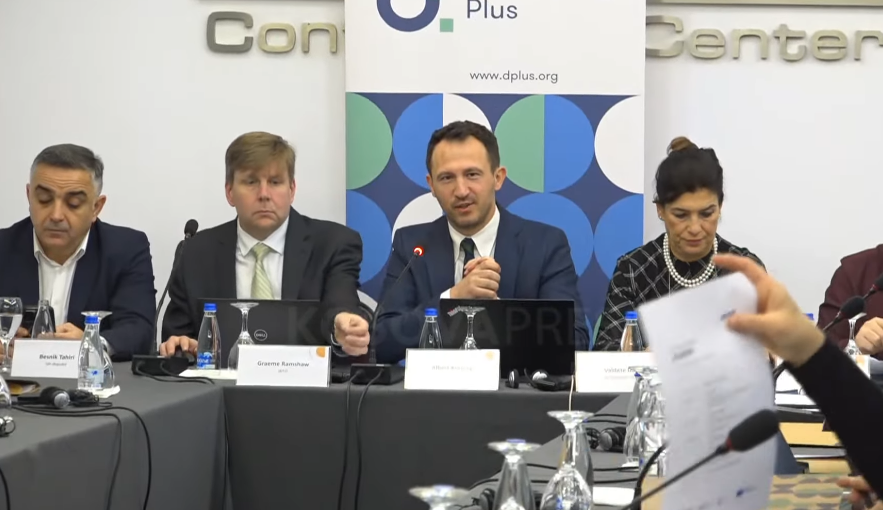
Graeme Ramshaw, Director for Quality and Innovation in London, said that obtaining a parliamentary seat is a challenge, adding that the report examines how much is spent, how campaigns are financed, and the pressures candidates face.
“This report is the result of collaboration with Albert [Krasniqi], funded by the European Union in Brussels. Today it is the 12th of 15 reports financed by the program for the engagement of women and children. This means that each report has been conducted since 2023 and covers countries worldwide. This project has been active in this field for 10 years. North Macedonia was one of the first countries where we conducted studies in 2016, and now I am pleased to return after 10 years to see how things have changed. I want to place the concept in this global perspective of what we have learned on this topic. In 2014, we heard from MPs and candidates about how politics was changing, becoming more monetized and more important than before. That was our earlier focus: to become an MP or to remain an MP. So, obtaining a parliamentary seat is equally challenging. We examined the expenses, how financing is done, and the pressures applied. With this project, in particular, we wanted to focus specifically on women and youth, hearing from Kosovo in the local context. We will look specifically at the impact and also place it in the context of global efforts when we review all these studies,” Ramshaw said.
Former Kosovar MP Besnik Tahiri said that the political cost in Kosovo is rising significantly, becoming a heavy burden for political parties and individuals seeking public office.
“The political cost in Kosovo is increasing extremely, initially as a burden for political organizations—in this case, the parties in particular—for those who want to hold a public position, a seat like in the Assembly or Municipal Assembly, but even more, to take on a mandate as a mayor. Trends and the influence of social media have made form override content. It is very important to understand that in politics, when you enter, you must sacrifice, meaning doing two jobs, even three jobs,” Tahiri added.
Albert Krasniqi from the NGO Democracy Plus revealed figures reflecting expenses during the election campaign.
“On average, men spent around 6,000 euros, while women spent up to 15,000 euros. A much higher amount, but certainly their success was also higher. Regarding funding sources, most were personal income: 38% of candidates financed their own campaigns, either through loans or personal savings. Then donations from businesses accounted for around 15%, and others reported support in the form of visiting cards or billboards,” he said.
It is worth noting that elections for the Assembly of Kosovo will be held on December 28, and political parties have published lists of candidates seeking to be part of the 10th legislature of the Kosovo Assembly.