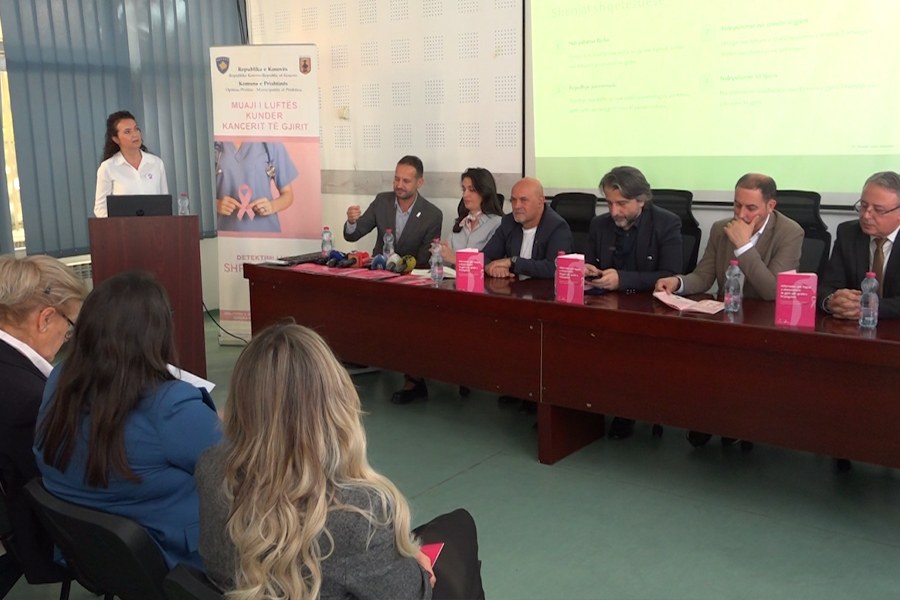
Prishtina introduces an information guide for breast examination for women
As part of Pink October, the Directorate of Health in Prishtina, in cooperation with the organization Action for Mothers and Children (AMC), has promoted the Information Guide for Breast Examination for women in the capital.
Women in Prishtina will now have accurate information on how to perform breast examinations, as well as where and how to seek further care in case of concerns or possible symptoms.
The Mayor of Prishtina, Përparim Rama, stated that women’s health is the foundation of a healthy and sustainable society.
According to him, the Municipality of Prishtina has made investments in the field of breast cancer treatment, including subsidies for women affected by the disease.
Rama emphasized that in the last two years, the number of mammograms has increased by 250 percent.
“During this period, we have also provided additional mammography units and invested so that the capital has new mammography machines and no longer faces long waiting lists for these services. Today, no woman in Prishtina has to wait to have a mammogram. We have also extended this service to surrounding municipalities. Mammography services are completely free for all women... These investments and continuous campaigns have produced concrete and measurable results. In the last two years alone, the number of mammograms performed in Prishtina has increased by more than 250 percent. This is a clear indicator of our joint success in the capital,” he said.
The Director of the Oncology Clinic at the University Clinical Center of Kosovo, Ilir Kurtishi, said that this guide is simple but will have an impact on the early detection of breast cancer.
“Today, we have in our hands a very simple guide, but one that will have an impact on the early detection of breast disease. This is an extraordinary achievement, and we hope it will be implemented widely. In the coming years, we expect to have a national screening program, already being developed by the Ministry of Health, through which women aged 40 will be identified and invited to undergo mammography. This will greatly increase early detection rates for breast cancer,” he said.
The Executive Director of Action for Mothers and Children, Rina Demiri-Spahija, stated that the goal of this guide is to promote early detection of breast cancer.
“We are united by a simple cause — to raise awareness about breast cancer. When a woman suffers from breast cancer, it’s not only she who suffers, but her whole family and community as well. For this reason, AMC has taken the initiative, together with the Municipality of Prishtina, to create a simple guide that explains the steps a woman should follow to detect the disease at its earliest stages,” she said.
The Director of the Kosovar Center for the Fight Against Breast Cancer “Jeta-Vita”, Nafije Latifi, emphasized the need for more information, medical staff, and advanced equipment to treat this disease.
“Today, I want to raise an important question: have we placed the patient at the center of our healthcare system? There have been many achievements that deserve recognition, but challenges remain that require sustainable solutions. We believe that institutions must do more to provide information about the need for ultrasound and mammography screenings, since we are the first point of contact for every patient — and it is there that she should be informed about further steps. We need sufficient radiology staff across all municipalities, advanced equipment, broader access to modern medications, more dignified conditions, and more treatment spaces. We must also strengthen capacities with sufficient staff, especially mid-level personnel, and establish a center for palliative care,” she said.
October is known as Pink Month, dedicated to raising awareness about breast cancer.