Palatova: The Growth Plan is not just a financial mechanism, but a profound social transformation
The Policy and Legal Studies Group (GLPS) has warned that Kosovo could lose millions of euros from the European Union due to delays in implementing reforms foreseen under the “Reform and Growth Facility” (RGF).
According to a report published by GLPS, Kosovo has failed to benefit from around 61.8 million euros, as agreements with the EU were not ratified on time. The report also warns that if the planned reforms due by June 2025 are not implemented by June 2026, there is a risk that the funds could be permanently lost.
The document highlights that the political crisis and the lack of functioning institutions during 2025 directly slowed down reforms, blocking the adoption of key laws, including the Civil Code.
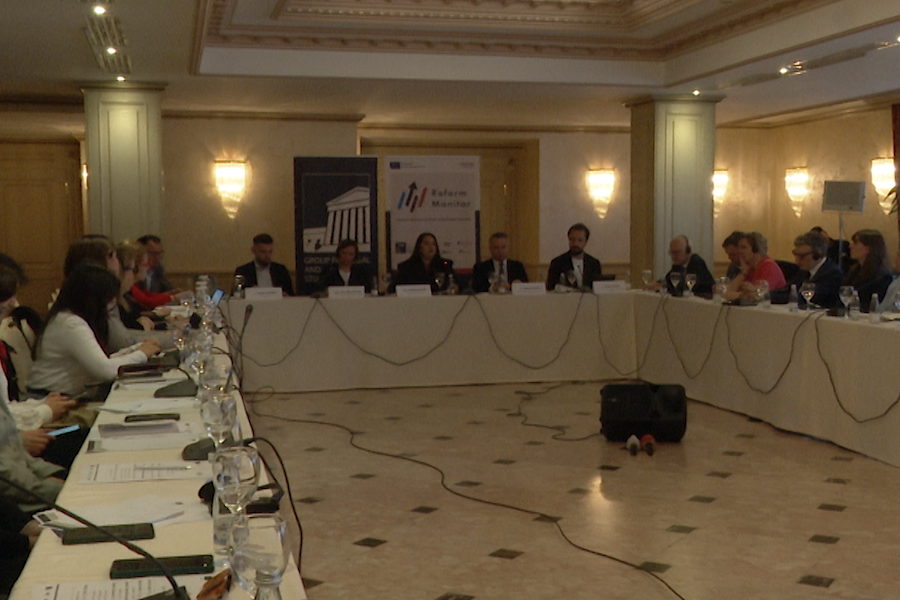
In this context, GLPS organized a roundtable discussion titled “Kosovo’s Reform Agenda: what next?”, where challenges and next steps in the European integration process and the EU Growth Plan for Kosovo were discussed.
Speaking at the roundtable, chief negotiator with the EU and national coordinator in the Office of the Prime Minister of Kosovo, Jeton Zulfaj, stressed that the integration process is not only the responsibility of the government, but of society as a whole.
He added that if deadlines are not met, Kosovo risks failing to fulfil its financial obligations toward the EU and losing a significant portion of the funds under the Growth Plan.
GLPS executive director Njomza Arifi said that although Kosovo was among the first countries to submit its reform agenda, it is now lagging behind in implementation.
The acting head of the EU Office in Kosovo, Eva Palatova, said that the Growth Plan is not merely a financial mechanism, but a profound societal transformation.
“It is essential to monitor and oversee the government’s work, to promote transparency, and to help ensure that the reforms to which governments across the region have committed are translated into real changes for people. I also want to emphasize the fact that Kosovo is an inseparable part of the overall framework that the European Union has made available to the region to accelerate reforms and the integration of the Western Balkans into the European Union. Kosovo is in an equal position there and also has equal opportunities to advance on the path of integration and to use all financial instruments, just like the other five Western Balkan countries. This is crucial and, in fact, Kosovo initially used this very well and was among the leading countries. Now we are where we are: you mentioned this, and I will also return to it. What we have seen in recent months are two key developments in the context of the Reform Agenda and the Reform and Growth Instrument. The first is the ratification of the loan agreements of the instrument in February by the new parliament, which allowed us to truly enter a formal phase, because until then we were only informally monitoring and analysing the entire mechanism we have in the EU Office in support of the reform agenda and Kosovo’s broader reforms. So until then we were observing informally what was happening and how the situation was developing, but now, thanks to ratification, we can move into a formal phase.”
Meanwhile, executive director of the Kosovo Civil Society Foundation (KCSF), Dren Puka, said that the reform process has been handled superficially and is often politicized.
The roundtable emphasized the need for greater institutional cooperation and broader involvement of civil society, in order for Kosovo to avoid losing EU funds and to accelerate its path toward European integration.