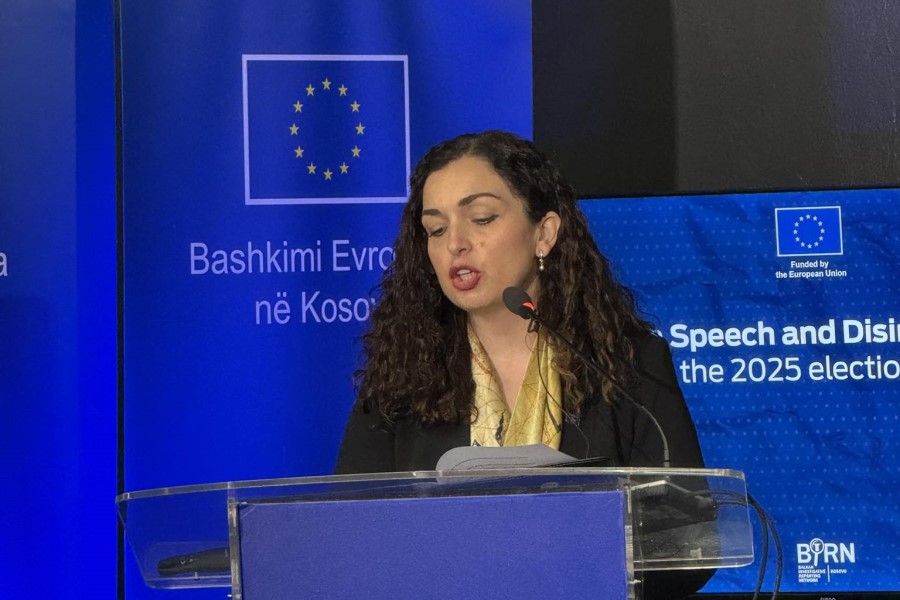
Osmani: Media supported by Russia spread disinformation about elections in Kosovo
Russia and Serbia have actively promoted disinformation and divisive narratives to undermine trust in democratic processes in Kosovo. This was stated during the publication of a report on hate speech and disinformation during the campaign for the parliamentary elections of February 9th in Kosovo by the European Union Office in Kosovo and the Balkan Investigative Reporting Network (BIRN) Kosovo, KosovaPress reported.
On the International Fact-Checking Day, the head of the EU Office in Kosovo, Aivo Orav, said that disinformation is more than just misleading content. He added that disinformation manipulates public opinion, fuels division, and undermines trust in institutions.
Orav said that any individual could become a target of information manipulation.
Among other things, Orav emphasized that the report reveals that disinformation narratives were spread not only by local political actors but also by external forces, with the aim of destabilizing public trust in Kosovo’s electoral process, as reported by KosovaPress.
Orav stated that the European Union remains deeply committed to supporting media freedom, fact-based journalism, and efforts to combat disinformation.
Kosovo's President, Vjosa Osmani, said that disinformation is not only a challenge but a real danger to stability, the integrity of our state, and democracy. She added that, in the context of state security, the failure to verify facts is not just an ethical or professional problem for the media but, according to her, becomes a serious threat to the state.
Osmani, according to KosovaPress, emphasized that Serbia and Russia have promoted disinformation to undermine the democratic process in Kosovo and incite tensions in the region.
Meanwhile, the main findings of the report on hate speech and disinformation during the campaign for the parliamentary elections of February 9th in Kosovo were presented by Kreshnik Gashi from BIRN Kosovo.
He emphasized that the elections in Kosovo were characterized by hate speech and disinformation from the Kremlin and Serbia.
Additionally, Gashi said there was hate speech and dehumanization of political opponents within the country.
In the February 9th elections, according to this report, there was high usage of social media in the amplification of hate speech and disinformation narratives.
“It is very clear that during the last elections in Kosovo, there was a disinformation campaign and hateful material which was initiated and created by the Kremlin, that is, by the Russian government. We had a dehumanizing campaign and a hate campaign, which originated from people who play a role in the government of Serbia or the Serbian state. Social media is identified as a very serious problem, as it has created opportunities for the amplification of disinformation narratives, hate speech, but also in cases where it was created depending on the technique used. Either the politician was the source of hate speech, or it was social media that developed hate speech. What is problematic for us and identified in the report is the fact that state institutions or media regulatory bodies in our country have failed to regulate the audience,” said Gashi.
The report also highlights the rise in the use of artificial intelligence in disinformation, the presence of Chinese influence in sponsored articles, and low transparency in campaign financing as characteristics of the parliamentary elections, according to the report published on Wednesday.