Opening the files of the former State Security: a key instrument for building transparency
The Albanological Institute of Prishtina has brought renewed attention to the necessity of a structured confrontation with the past, positioning the opening of the files of the former State Security as a key instrument for building institutional transparency, strengthening public trust, and advancing contemporary scholarly research.
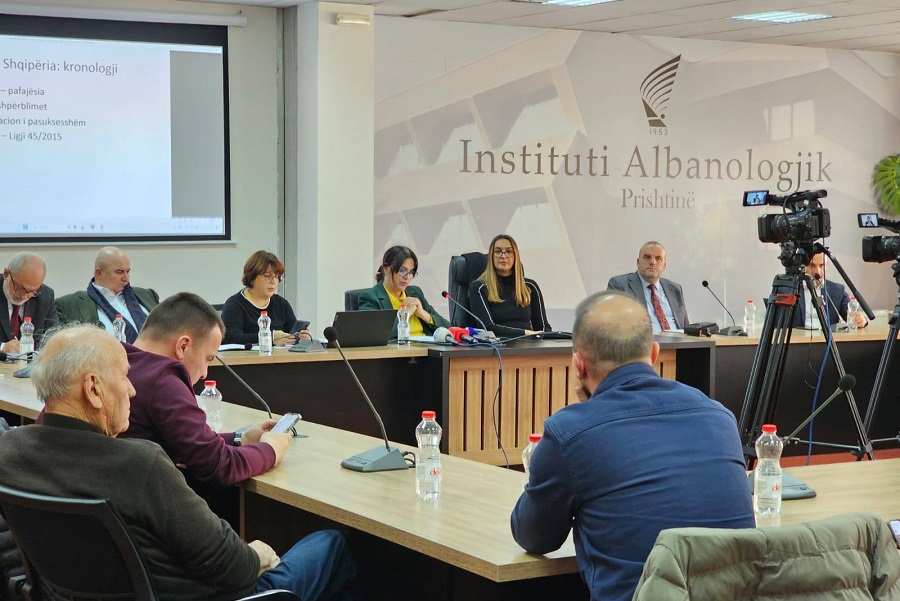
At a scientific event with local and inter-institutional participation, it was emphasized that controlled and verified access to the archives of the dictatorship is not merely an archival process, but an act of democratic and civic significance.
In this regard, the Head of the History Department at the Albanological Institute, Nuridin Ahmeti, stressed that the adoption of the law on the right to information regarding documents of the former State Security, as well as the functionalization of the relevant Authority, marked a turning point in the way the Albanian state has approached its authoritarian past.
According to him, this process has created concrete opportunities for citizens to access documents directly related to their personal and collective histories, contributing to the construction of a broader climate of transparency and social reflection.
Ahmeti added that the cooperation agreement signed between the Albanological Institute and the Authority for the Files represents an important development for the advancement of scholarly research and the enrichment of pedagogical approaches, with the aim of building a more aware and responsible citizenry toward historical heritage.
“As is known, with the adoption of the law ‘On the Right to Information on the Documents of the Former State Security of the People’s Socialist Republic of Albania’ in April 2015, as well as with the election of the members and chairwoman of the Authority in November 2016, Albania undertook a historic step to confront its recent past more openly. This step by the decision-making institutions of the Albanian state enabled citizens’ access to documents related to their lives and destinies and consequently fostered a culture of transparency, and perhaps even accountability and social reflection. For our institution, which since September 2025 has a signed cooperation agreement with this Authority, this is an important moment. Such collaborations give us the opportunity to strengthen scholarly research, advance pedagogical approaches, and contribute to the formation of a conscious and responsible citizenry,” Ahmeti added.
The Chairwoman of the Authority for Information on the Documents of the Former State Security in Tirana, Gentiana Sula, emphasized that confronting the authoritarian past constitutes an indispensable challenge for societies aiming at democratic consolidation. She highlighted that historical truth, grounded in documents and verification, is a prerequisite for building public trust and the functioning of the democratic order.
Sula stressed that totalitarian regimes have aimed not only to distort reality, but also to destroy the very concept of truth itself, which makes its restoration a complex but irreplaceable process. She recalled that Albania’s dictatorial experience during the years 1944–1991 makes the role of archives even more important in building a collective memory based on facts and verified testimonies.
“Societies that have gone through dictatorial or authoritarian experiences face a dual challenge: on the one hand, the need to build functional democratic institutions and, on the other, the moral and scholarly obligation to confront the legacy of state violence. In this context, historical truth is not merely an academic issue, but a prerequisite for public trust and democratic order. Hannah Arendt emphasized that factual truth constitutes the basis of moral judgment and political action. Unlike ideological truth or opinion, factual truth is grounded in documents, testimony, and verification. Totalitarian regimes do not aim only to lie, but to destroy the very concept of truth, replacing it with narratives produced by power. For this reason, the restoration of truth after dictatorship is a complex but necessary process. Albania, from 1944 to 1991, experienced a totalitarian dictatorship of the Stalinist type, characterized by extreme isolation, absolute centralization of power, and the systematic use of state violence,” Sula added.
Meanwhile, the Acting Director of the Albanological Institute, Meliza Krasniqi, assessed the cooperation with the Authority for Information on the Documents of the Former State Security as a strategic step toward deepening academic studies and building a balanced and responsible discourse on the past.
She emphasized that working with the archives of the period of dictatorship goes beyond the technical aspect of document administration and represents a process of high moral, scholarly, and civic responsibility.
According to Krasniqi, such institutional partnerships create a sustainable foundation for the exchange of experiences, professional dialogue, and the long-term development of scholarly research.
“I wish to express my special gratitude to Ms. Gentiana Sula and her team, not only for their continuous commitment in leading an institution of extraordinary public importance, but also for their readiness for inter-institutional dialogue, exchange of experiences, and sustainable scholarly cooperation. Your presence here today is concrete proof that working with the archives of the past is not merely a matter of document administration, but an act of moral, scholarly, and civic responsibility. The Albanological Institute highly values cooperation with institutions that operate at the delicate intersection of memory, history, and public ethics,” Krasniqi said.
The opening of the files of the former State Security represents one of the most complex and sensitive processes of democratic transition in post-authoritarian societies. These documents are not merely archival materials, but direct sources of factual truth about the mechanisms of control, repression, and state violence that profoundly shaped social and institutional life.