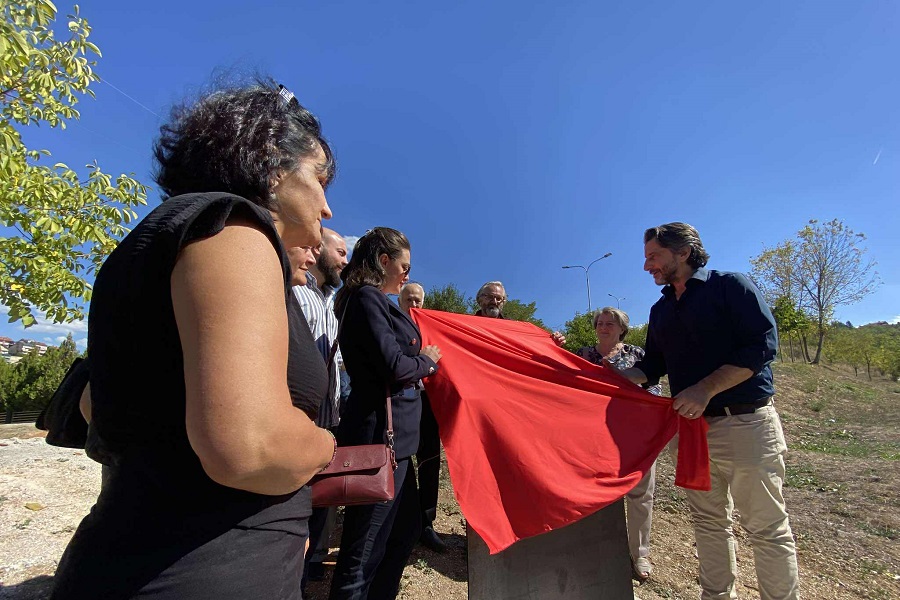
Memorial plaque unveiled for Albanian civilians killed after the Second World War
A memorial plaque for the Albanian civilians executed in Prishtina by the former Yugoslav communist forces, in the first five years after the Second World War, was unveiled today on “Dëshmorët e Kombit” street.
The unveiling of the memorial plaque was done by the Mayor of Prishtina, Përparim Rama, together with some family members of the victims.
The head of the capital, Përparim Rama, said that the place where the memorial plaque was placed is a painful point in the history of the city, known as “Strelishte”, which as he said means execution site.
He emphasized that this name should not and cannot be forgotten, because there thousands of Albanians were executed by the Yugoslav military administration after the Second World War.
Rama stated that many of the victims disappeared without a trace, were buried in unknown places and even today not all the names or the locations of their bodies are known.
“This is a point of our city, where the very soil speaks. It speaks with its memory. Prishtina has known this place with a grim name: Strelishte – which translates: execution site. And this name, although terrible, should not and cannot be forgotten. After the Second World War, which ended with new lines over the maps, terror continued over the people. The ‘Yugoslav military administration’ was established and with it came cells filled with Albanian patriots and executions without trial. Precisely in this place. Here the breath of thousands of Albanians was taken. Many disappeared without a trace, were buried somewhere without a name. Many names we still do not know, and many bodies were never found,” said Rama.
The Mayor of Prishtina, Përparim Rama, recalled the event of August 31, 1947, when in Taukbahçe Gjon Serreçi, Ukë Sadiku, Ajet Gërguri and Osman Bunjaku were executed.
He said that these names today are torches of memory and that this place remains a symbol of pain, memory and dignity.
Rama admitted that the memorial plaque was placed very late and that it cannot close the families’ wounds, nor bring back the lost loved ones, but according to him, it has great meaning because “it gives voice to the soil that speaks.”
“In Prishtina of those years, history also marked August 31, 1947, a dark night, but with names that remained indelible, like light in the darkness: Gjon Serreçi, Ukë Sadiku, Ajet Gërguri, Osman Bunjaku. They were taken out before dawn and were executed here, in Taukbahçe. Then, their bodies were thrown into a mass grave. Today, these names are torches of memory. And this is a place of pain, of memory, but also of dignity. We know that this memorial plaque comes very late. It should have been placed here about two decades ago. And we know well that it, even today as we unveil it, will not close the wounds. It will not bring back grandfathers, parents, brothers. It will not show where the unknown graves are. But, it will do one great thing: it will give voice to this soil that speaks,” emphasized Rama.
80-year-old Padishahe Islami, granddaughter of one of the Albanian civilians killed at that time, said she was happy that this memorial plaque was unveiled while she is still alive.
She described her uncle, Shyqri Begu, as a patriotic and humane man.
“My uncle was the chairman of the Committee for Ethnic Albania, they fought for a Greater Albania. He was a great patriot... I have heard that he was a humane man, who helped a lot, Shyqri Begu... He took part in the Second League of Prizren. He also helped with scholarships for good students at that time. Great joy that I did not die without experiencing (the unveiling of the memorial plaque),” said Islami.
Meanwhile, Dardan Islami, a family member of Shyqri Begu, said that even after so many years, the remains of over 500 victims have still not been found.“The executions at that time and the suffering of Albanians are normal. It is not something new. But, the problem of this case, the specificity of this case is that the bones and graves of these 508 people have never been found. Their families for 80 years, while the communist killers enjoyed privileges, we have not been able to know even about the bones. At least today we have a memorial to remember them,” said Islami.