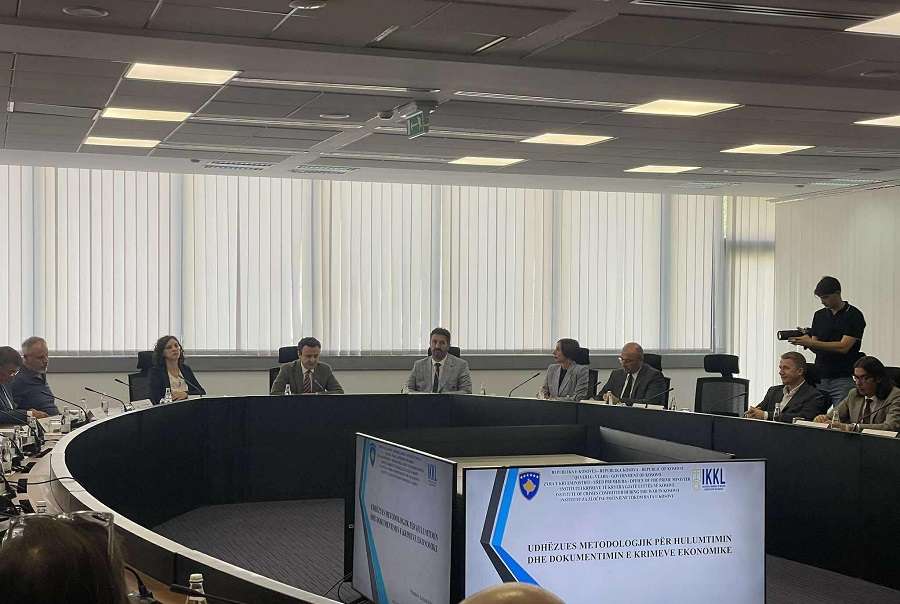
Kurti: Over 345 meters of physical material are preserved in the archives of the Institute of War Crimes
More than 345 meters of physical material and 23.6 terabytes of digital material are already preserved in the archives of the Institute of War Crimes. This was stated by the acting Prime Minister, Albin Kurti, during the presentation of the annex to the working methodology of the Institute of War Crimes (IKKL) for documenting and researching economic crimes.
On Wednesday, he said that with the documentation of economic crimes during the war in Kosovo, a reliable archive can be created.
“This process, beyond being an institutional and professional duty, is a moral obligation to the victims and a national obligation for our Republic. It serves us for confronting the past, for the present with dignity, and for a fairer and more sustainable future for our society. The war in Kosovo was a project of destruction, annihilation, looting, and abduction by the forces of Serbia with organized and planned crimes. Therefore, documenting them is vital. During the war, the people of Kosovo experienced great pain, killings, enforced disappearances, mass expulsions, destruction of property, and systematic looting. Alongside the enormous damage to human lives from Serbia’s genocide, incalculable damages were also caused in Kosovo, including the burning of private and public properties, the destruction of infrastructure, and the devastation of cultural and educational facilities. Documenting these economic damages is an integral part of the historical truth,” Kurti declared.
Kurti added that more than 345 meters of physical material are preserved in this institution, stating that they come from over 500 sources with great documentary value.
“Over 345 linear meters of physical material and 23.6 terabytes of digital material are already preserved in the institute’s archives — an extraordinary achievement for the institute and our Republic, and a significant increase compared to last year. Likewise, wide cooperation has been achieved with over 500 sources that have submitted materials of great documentary value. Today, with the annex to the methodology for documenting economic crimes, we are taking another important step together. This document will serve as a guideline for collecting evidence, ensuring that the final work is both accurate and unified,” he said.
The Director of the Institute of War Crimes, Atdhe Hetemi, said that there are six regional offices throughout the country.
“Within a short period, it has turned into a functional institution, with a central office in Prishtina and six regional offices across the country. Thus, we have created a state network for collecting, verifying, and preserving materials on war crimes — a basic necessity for justice and memory. Today, the IKKL archive contains physical and digital materials collected from 11 different states, thanks to the trust we have built with institutional partners, families of victims, and surviving victims themselves. The Institute is not only an archive; we are building it as a platform of knowledge and memory that generates scientific facts and raises public awareness,” said Hetemi.
The Institute of War Crimes was established in November 2023 for the first time under a special law.
According to the Kosovo Agency of Statistics, from the damages of the war, a total of 154,272 households were affected, while the damages only in household economies, excluding institutions, were estimated at over 5 billion euros.
During the last war in Kosovo, more than 13,000 civilians were killed, over 20,000 women and men were sexually abused, and the fate of more than 1,600 people is still unknown.