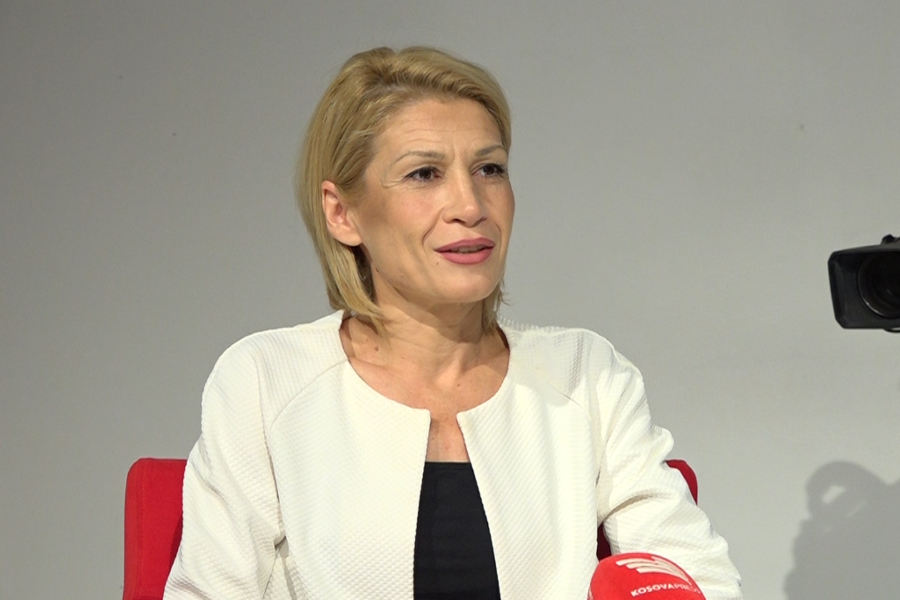
KTV celebrates 25th anniversary, Chief Editor Rexhepi: “We have always delivered only facts”
Kohavision (KTV) today marks its 25th anniversary since its establishment. The television station, which has been characterized by professionalism and accurate reporting throughout this quarter-century, continues to maintain a strong reputation for its journalistic integrity.
Brikenda Rexhepi, the Chief Editor of the KOHA Group, emphasized that facts and truth have always been the priority for KTV.
In an interview with KosovaPress, Rexhepi stated that KTV's influence in shaping public opinion has been significant due to its professional approach and dedication to delivering accurate information to its audience.
"I believe KTV has had a significant impact precisely because of the professionalism it has shown by providing the audience with accurate, professional news and information. By delivering facts, the audience can then make their own decisions about whether something is good or bad. KTV has always brought only facts and respected its audience, never attempting to influence how they think or assess an event," Rexhepi explained.
Rexhepi, who has been part of the KOHA journey since its inception, also mentioned the challenges faced by television stations. She noted that, unlike newspapers, where there is time to write, reread, and analyze news before publication, television is constrained by time and a fast pace.
Moreover, she highlighted that despite the pressure to be the first to publish breaking news, KTV prioritizes the full verification of information before it is broadcast.
"In newspapers, we have the luxury to write, reread, analyze, and consult with colleagues before publishing. On the other hand, television has speed, seconds don't wait. One must be much more cautious about what is said, written, and read. This is perhaps the biggest challenge for TV stations, more so than for journalists in newspapers. But we must adapt and be more careful, always giving priority to confirming the news before it is broadcast. In KOHA, our principle is that if we haven’t confirmed 100% that the news is true, that the event has actually occurred, and that the facts surrounding it are verified, we don’t publish it. We don’t have as much desire to be the first as we do to be accurate," Rexhepi emphasized.
In addition to these points, Rexhepi discussed the impact of technology on transforming journalism. She pointed out that while technological advancements have brought many benefits to the media, they have also created new challenges. According to her, this has led some media outlets to fail to maintain ethical standards in their reporting.
"When you look at the cameras used in the year 2000 compared to the ones used today, the difference is physical and noticeable. But technology has its good side. It has made news gathering, access, and the delivery of information and videos easier. It has its positive aspects. However, challenges exist. One challenge I see in TV stations today is maintaining ethical standards. This also affects social media networks and online media. To reach more people, often journalists and editors are pushed to do something more sensational, which sometimes crosses ethical boundaries that should be respected by all media... Traditional journalism might change its form, but its core principles will always remain universal," Rexhepi stated.
Rexhepi also discussed the competition among online media, which she considers a "legacy" of written newspapers and social media platforms. Regarding social media, she emphasized that they cannot be considered "online media" in the true sense because they are not regulated and do not have editorial responsibility.
"Online media are somewhat the 'heirs' of newspapers. When the Kosovo Press Council was founded 20 years ago, it was established by print newspapers. Gradually, this has evolved into a self-regulating body for online media and portals that are registered and have their own code of ethics, which they have accepted and committed to respecting. Social media platforms, on the other hand, cannot be classified as true online media. Although most media outlets have profiles on social media, there are also profiles that identify as media but are not officially registered as such. The fact that social media lacks regulation makes these platforms less trustworthy in terms of what can be posted and to what extent ethical principles are respected," Rexhepi explained.
Veton Surroi, the founder of "Koha Ditore," established Kohavision (KTV) in 2000 to further enrich the media landscape with one of the first independent TV stations in the country.
Over this quarter-century period, KTV has stood out for its professionalism and commitment to informing the Kosovar public. With a diverse programming schedule that includes news, analysis, and cultural shows, KTV has played a key role in the development of media in Kosovo.