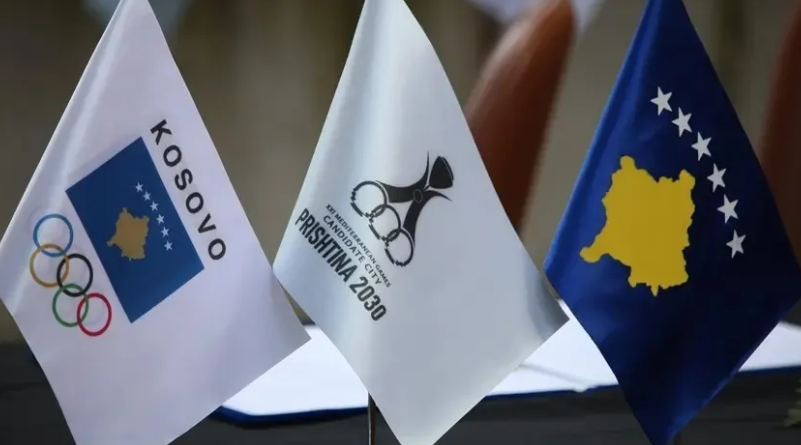
Kosovo’s Parliament adopts Law on the Mediterranean Games
The Assembly of Kosovo has adopted the Law on the Mediterranean Games Prishtina 2030, with 64 votes in favour and none against or abstentions, paving the way for the organisation of this major sporting event in the country. However, the draft law was accompanied by debate and criticism from the opposition, which raised concerns over transparency, accountability, and the management of public finances.
Democratic Party of Kosovo MP Arbnora Salihu expressed concerns regarding the content of the law and the lack of additional institutional reporting mechanisms. She stressed the need for the Organising Committee to report also to the Assembly, given that the main funding comes from the state budget. She also raised the issue of bypassing public procurement procedures, which, according to her, has also been raised by the European Union.
On the other hand, Democratic League of Kosovo MP Adelina Thaqi-Meta highlighted the lack of legal clarity and accountability in the draft law. She referred to remarks from the European Union, stressing concerns about the structure of the governing board and the broad inclusion of government representatives in this body.
“The lack of legal clarity and accountability raises serious concerns regarding compliance with public financial management standards. These are remarks from the EU, which I also highlighted in the previous session, where regarding the governing board they point out that as the highest governing body of the entire project, meaning the OSMG, it was planned to include the entire government, from the Prime Minister’s Office as the lead, which is not seen anywhere else, as well as four ministers,” Thaqi-Meta stated.
Criticism was also raised by PDK MP Arben Mustafa, who highlighted the risk of bypassing public procurement procedures for a significant amount of budget funds. He raised doubts about how these funds would be managed and about the powers granted to the organising body.
“We are talking about a bypassing of public procurement procedures in Kosovo for an amount of 254 million euros of Kosovo’s budget funds. With this law, you are asking MPs to allow you to abandon the procedures established by this Assembly through law for the use of public money, and to entrust it to a body that you as a government will create to determine how these funds will be distributed. I believe this is unfair,” Mustafa said.
Meanwhile, Minister of Sports and Youth Blerim Gashani defended the draft law, stating that public procurement legislation remains fully in force for all expenditures financed by the state budget. He explained that the internal regulations of the Organising Committee are in compliance with the law and are necessary for the organisation of the Games, in line with international standards set by the relevant bodies.
“The procurement law remains fully in force for all expenditures financed by the state budget. The internal regulations of the Organising Committee cannot contradict the legislation in force, and these regulations are necessary and stem from the requirements and standards set for these events by the ICMG, which is the owner of the Games,” Gashani said.
Kosovo secured the right to host the Mediterranean Games 2030 through a decision of the International Committee of the Mediterranean Games, marking an important moment for the country’s sport and international image. The event is expected to be held mainly in Prishtina, with some activities potentially distributed across other cities depending on sports infrastructure.