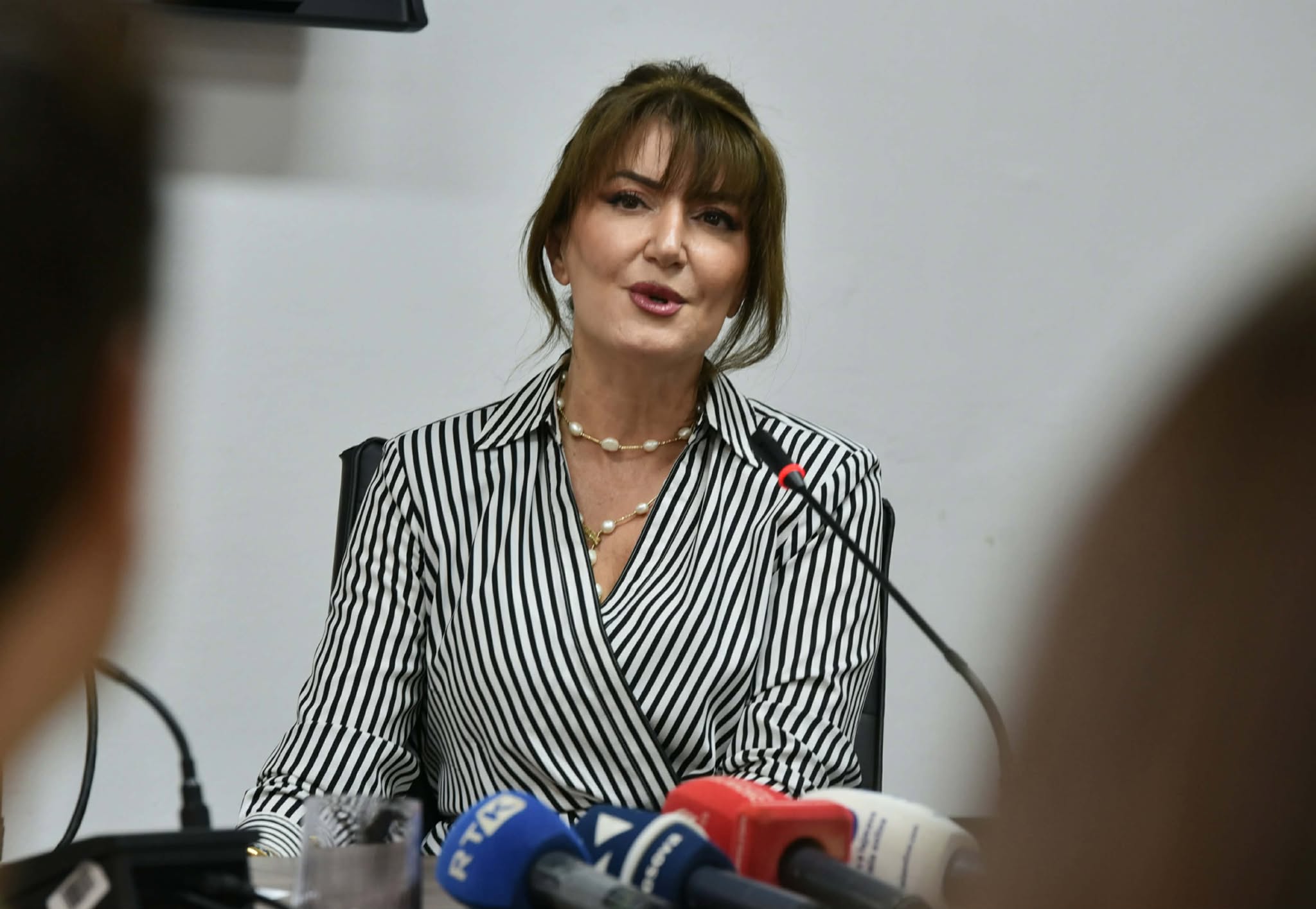
Former President Jahjaga reveals behind-the-scenes details of her election: Kosovo was facing a deep crisis
Former President of Kosovo, Atifete Jahjaga, has shared her experience at the helm of the state, the political circumstances under which she was elected president, as well as the responsibilities she faced during her five-year mandate.
Speaking at the “Prishtina International Summer University” in a discussion on leadership, women’s empowerment, peace, and the role women play in building a stronger future, Jahjaga said that her decision to accept the candidacy for president was not based on personal interests, but rather on the political crisis and the need for institutional stability.
She recalled the circumstances in which she was elected president.
“Between 2010 and 2011, we were facing a very deep political crisis. According to Kosovo’s Constitution, if the president is not elected by the third round of voting, the country automatically goes into extraordinary elections. At that time, within one year, Kosovo was close to entering a third round of parliamentary elections. We were facing a highly polarized political scene in Kosovo, which is normal for the southeastern part of Europe, but the moment Kosovo was in at that time was somewhat different, because we were only in the third year after declaring independence. And some crises, at certain moments, cannot be easily overcome or can have negative consequences for the country’s future,” Jahjaga said.
She explained that, due to political parties’ inability to secure the necessary votes for their proposed candidates, a consensus candidate with integrity and proven experience in public service was sought.
Jahjaga said that her name was included among the candidates because of her long experience in the Kosovo Police.
“Initially, what was required was high integrity, proven through public service, and a clean background. In a way, my name entered among the nominated candidates based on these criteria, because of my proven service in public administration, as at that time I had more than 15 years of experience in public service. I started immediately after the end of the war, as a young law graduate, with the aim of introducing the gender role into a highly male-dominated institution, which was the Kosovo Police. After the war, I wanted to join that organization to initially contribute to the inclusion of women’s roles, because, whether we like it or not, Kosovo has been and, to some extent, continues to be, like many countries in the region, a very patriarchal society, where certain roles and professions were reserved only for men and women had no role in them,” she said.
According to Jahjaga, one of her constant demands was that public and state interests should come before personal interests.
During her mandate, Jahjaga decided that the presidential cabinet should have strong representation of women and young people. Initially, her goal was for half of the cabinet to consist of women, while later their representation reached over 70 percent.
Jahjaga assessed that her mandate also contributed to strengthening the role of women in Kosovo’s institutional and political life.
Atifete Jahjaga was elected President of Kosovo in 2011 and served in this position until 2016. She was the first woman and the youngest person to lead the state of Kosovo.