Inauguration of renovations in social housing buildings in Pristina
“These are apartments for 200 families in total or 790 residents. After the completion of these renovations, the residents will have warmer and safer winters this year. The total investment is €1.24 million, 90% funded by the European Union, for which we thank Mr. Alessandro Bianciardi for his great support to the renovation project. Renovations include roof insulation, wall insulation, replacement of windows and doors, and installation of new heating systems and safety measures. This project is part of a larger €6 million program for 28 social housing buildings in 13 municipalities, benefiting 889 families,” said Kurti.
Kurti explained that renovations in the four buildings included roof insulation, wall insulation, replacement of windows and doors, and installation of new heating systems and safety measures.
Meanwhile, Acting Minister of Economy Artane Rizvanolli said that the four buildings inaugurated today in Pristina are part of a project covering a total of 28 social housing buildings across the country.
She emphasized that the renovation of these social apartments aims to improve living conditions for vulnerable social groups, including social assistance beneficiaries, KLA veterans, single mothers, war invalids, and others.
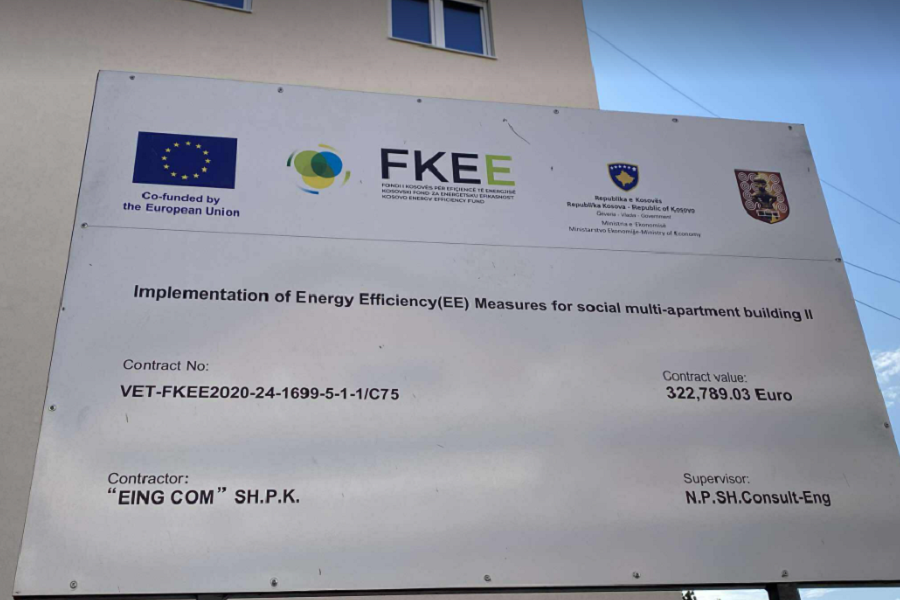
The Energy Efficiency Fund today inaugurated works on multi-family social housing buildings in the Municipality of Pristina, as part of the project
"Implementation of Energy Efficiency Measures in Multi-Family Social Housing Buildings", reports KosovaPress.
The inauguration of renovations took place in four multi-family social housing buildings — two near the Medrese and two in Hajvali.
This project aims to improve housing conditions and reduce energy consumption through efficient measures, contributing to environmental protection and lowering expenses for beneficiary families.
At the inauguration ceremony, Kosovo’s Acting Prime Minister Albin Kurti said these apartments are for 200 families or 790 residents.
Kurti emphasized that the total investment for these buildings is €1.24 million, of which 90% is funded by the European Union.
“The buildings we are inaugurating today in Pristina are 4 out of 28 across Kosovo, and the vast majority — except those in Prizren, which started later — will be completed before this winter… The renovation of these social apartments, which are in 28 locations across Kosovo, is mainly benefiting social assistance recipients, KLA veterans, single mothers, war invalids, and other vulnerable groups. In Pristina, out of the 200 families, 100 are KLA veterans, while the other 100 are vulnerable families,” said Rizvanolli.
From the EU Office in Kosovo, Alessandro Bianciardi said the renovation of the two buildings near the Medrese cost around €650,000 and benefited 100 socially vulnerable families.
He explained that the renovation included thermal insulation of the buildings, installation of energy-efficient windows, a new lighting system, improvements to shared spaces, and replacement of the entrance door.
“The full renovation of these two buildings cost around €650,000, and 100 socially vulnerable families have benefited from this investment. As you have already heard, the investment is 90% funded by the European Union and co-financed 10% by the Municipality of Pristina, implemented by the Kosovo Energy Efficiency Fund. This project is part of the energy support package developed jointly with the government and the Energy Efficiency Fund in early 2023. As we can see, the project has included installation of thermal insulation, new energy-efficient windows, a lighting system, improvements to the building’s shared spaces, and replacement of the entrance door. I am happy that the energy support package is enabling such an important investment for the benefit of citizens, while also advancing Kosovo’s energy transition,” he said.
Bianciardi also said that the renovation of the two multi-family social housing buildings in Hajvali cost around €540,000.
The Director of the Department of Transformations in the Municipality of Pristina, Gëzim Kastrati, said that such projects should continue in the future to improve the quality of life for citizens
“I hope that such projects will continue in the future, improving the quality of life for all citizens of the Municipality of Pristina. We are inaugurating a project or facility that increases energy efficiency, and as such, I believe there will be more projects like this in the future,” said Kastrati.
The Director of the Kosovo Energy Efficiency Fund, Driton Hetemi, said that this institution has been working intensively on numerous projects over the past three years, but those with social impact have special importance.“For the past three years, the Fund has been working intensively on many projects. But when we work on projects with a social aspect, naturally, they make us much prouder, and the satisfaction is doubled. Projects like this, we hope, will continue even more in the future — that’s our goal — and we are also designing them with financial mechanisms and expect to expand them as much as possible,” Hetemi said.