"I sat down and put my head in my hands...": The story of a foreign war photographer in Kosovo
Bodies killed and massacred…
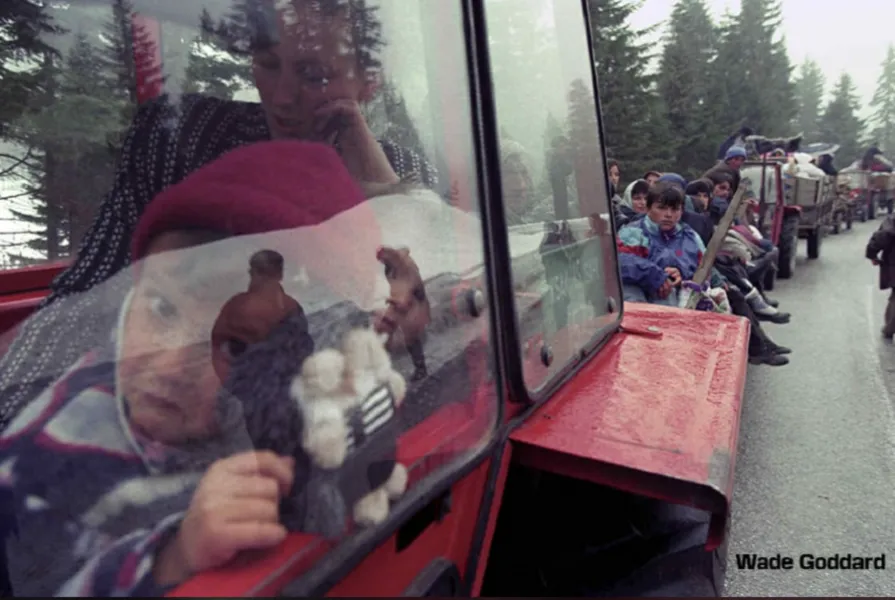
Mothers with children crossing the border without food, without shelter…
The images from the morning of September 26, 1998, in the village of Lower Abri still follow Wade Goddard everywhere — once a war photojournalist.
As a boy watched his murdered family members, Wade Goddard approached and also "put his head in his hands." Through his lens, the atrocities that occurred in Kosovo were documented.
Today, those photographs serve as living testimony to a bloody history.
He reported on the 1998–1999 war for The New York Times and later for Newsweek.
“The first thing that comes to mind is the massacre in Lower Abri. It was so devastating that I couldn’t do what I was supposed to — to take focused photos. I sat next to a local resident and put my head in my hands, wondering who could do such a thing. I had to make a great effort to stand up and take some photos because I knew how important it was to document the events. Normally, when you work with a photo, you focus on the image, but at that moment, I was just taking quick shots and couldn’t focus properly. That was the hardest part. It hurt me deeply to see mothers with children crossing borders without food, shelter, or care,” Goddard told KosovaPress.
In February 1998, he came to Kosovo with journalist Chris Hedges.
Goddard also recalls for KosovaPress his encounter with legendary commander Adem Jashari.
“We didn’t realize until later that it was actually Adem Jashari whom we were talking to. We had a translator, I can't remember who it was. Chris, the journalist from The New York Times, performed an interview with Adem Jashari, and he didn’t want to be photographed, which was inconvenient for me. But in the end, I managed to convince him to at least let me photograph his security detail — and I did. For me, it was like five seconds of work after a whole day getting there, but for Chris, it was very useful,” Goddard recalls.
When remembering Kosovo, what comes to his mind are the murdered children and the images of the suffering population.
“The war was long and had many shocking events. The mass burials of massacred Kosovars always stand out. Finding murdered children in the surrounding forests, such as in Lower Abri, was really shocking. Twenty-five family members were killed, and you could see they had been hiding in the forest around the
village. They were chased by killers who shot at them while they were trying to escape through undergrowth. That was really shocking. There were kids — even a baby had been shot — most of the children were under 11 or 12 years old. That was particularly shocking. The war in general is shocking,” he said.
During NATO’s bombing campaign against Serbian targets, the war photojournalist said he witnessed thousands of refugees being displaced toward Albania and Macedonia.
The New Zealand-born photographer left Kosovo at the end of March 1999 and moved across the borders, where he then documented the mass displacements.