Gender-Based violence: Laws exist, but implementation is insufficient
“Monitoring Institutional Response to Gender-Based Violence in Kosovo (2021–2024)” highlights both legal progress and significant challenges in implementation. According to the report, only 54% of the National Strategy for Protection from Domestic Violence and Violence Against Women has been fully implemented, while institutions often face a lack of training, staff, and coordination.
The findings show that the police, prosecution, courts, social services, and health sector face difficulties in handling cases, affecting adequate protection for victims. The report calls on institutions for greater accountability and full implementation of the Istanbul Convention.
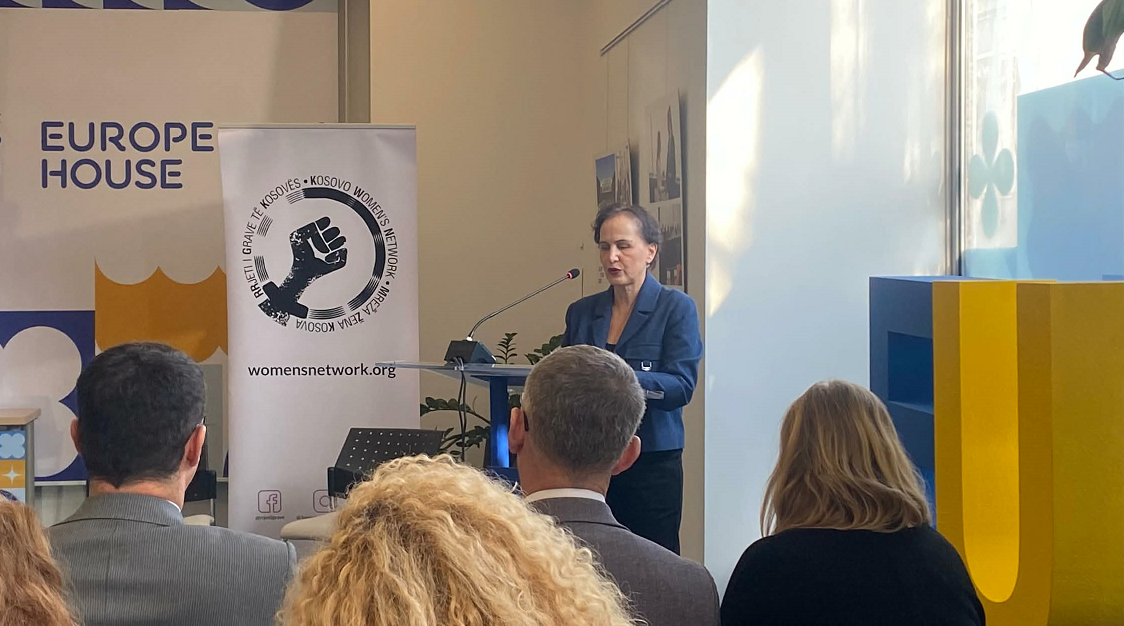
Nermin Mahmuti, Chair of the Board of the Kosovo Women’s Network, stated that the main challenge in combating gender-based violence remains the implementation of laws, especially at the local level, where resources, professional capacities, and institutional coordination are lacking. She emphasized that civil society organizations are the main pillar of the response to violence, often being the first point of contact for survivors by providing emergency support, legal assistance, and shelter. According to her, their contribution has been crucial in identifying gaps, increasing accountability, and promoting reforms.
Mahmuti added that the financial sustainability of NGOs remains a serious challenge, while procedural delays, light sentences, and weak enforcement of protective orders continue to undermine citizens’ trust in the justice system.
“The main challenge remains implementation, which is present in this field as in others, and institutional response continues to be especially weak at the local level, where resources, professional capacities, and effective coordination are lacking… In this context, civil society organizations are a pillar of the response to gender-based violence. They are often the first point of contact for survivors, providing emergency support, legal assistance, shelter, and building trust between communities and institutions. The contribution of the network has been crucial in identifying gaps, increasing accountability, and shaping reforms… In the last year, financial sustainability of civil society organizations, not just the network, remains a serious challenge… So, although there have been improvements in the justice system, procedural delays, light sentences, attempts at reconciliation, and weak enforcement of protective orders continue to undermine citizens’ trust,” she said.
Meanwhile, within the report, Rita Glavitza, Head of the Austrian Development Agency Office, acknowledged developments enabled by institutions and civil society, but noted that much work remains to strengthen this area.
“This report presents the progress made by institutions, such as the Ministry of Justice, in improving the legal framework and mechanisms for preventing and addressing violence. I want to emphasize the importance of civil society in driving this process, including the Kosovo Women’s Network. Change usually comes from civil society and its push for reform. Even though many steps have been taken in the right direction, much remains to be done to achieve practical and real-world tolerance, including further strengthening knowledge and capacity within institutions, so that gender-based violence can be addressed and a victim-centered approach ensured.”
Besarta Breznica, Official of the Program for Addressing Gender-Based Violence, explained that gender-based violence includes domestic, physical, sexual, and psychological violence, primarily affecting women, as a result of gender norms and power inequalities.
She emphasized that since 2020, the Istanbul Convention has been part of Kosovo’s Constitution, which has prompted significant changes in primary and secondary legislation to address this phenomenon.
“Gender-based violence refers to any form of violence that occurs against a person because of their gender. It includes domestic violence, physical and sexual violence, as well as psychological violence. We know that this violence affects women the most, with men being perpetrators due to existing gender norms and power inequalities. Since 2020, Kosovo has incorporated the Istanbul Convention into its Constitution, which has in turn compelled us to revise all laws, both primary and secondary,” she said.
In this context, civil society organizations, including the Kosovo Women’s Network, continue to play a key role as the first line of response to gender-based violence, providing emergency support, legal assistance, and shelter for survivors, as well as promoting institutional accountability and reforms.
The report also emphasizes the need to strengthen institutional capacities and fully implement the Istanbul Convention, which has been part of Kosovo’s Constitution since 2020.