From the small booth to the hearts of sports fans, these are the behind-the-scenes moments of a commentator’s work
Interviews
Read in: 4 min.
1 year ago
Link copied
Sports commentary is not just a voice over the game; it is an art that requires preparation, concentration, and great passion. The work of a commentator makes you face challenges, responsibilities, and emotions that accompany this dynamic profession.
From the small broadcast booths to sleepless nights with matches that last for hours, these are just some of the hardships faced by those who choose this profession.
One of Kosovo’s sports commentators, Gramos Pylla, in an interview with KosovaPress, talks about the seriousness and responsibility that the work of a commentator demands, especially during live broadcasts. According to him, mistakes have no place because, unlike studio work, there is no chance for a redo or editing there.
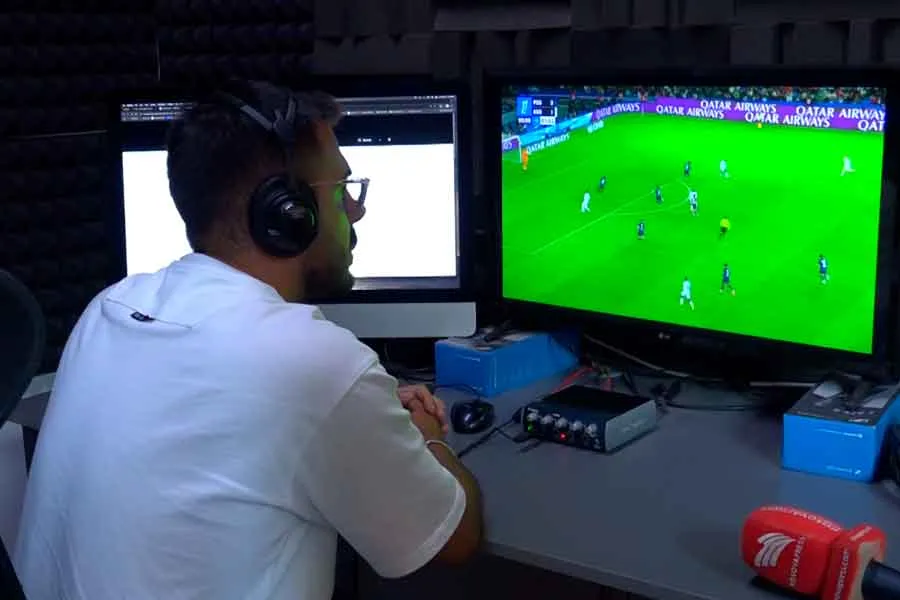
“Absolutely, especially in the first months, because now commentary and live broadcasts are work with a lot of responsibility. The margin for error is very small, if not zero, because those mistakes cannot be corrected like in different studios where recording is done and some sequences can be replayed. It has been challenging because of the flow of speech, rhythm, emotions, the environment... Booths are usually small, some a bit bigger to give the impression you are in a closed space, but when you put on the headphones and enter the atmosphere of the game, it feels like you are actually in the stadium or at the event of whichever sport you’re commentating. It has been challenging, but as I emphasized, we had very professional people behind us. Like any commentator starting out, there is a margin where you can make mistakes in some situations, but with experience, all this is learned,” Pylla says initially.
Talking about preparations before a match, Pylla explains that the commentator’s work begins well before the game starts.
"Usually, when we have a broadcast during the day, we prepare one and a half, maybe two hours earlier, coming to this part you see here. This is the booth; we have a laptop or a computer where we start searching for the latest information because most matches provide key basic info an hour or two before the game—like which players are available, who will play, who might be injured during training, along with basic statistics, rankings, points, wins. We can even prepare some of this in advance at home. But the idea is to enter with almost complete information that you will feed to the viewer throughout the ninety minutes,” Pylla explains.
One of the most common questions he is asked is how he identifies the names of the players on the field. Pylla clarifies that memorizing players’ names comes naturally since many teams are commentated on regularly throughout the year, and their names become part of the commentator’s daily routine.
“People often ask me, ‘Do the names appear down there?’ or ‘How do you remember all these names?’ As I said, there are about three hundred broadcasts that an average commentator on a platform can cover in several sports… When you have three hundred matches a year, almost eighty percent of the days in the year, it’s very difficult not to remember all those players. But let’s not forget that matches start to repeat. For example, a team might come up that you comment on twelve, fifteen times a year, and it’s impossible not to learn all the players’ names,” Pylla reveals.
When discussing impartiality, Pylla admits that commenting on teams he supports requires a high level of professionalism. If he feels this might affect his objectivity, he prefers to ask not to comment on that match at all.
“In international football matches, I have often had the chance to comment on both the national team I like and the club team I support. The idea is not to transmit the fan’s side to the viewer. I don’t have a problem with this; when I enter this booth, I enter my profession and try to maintain professionalism at the highest level. The moment I couldn’t comment on a team I sympathize with, I would communicate with our responsible team and ask not to do it because otherwise, I might sound like a fan of that team,” Pylla declares.
Finally, he talks about the physical and mental challenges that come with matches that go into extra time, especially those played past midnight. Despite being tiring, Pylla says that the final emotions of the matches and the high pace keep the commentator alive until the end.