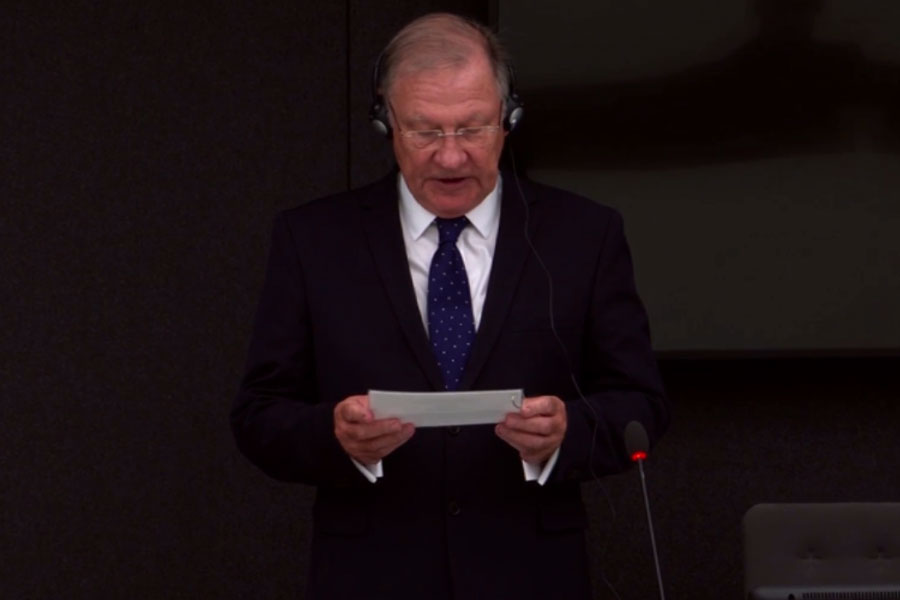
Former British diplomat speaks in The Hague about his role in Kosovo
Former British diplomat John Stewart Duncan, who in the 1990s served as political adviser to Wesley Clark, then NATO commander, spoke at the beginning of his testimony before the Kosovo Specialist Chambers in The Hague about his role in Kosovo.
He said his duty was to inform Clark—the general who led the 1999 bombing campaign against Serbian targets.
Duncan is answering questions from the defense of Hashim Thaçi, led by lawyer Nina Tavakoli, and stated that his work also covered the Kosovo Liberation Army (KLA).
“I focused on briefings, informing General Clark at 7:30 a.m. It took me 45 minutes to drive to where he was. Usually, I would wake up, go online, read all the information I could find on the internet about what had happened in the last 24 hours in Kosovo. Then I would listen to the latest news, get in the car, listen to the BBC while driving, and when I arrived at the office, I read all the diplomatic cables exchanged overnight, monitoring reports that might have identified things not reported in the news, and all intelligence assessments. At the meeting, I briefed General Wesley Clark, and together we would then inform operational commanders on the ground via video link. During the day, I read incoming cables, spoke with contacts, journalists, NGOs, various organizations, and individuals to gather as much information as possible to create a clear picture of what was happening,” he said.
At the start of his testimony, Duncan, who also served in Albania after the fall of communism, spoke at length about the Albanian population.
“The international community found it very difficult to understand in detail the characteristics of Albanians. Their assessments were often far from the truth, and this matters when dealing with people simply trying to defend themselves… I explained the dominant characteristics of ethnic Albanians. It’s not important here to distinguish between Albanians from Albania and those from Kosovo,” he said.
“The Albanians of Kosovo were part of an apartheid system under Milošević. They were excluded from participation in government and public services, and all this eventually led to the ethnic cleansing we all witnessed,” he added.
His testimony comes after former U.S. Assistant Secretary of State James Rubin and former legal adviser to the Kosovo delegation in the Rambouillet negotiations, Paul Williams, were heard at the Kosovo Specialist Chambers in The Hague.
The defense’s presentation of evidence began a week ago, on September 15. Thaçi’s defense plans to present a total of 11 witnesses, after which two more witnesses called by Jakup Krasniqi’s defense are expected to testify.
The defense evidence presentation is expected to conclude by mid-November, and the trial chamber expects the defense teams to submit their final briefs by December 22 of this year.
Hashim Thaçi, Kadri Veseli, Jakup Krasniqi, and Rexhep Selimi are accused of alleged war crimes. They have been in detention since November 2020.