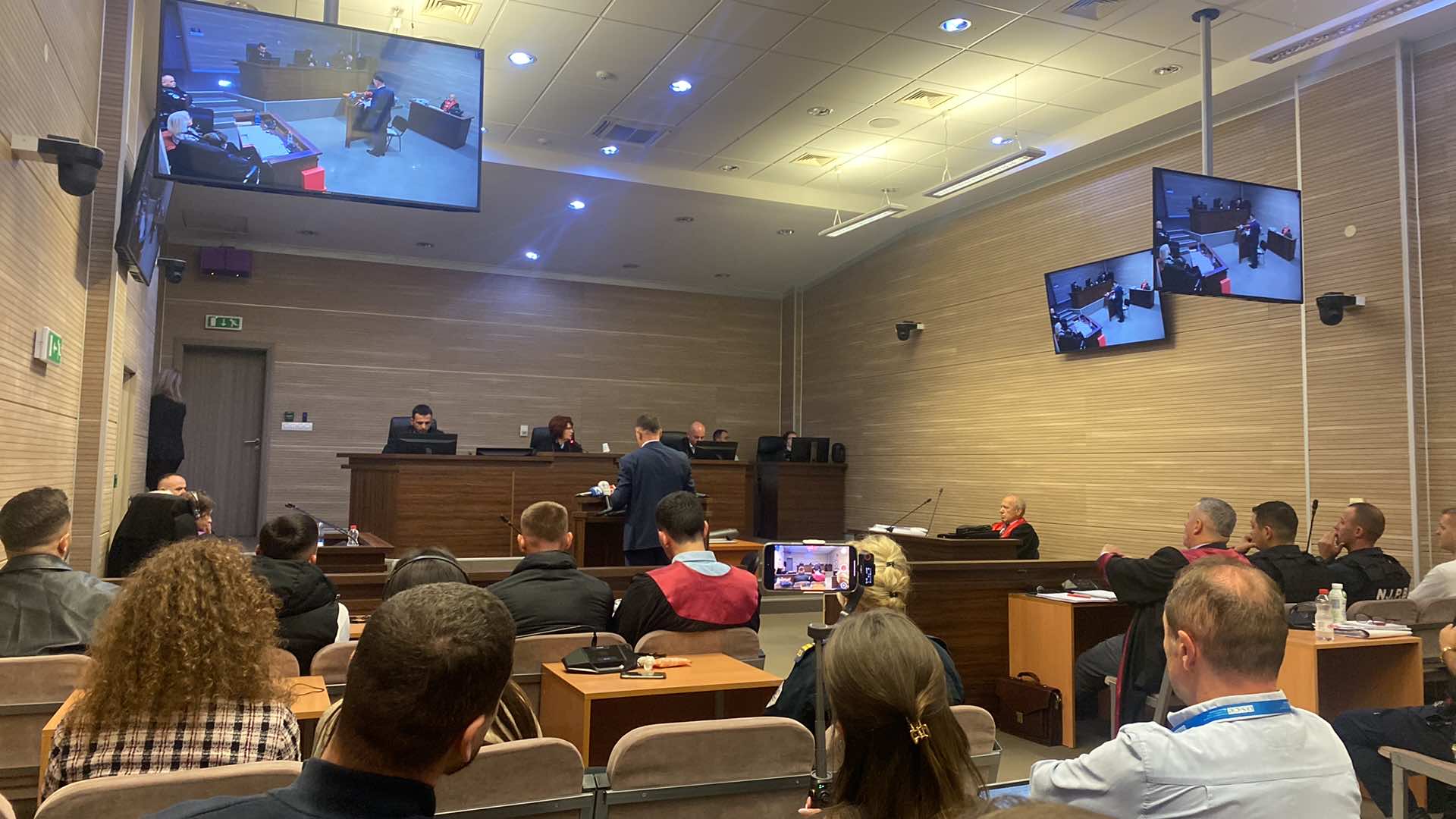
At the Basic Court in Prishtina, the trial for the murder of Liridona Ademaj continued, where forensic medicine expert Naim Uka gave his testimony. He clarified that the wound that took the victim’s life was caused by a close-range gunshot, at a distance of two to five centimeters, categorically excluding the possibility of suicide.
In the session, three defendants appeared in custody: Naim Murseli, the victim’s husband and suspected organizer of the murder, Kushtrim Kokalla, and Granit Plava, suspected as the executor.
Expert Uka provided details about the fatal bleeding and the hematoma on the victim’s left hand.
“During the examination of the entry wound, we observed the presence of gunshot residue around the entry hole, which caused skin burns with the presence of powder particles. Based on these forensic medical findings, it was determined that the shooting distance ranged from 2 to 5 cm, excluding the possibility of close-contact or half-contact shooting due to the absence of barrel imprints around the entry wound. The wound was described as triangular, accompanied by multiple bone fractures and surrounding soot,” he said.
The prosecution, Javorka Përlinnçeviq, asked the forensic expert whether the examinations exclude the possibility of suicide.
Later, Uka ruled out the possibility that Liridona Ademaj had committed suicide.
“In similar cases, when preliminary data from the crime scene are missing, detailed examinations of the hands of the deceased are conducted. In this case, we examined both hands to determine, based on the presence or absence of gunshot residue and blood spatter, whether the deceased had used any weapon or caused suicide. The absence of pressure marks on the index finger is further evidence supporting this conclusion and leaves no doubt about any other possibility,” Uka stated.
During his testimony regarding the autopsy report of Liridona Ademaj, Uka, who prepared the report, also shared details about the wound that caused her death.
“During the forensic autopsy procedures, an entry wound was observed on the right side of the head, caused by the dynamic action of the bullet. It is important to note that part of this bullet was found on the left side of the head, which was submitted as evidence according to the chain of custody to the investigating police officers. As a result of this wound, internal and external bleeding occurred, which led to death,” he emphasized.
During the questioning of the forensic doctor from the Institute of Forensic Medicine, Naim Uka, the prosecution asked for clarifications about a blood accumulation (hematoma) the deceased had on her left hand.
“On page 7, in the last paragraph regarding the extremities, you were asked about a large blood accumulation or hematoma measuring 6 by 1.5 cm. Can you clarify?” she asked.
Regarding this wound, the forensic doctor, Naim Uka, said that during the examination of the deceased, Liridona Ademaj, a subcutaneous hematoma was observed on the left arm.
He stated that the size of the hematoma was 6 by 1.5 centimeters and could have been caused before or during the victim’s murder.
“During standard forensic procedures, besides lethal wounds, all other possible injuries are examined. In this case, during the external examination, a subcutaneous hematoma measuring approximately 6 by 1.5 cm was observed on the upper outer left arm. This hematoma was described as red and blue in color. According to forensic literature and practice, this hematoma was caused before or during the murder of the deceased… the autopsy shows that the subcutaneous hematoma was caused by the moment of the murder and up to 24 hours before, with high probability, or based solely on the red coloration, no more than three hours before the murder… the injury in this area, based on its characteristics, was caused by the action of a blunt, not sharp, object without edges or tip,” he declared.
Besides the prosecution, the family’s defense lawyer, Leutrim Syla, asked the forensic doctor whether the hematoma on the deceased’s left hand could have been caused by a hand. The forensic doctor did not exclude this possibility, saying that a hand cannot be ruled out as the instrument that caused the injury.
The defendant himself, Naim Murseli, also questioned forensic doctor Naim Uka. He asked whether the autopsy report indicates that he had held the deceased, Liridona Ademaj, by the hand to prevent her from avoiding the bullet.
“Normally, I do not even need to ask, as I do not believe a mark on the hand could have been caused by a hand that was not present at the moment of the murder. However, the prosecution claims in its indictment that this mark was caused by me because I allegedly held my wife to prevent her from avoiding the bullet. Does your report confirm that I held my wife at the moment of the murder?” he asked.
Later, Uka said that a forensic doctor does not pre-judge positions or situations that may have occurred at the moment of the murder.
“The forensic doctor’s duty is to make a clear description of every bodily injury, describing the characteristics of injuries based on which forensic evidence is interpreted… Therefore, it is normal that such assumptions are not included in the autopsy report,” he said.
The former husband of the deceased, Naim Murseli, accused of planning the murder of his wife, asked whether the wound on the left hand could have been caused during an attempt to escape.
“I cannot exclude it, nor is it my duty to do so,” he added.
At the end of his testimony, Naim Uka, forensic medicine expert at the Institute of Forensic Medicine, said that the direction of the shot toward Liridona Ademaj is confirmed by the same direction of blood flow on the left side of her body.
“I would like to add that, in addition to the injuries elaborated during this session, based on the crime scene observation, the direction of the shot is confirmed by the same direction of blood flow on the left side of the deceased’s body,” he declared.
After the completion of the forensic expert Naim Uka’s testimony, in the afternoon session of the trial for Liridona Ademaj’s murder, witnesses Jeton Binaku, Naim Sadiku, and Hasan Hasanaj will be heard.
Meanwhile, in the previous session, psychiatric experts who conducted psychiatric evaluations of the defendants Naim Murseli and Granit Plava testified.
The experts stated in court that no mental health disorders were observed in Naim Murseli, neither permanent nor temporary.
Liridona Ademaj was killed on November 29, 2023, in the village of Bërbicë in Prishtina. According to the prosecution, the incident was staged as a robbery, and the murder is suspected to have been planned, with Granit Plava as the executor and Naim Murseli as the organizer.