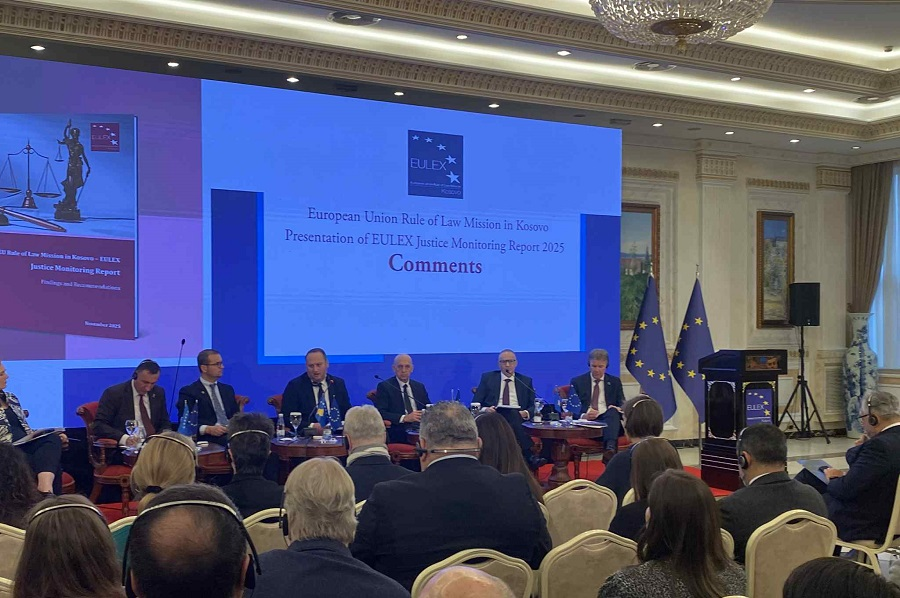
EULEX: Challenging, high-profile justice cases remain stalled
The Kosovo justice system continues to be challenged by high-profile cases that have been stalled for years, and some have not reached the verdict phase even a decade after the crimes were committed. This is stated in the 2025 Justice Monitoring Report published today by the European Union Rule of Law Mission in Kosovo (EULEX). The report highlights concerns over the non-application of supplementary sentences as well as the frequent use of pre-trial detention.
The Head of the EULEX Mission in Kosovo, Giovanni Pietro Barbano, stated that this latest report emphasizes their support for the Kosovo justice system as it develops toward European standards, which include stability, democracy, and accountability.
“The key findings of this year’s report come from monitoring and implementation activities. The focus remains on areas where gaps persist and development is still needed. Systemic monitoring seeks trends and patterns that impact the justice system as a whole. Thematic monitoring, on the other hand, focuses on specific types of crimes, such as gender-based violence, and the management of cases and the information system. Some findings refer to challenges identified in previous EULEX reports, while others focus on other topics,” he said.
The main findings of this report were presented by the Head of the EULEX case monitoring unit, Hubert van Eck Koster, who noted that high-profile cases have been stalled for years.
Koster emphasized that the Kosovo justice system has made slight progress in the productivity of court sessions, while gaps remain in the non-application of supplementary sentences.
The report also highlights concerns about arrests made by the Kosovo Police without a warrant and without the knowledge of the State Prosecutor, as well as threats directed at prosecutors.
The EULEX report notes that there has been progress in scheduling court sessions more frequently in certain cases, and in cases of domestic violence there has been improvement and stronger engagement.
“The handling of high-profile cases, mostly involving high-profile defendants, shows certain positive developments in some cases. Courts have increased the scheduling of consecutive hearings in some long procedures, which have advanced and reached verdicts. However, the overall picture remains challenging. Many high-profile cases have been stalled for years, and some have not reached the verdict phase even a decade after the crimes…. Regarding repeated trials and court session productivity, there has been slight progress since last year. Of all sessions observed between mid-2024 and 2025, around 285 were unproductive or canceled, and in high-profile cases this percentage was 35%…. In the application of supplementary sentences… in the cases reviewed by the mission, we identified judgments where supplementary sentences were not applied even though they are legally required, and in some cases the conversion of prison sentences into fines has effectively prevented the application of these supplementary sentences. There still lacks a unified and well-coordinated system,” he said.
The findings of this year’s justice system report by the heads of these institutions were considered helpful for achieving efficient justice.
Acting Chief State Prosecutor Besim Kelmendi stated that reports like today’s EULEX report improve their work, although according to him, only 92.5% of cases received this year have been completed.
He also noted that challenges for the prosecutorial system remain in cases inherited from international missions and the small number of prosecutors.
“In recent years, the prosecutorial system has made significant achievements despite some cases we are trying to improve… it is always challenging for us given the large number of cases inherited from our international colleagues UNMIK, EULEX, and post-war cases… Just this year, we have managed to complete 92.5% of all cases received during this year… The number of prosecutors compared to the cases received is roughly what we wanted, but given the increasing number of daily court sessions, it is truly insufficient, and the lack of budget allocation to increase the number of prosecutors has harmed us greatly,” he emphasized.
Meanwhile, the Chair of the Kosovo Judicial Council, Albert Zogaj, agreed with the report’s findings regarding the judiciary, noting that pre-trial detention is applied extremely frequently.
“We acknowledge the report’s assessment that the dynamics of cases in the Special Department at the first instance level have not been the same, and this requires internal addressing because in high-profile cases the dynamics have not been comparable to other cases, even though case completions in 2024-2025 are increasing… The application of supplementary provisions is, as we have also identified, a critical point for the judiciary, and we have a decision for an extraordinary report on the executive system within the judiciary; the report is nearly complete… Pre-trial detention is also a challenge; we have addressed this in the extraordinary report, and I believe that in discussions in January with the Supreme Court, a guideline will emerge on pre-trial detention because the number of cases where this measure is applied is extremely high, and its impact on human rights and the KJC budget is significant,” he emphasized.
The 2025 Justice Monitoring Report by the European Union Rule of Law Mission in Kosovo (EULEX) is the eighth report produced by the mission since 2018. The report is based on monitoring around 400 court sessions and collecting data from the police, judicial officials, members of the Bar Association, and civil society.