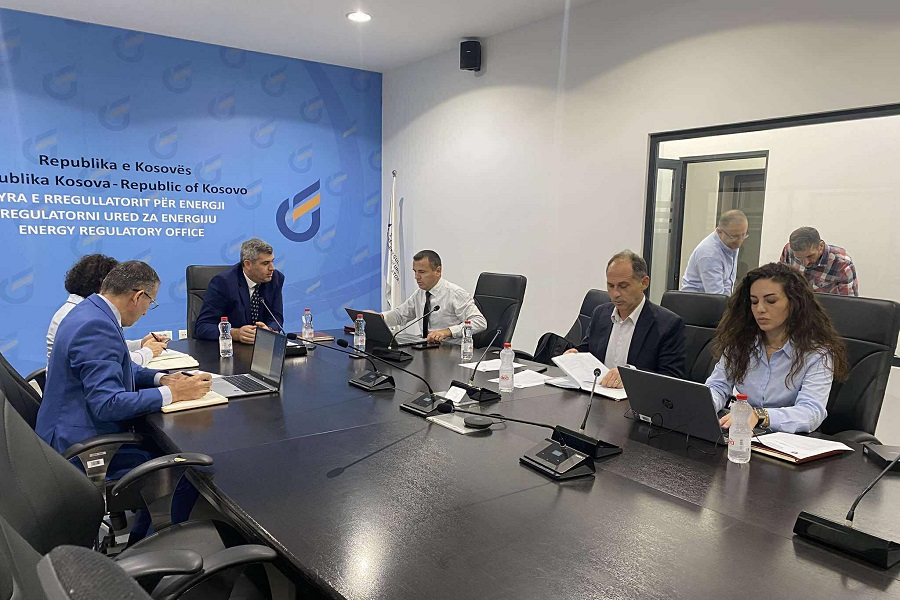
ERO: The possibility of reviewing electricity tariffs again in December is not excluded
The Energy Regulatory Office (ERO) does not rule out the possibility of reviewing new electricity tariffs by the end of the year.
According to the chair of ERO, Ymer Fejzullahu, the tariff review could include either an increase or even a decrease in electricity tariffs, depending on the cost of the system.
Fejzullahu made these comments after the meeting of the ERO Board, where he emphasized that electricity consumption has increased among a large category of consumers.
“Unfortunately, we have seen an increase in consumption among a large category of consumers, and at the same time, there has been an overrun of the projected import costs compared to the estimates made during the tariff review process. All our licensed operators have exceeded the purchase cost of electricity for the period under discussion compared to the forecast, since prices in regional markets have turned out higher, both in volume and price, than predicted during last year’s tariff process. That process began in December and ended in mid-April. There is a possibility that the next tariff review will be in December of this year. The ERO staff will then review the system’s costs. Depending on the system’s cost, there may be increases, but a reduction is not excluded either if there are savings. It is not necessarily an arbitrary increase or decrease—it depends on the system’s cost,” declared Fejzullahu.
In April this year, ERO had decided to raise electricity tariffs by 16.1%, a decision that came into effect on May 1.
Regarding the liberalization of the energy market, Fejzullahu emphasized that there are now more than five suppliers with whom businesses have signed electricity supply contracts.
He stated that 40% of businesses included in the liberalized energy market are supplied with electricity by KEK.
“The number of suppliers who have signed contracts with businesses that, according to the law, are obliged to enter the free market is more than five. In today’s meeting, we had three requests for supply licenses, as well as two reciprocal supply licenses through memorandums of understanding signed with Albania and North Macedonia. The sole purpose is to provide additional opportunities for businesses to sign contracts with these suppliers, with the hope of offering better prices in the future and increasing the number of suppliers. Around 40% of businesses are supplied by KEK,” said Fejzullahu.
Speaking about court rulings related to the liberalization of the energy market, ERO’s chair Ymer Fejzullahu said they would respect these rulings not out of preference but as a legal obligation.
“ERO will respect every court decision, and it has respected every court decision. Regarding rulings on market liberalization, both past and future, we have complied and will comply with all of them. We call on businesses to understand this—not because we want to, but because it is a legal obligation for our institution. None of these rulings are final; the criteria are defined in the law,” stressed Fejzullahu.
According to him, the decision to liberalize the energy market for businesses with over 50 employees and over €10 million turnover was taken one year ago, with an additional three-month grace period granted to businesses to prepare for the process.
“The decision was made one year ago when we set the tariffs until March 31. The ERO’s latest decision to extend regulated tariffs for this category of consumers was valid until March 31, 2025. The ERO Board, with the aim of preparation, gave an additional two months until June 1 so businesses could prepare. There were doubts about whether there would be another extension this year, even though we warned them last year that, according to the decision, these businesses would be supplied with regulated tariffs only until March 31, 2025,” said Fejzullahu.
“ERO is not acting out of desire—it is legally obliged, based on commitments it has made in relation to EU institutions,” he declared.
The chair of ERO also told journalists that more than 90% of consumers in northern Kosovo are supplied at market tariffs.
At today’s meeting, the ERO Board approved several requests for licenses and authorizations for supply, generation, and self-consumption of electricity.
The ERO Board approved licenses for electricity supply activity for the companies Norwegian PX Kosovo Sh.P.K., BE Power Sh.P.K., and Energy for Change L.L.C. It also granted authorization for construction to Lindja Solar L.L.C., with a capacity of 100 MW in the cadastral zone near Rahovec.
During this meeting, dozens of requests for self-consumption authorizations for companies and individuals were also approved.