Domestic violence alarming in Kosovo: 75% of victims are women
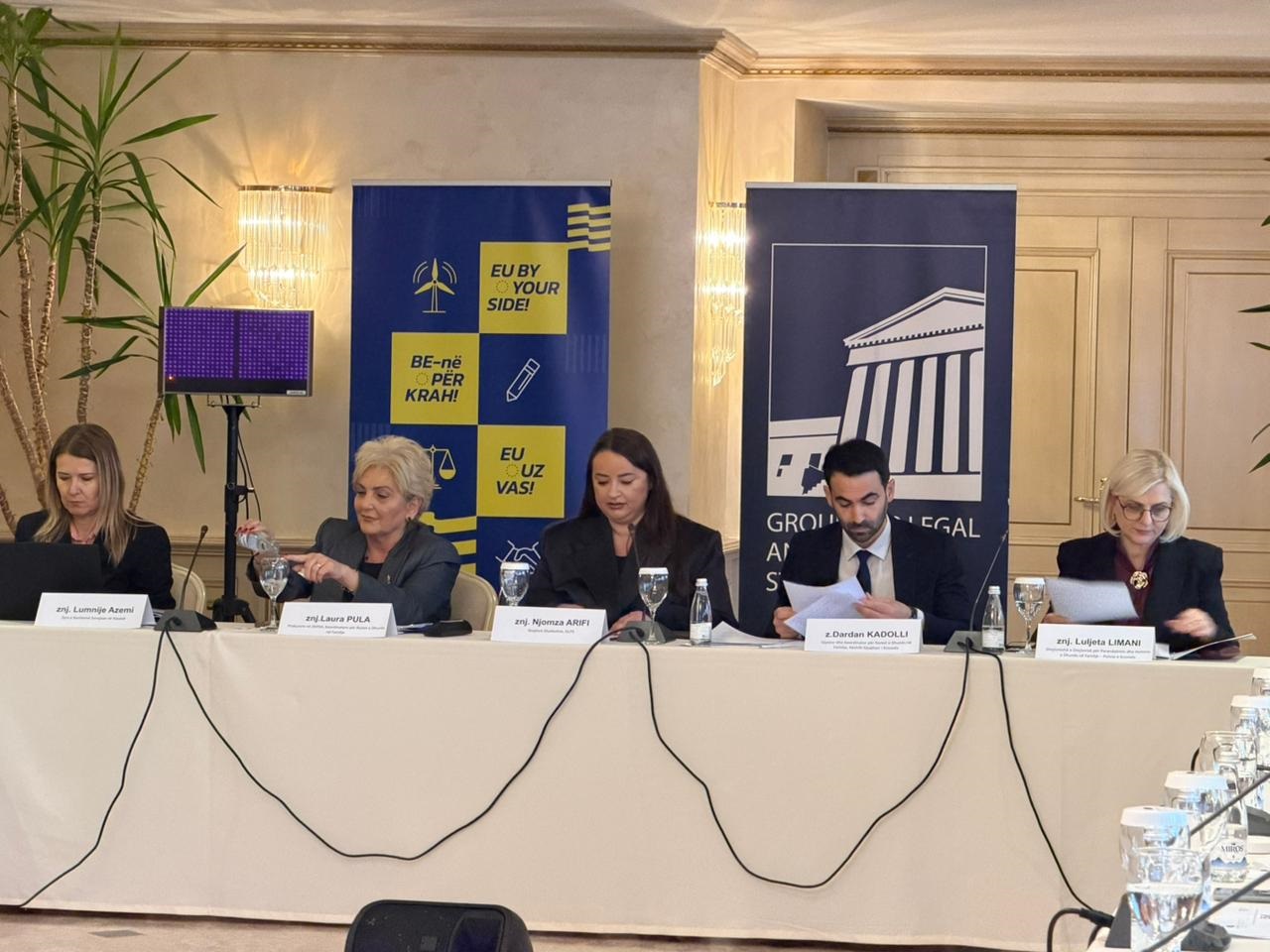
Domestic violence continues to remain a concerning phenomenon in Kosovo, while in 75% of cases women are the victims. This was stated at a roundtable organized by the Group for Legal and Political Studies (GLPS) on the topic “An assessment of the institutional handling of domestic violence cases: How were they treated during 2025?”.
Prosecutor Laura Pula considers domestic violence a serious challenge for the rule of law.
The coordinator for domestic violence within the Office of the Chief State Prosecutor stated that the institutional response to this phenomenon is not only a legal obligation, but also a moral and state responsibility.
“I consider domestic violence to be one of the most serious challenges to the rule of law and a real test for the functioning of criminal justice in any democratic society. We all agree that it does not happen in public spaces, in halls, it is not carried out in front of cameras; it happens in silence behind closed doors, where the victim often remains alone facing fear, pressure, and ongoing violence. Therefore, institutional response to domestic violence is more than necessary, and it is not only a legal duty but also a moral and state obligation. We can say that in Kosovo, the prosecution represents the key mechanism of state response, together with the Kosovo Police,” she said.
Although the justice system has made improvements in handling domestic violence cases, according to the executive director of GLPS, Njomza Arifi, there are still challenges.
“Domestic violence continues to be a concern in Kosovo and most victims are women. These are also the findings of our report. Although there have been improvements over the years in terms of how domestic violence and gender-based violence cases are handled by the judicial and prosecutorial system, there are still structural problems and challenges that require further attention both from the system and from other institutions,” she said.
Meanwhile, project manager Liridon Salihi stated that the most widespread form of domestic violence is violence against women, which accounts for 75% of cases.
According to him, the implementation of existing legislation remains a challenge.
The report states that the highest number of reported domestic violence cases comes from the Pristina region.
“The main finding of this report is that domestic violence remains a concerning phenomenon affecting all age groups in society, from children to elderly persons. The most widespread form of domestic violence is violence against women. The data show that around 75% of domestic violence victims are women, while 25% are men. Kosovo has a consolidated legal framework for the protection and prevention of this phenomenon. The main challenge remains the practical implementation of existing legislation,” he stressed.
The report also shows that sentencing policy remains challenging, with only 14% of cases resulting in cumulative punishment.
According to Salihi, another challenge for the judiciary is court hearings cancelled due to the absence of defendants.
“What remains challenging is sentencing policy. Around 87% of indictments filed by prosecutors are confirmed by the courts and result in convictions, which shows a high efficiency of indictments brought by the State Prosecutor. As for the courts, only 14% of defendants receive cumulative punishment, meaning both a fine and a prison sentence, as foreseen by the Criminal Code of the Republic of Kosovo,” he said.
Representatives of the Kosovo Judicial Council also attended the roundtable, stating that courts treat domestic violence cases with urgency.
The GLPS report on the handling of domestic violence cases shows that the most affected age group is 20–50 years, while in 50% of cases domestic violence occurs between couples, without excluding other family relationships.
The report “An assessment of the institutional handling of domestic violence cases: How were they treated during 2025?” is supported by the European Union Office in Kosovo, and covers domestic violence cases from 1 January to 31 December 2025.