Cuts in USAID funding affect civil society in the region
The freezing of programs by the United States Agency for International Development (USAID) by the American administration has had a significant impact on the six countries of the Western Balkans.
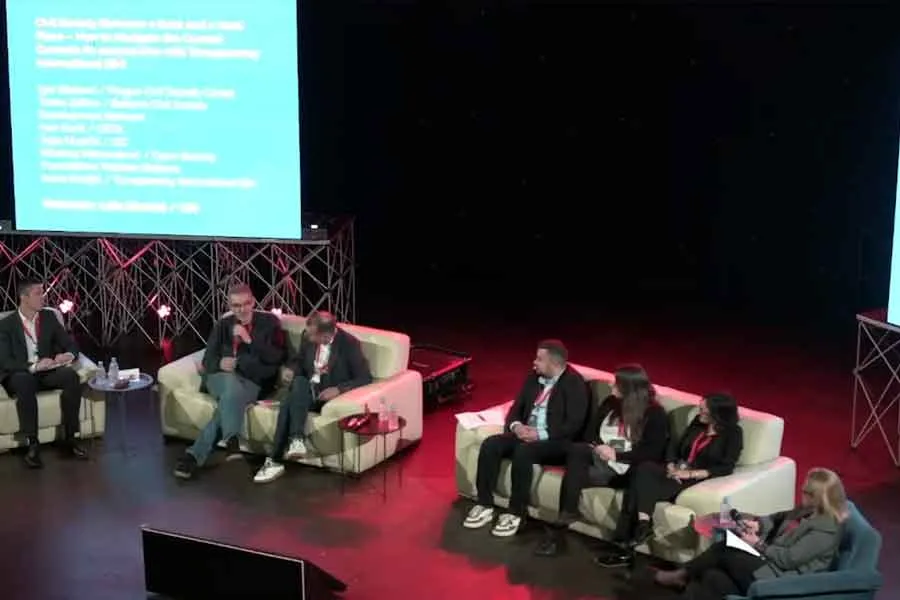
This was stated during the panel “Political Accountability and New Technologies,” held as part of the regional POINT 13 conference in Sarajevo.
Toshe Zafirov from the Balkan Civil Society Development Network said that civil society in the region has seen several negative trends in recent years.
According to him, the freezing of funds by the U.S. in the Western Balkans has also affected NGOs, with the biggest impact seen in Serbia, Bosnia and Herzegovina, and Albania. Regarding Kosovo, he noted that there is no precise data available.
“For some time now, the Balkan civil society network has been monitoring civil society and we've noticed several negative trends in the past and in recent years. One of them was what happened at the beginning of 2025 – the freezing of programs by the U.S. in the Western Balkans. The most affected countries [by this decision] were Serbia, Bosnia and Herzegovina, and Albania. We have data particularly focused on Serbia. According to data published by USAID, the amount cut – especially in Serbia – exceeded 53 million dollars... North Macedonia was not as heavily affected, but there are still many important programs for the country, such as the fight against corruption, which has also been frozen. If there are colleagues here from North Macedonia, correct me, but I believe that more than 4 million euros were cut, while the least affected country was Eastern Montenegro due to the fact that USAID’s program is not developed there; it is a bilateral cooperation,” he said.
The importance of USAID funding for the Western Balkans was also emphasized by Igor Blažević from the Center for Civil Society in Prague. However, he said the current geopolitical reality is not only about civil society but also about democracy and peace.
“This is not just about civil society – it’s about democracy, it’s about Europe, it’s about peace. If you want to talk about world order, we’re no longer in an order – we’re in complete disorder. So, it goes much deeper than just civil society. Also, it’s not just about USAID. In a way, we’ll talk about it and we’re all concerned, but it’s not what really matters. USAID is a wake-up call for all of us – I studied philosophy – from the dogmatic sleep that we, as civil society, have been in for quite some time now, following a lack of activity, after the theories of change of the 90s... First of all, as mentioned, the geopolitical landscape is completely different. Today, autocrats support other autocrats. Democracy no longer offers support. International institutions no longer function – they claim to serve the public interest, but they don’t,” he emphasized.
Upon taking office in January 2025, U.S. President Donald Trump shut down the United States Agency for International Development (USAID), eliminating the vast majority of the agency’s programs, while the remaining ones will be transferred under the authority of the State Department.
—
KosovaPress