Climate change is imposing “Green Construction”
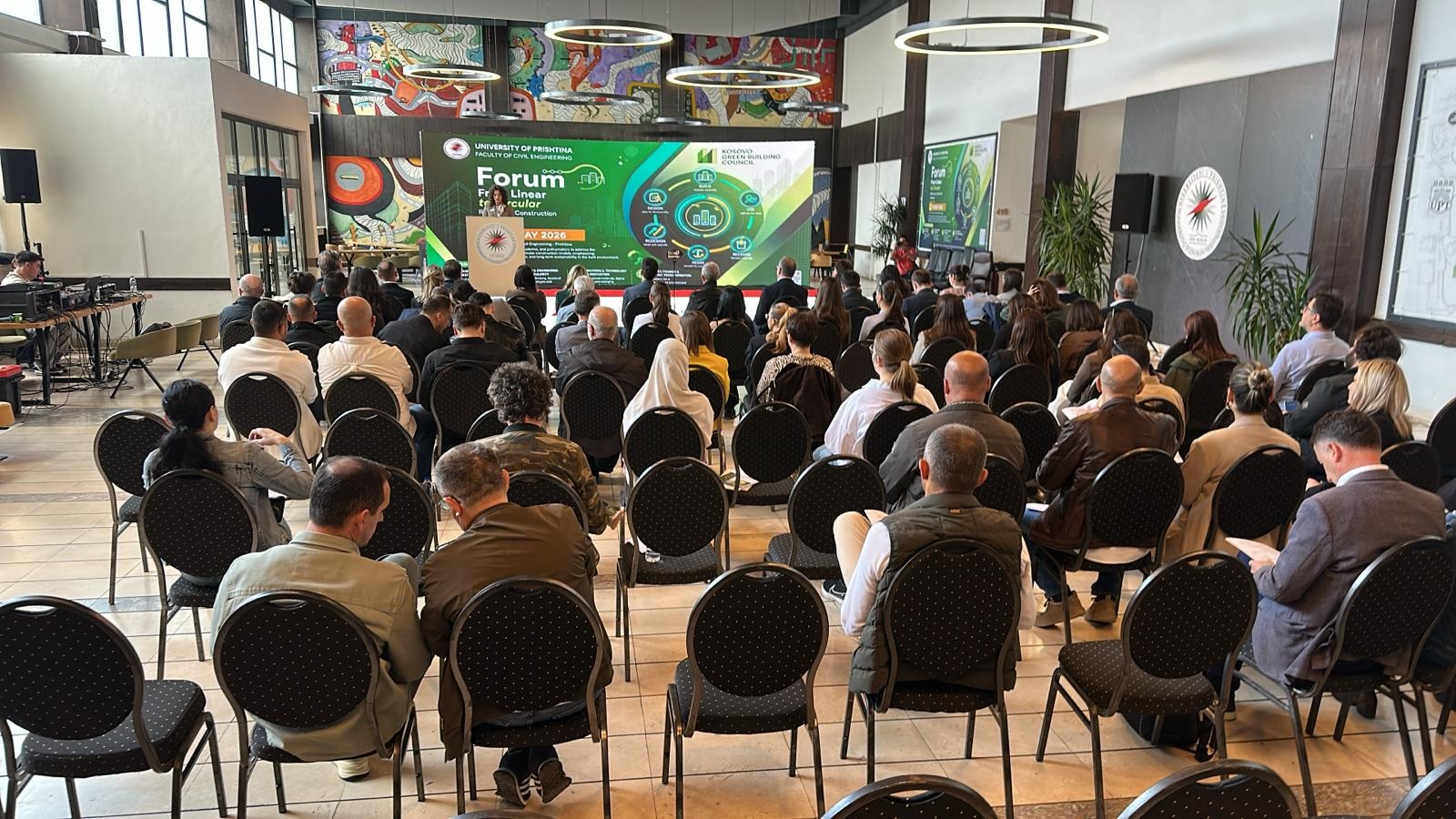
At the Faculty of Civil Engineering at the University of Prishtina, the Forum 2026 is being held in cooperation with the Kosovo Green Building Council (KGBC), focusing on transforming the construction sector from a linear model to a circular and sustainable one.
The Dean of the Faculty of Civil Engineering, Florim Grajçevci, said that global challenges such as climate change, intensive use of natural resources, and waste management require a new approach in the construction sector.
“Academia, industry, public institutions, professionals, organizers, and institutional partners have come together to discuss one of the most important challenges and opportunities of all time: transforming the construction sector from a linear model toward a circular and sustainable future. The construction sector has historically been one of the key pillars of the economy and urban development. However, today we are facing new and complex challenges: climate change, intensive use of natural resources, waste management, energy efficiency, and the growing need for more sustainable and resilient cities and infrastructure,” he said.
He added that the transition from a linear economy to a circular economy is a professional and social necessity, stressing that this transformation requires close cooperation between universities, industry, and institutions.
Meanwhile, the CEO and president of KGBC, Fahrush Azemi, stated that the forum has brought together ideas, institutions, businesses, and academia with a common goal: building a more sustainable future for Kosovo.
Professor from the University of Skopje, Elena Dumova Jovanovska, emphasized the importance of returning to traditions in the careful use of resources.
Representative of the Swiss agency “Helvetas,” Nastasija Stojanovski, said that the strong interest in the forum shows that circular economy and green development topics are receiving increasing attention in the Western Balkans.
“I would say, honestly, looking at this room, this already looks like a success. I am very happy to see so many of you here, and I am glad to see different stakeholders working together: friends from industry, academia, and associations such as the Kosovo Green Building Council, but also representatives from our Circular Economy Hub. I am happy to be here, and especially because, a few years ago, conversations like this might have seemed somewhat distant for our region, but today we are sitting in this full room and possibly discussing how we can make this a reality within the Western Balkans,” she said.
She added that the regional RECONOMY program, implemented by Helvetas and supported by the Swedish International Development Cooperation Agency (SIDA), is working across Western Balkan countries to support economic and green development.