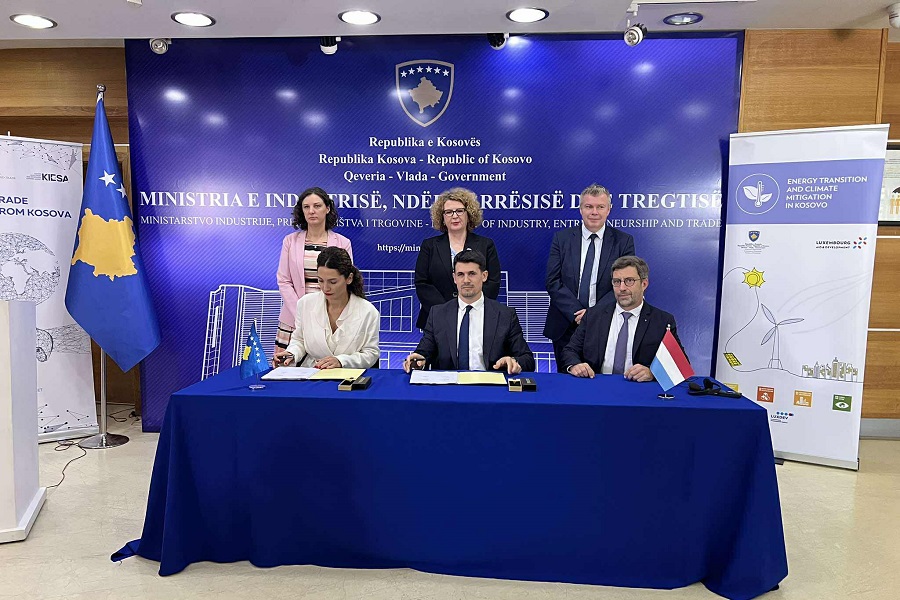
Agreement reached: One million euros for the clean energy grants scheme
One million euros is the value of the scheme signed between KIESA and LuxDev for the clean energy grants program. The signing ceremony was attended by the Ambassador of Luxembourg to Kosovo, Eric Dietz, the Acting Minister of Industry, Entrepreneurship and Trade, Rozeta Hajdari, and the Acting Minister of Economy, Artane Rizvanolli.
The Acting Minister of Industry, Entrepreneurship and Trade, Rozeta Hajdari, said that this scheme will benefit micro, small, and medium-sized enterprises.
“The purpose of this conference is to inform businesses about the signing of the agreement for implementing the clean energy grants scheme, providing financial support to micro, small, and medium-sized enterprises. This initiative comes as a result of financial support from Kosovo’s friendly state, Luxembourg, with a total value of 1 million euros for this scheme alone. The scheme will be implemented by the Kosovo Investment and Enterprise Support Agency (KIESA) under the Ministry of Industry, Entrepreneurship and Trade, as part of project KSV/024, executed by the Luxembourg Development Agency in close cooperation with the Ministry of Economy,” she said.
Meanwhile, the Acting Minister of Economy, Artane Rizvanolli, stated that this agreement comes at a time when, as she said, over 700 businesses are already operating in the liberalized energy market.
“This scheme comes at a time when Kosovo is implementing the second phase of energy market liberalization, with over 700 companies already operating in the market since June 1 of this year. It is not by chance that in designing this scheme, special attention was given to enterprises operating in the liberalized market, though I want to note that other enterprises are not excluded. This is also an effort by the Government of Kosovo, in cooperation with partners—in this case LuxDev—to support production enterprises and facilitate the energy transition for Kosovo’s productive companies,” Rizvanolli said.
The Ambassador of Luxembourg to Kosovo, Eric Dietz, said that this scheme will support private businesses.
“With a budget of one million euros for clean energy, this marks a step in our joint commitment to advance Kosovo’s energy transition. This scheme will provide direct support to the private sector, enabling companies to invest in solar energy, improve energy efficiency, and advance production processes to reduce energy loss. These measures will help lower energy costs, strengthen competitiveness, and contribute to the transition to clean energy in Kosovo,” he concluded.
The decision by the Energy Regulatory Office (ZRRE) to allow large companies to enter the liberalized energy market came into effect in June. This decision has been consistently opposed by businesses and the business community, who argue that an open energy market harms the country’s economy and risks massive job losses.