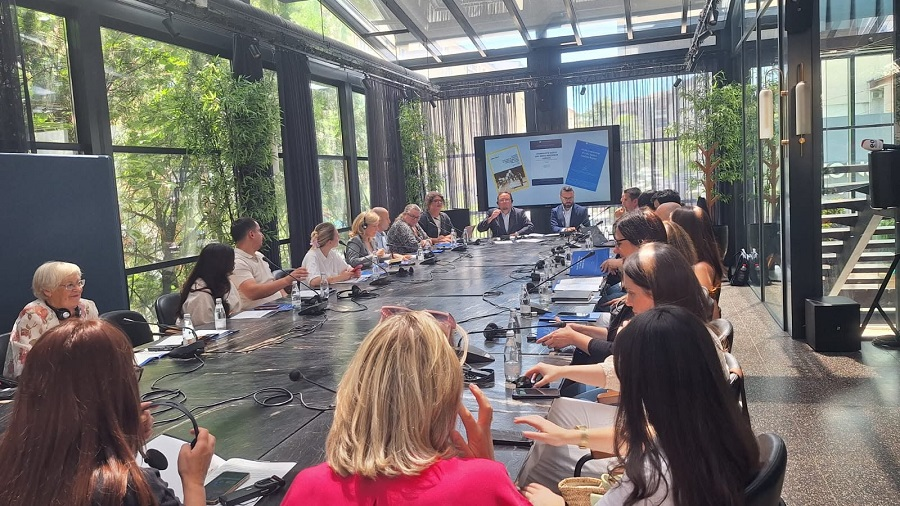
The safety of journalists in Kosovo remains fragile, and journalists are still targeted by attacks from politics and the Government. This was stated during the presentation of key findings on media freedom, journalists’ safety, and hate speech in Kosovo by the Association of Journalists of Kosovo (AGK). It was also announced that only during the first five months of 2026, nine physical and non-physical attacks on journalists in Kosovo were reported.
The president of AGK, Xhemajl Rexha, said that attacks on journalists are mostly occurring in the online space.
Meanwhile, Jerome Bouyjou, head of the Human Rights component in UNMIK, said that trends suggest we may be moving toward a less favorable environment for independent journalism, as reported by KosovaPress.
“These reports provide us with evidence-based data, not just an interpretation, but evidence-based data, allowing us to measure developments and place them within the broader context of freedom of thought and expression, media freedom, and recent developments in Kosovo, the region, and beyond. The trends that we all witness on a daily basis show that we may be moving toward a less favorable environment in Kosovo for free expression and independent journalism. This underlines the need to intensify efforts and focus on preventing further deterioration. It is essential that all stakeholders remain vigilant and committed to protecting these fundamental freedoms,” Bouyjou said.
Meanwhile, Professor Jeton Mehmeti presented findings on this issue, stressing that the main finding is that harmful discourse in Kosovo is dominated by political polarization.
“The main finding of this report—the biggest and most important finding—is that harmful discourse in Kosovo is dominated by political polarization. Of the 148 cases we identified, over 40% are related to political and ideological discourse, meaning that different political actors use expressions that denigrate each other, using terms such as ‘traitor’, ‘foreign agent’, ‘enemy’, and so on. So, words that, instead of discussing public policies, aim to demonize and delegitimize the other person, preventing discussion on public policies. Another finding of the report is an intensified language of attacks against journalists. And this is perhaps the most important finding in terms of the impact it can have on the institution of journalism. There we have encountered expressions, discussions, and debates referring to journalists with various terms such as ‘mercenaries’, ‘paid’, ‘sponsored’, ‘they take bags of money’, and so on. These expressions, during this month that we have…,” Mehmeti said.
Meanwhile, Burbuqe Kastrati from the “Fol” Movement stated that the report shows journalists’ safety remains fragile, noting that in the period January–May 2026, nine cases of physical and non-physical attacks on journalists were reported to the police.
Lawyer Yll Zekaj emphasized that the number of reported cases of these attacks in courts remains high and that procedures are still prolonged.