The 13th salary, which will be given for the first time this year, is not necessarily seen as an increase in purchasing power.
At least according to public sector employee unions, who are the only beneficiaries of this payment.
At a time when inflation in Kosovo has recorded an average increase of around 6 percent, and when fuel prices have recently risen and there are warnings of possible increases in electricity tariffs, this additional payment risks being quickly spent on everyday needs.
According to employee representatives, the 13th salary is a welcome help, but it is not enough to cope with the economic crisis and the ongoing rise in prices.
In fact, they say that a permanent increase in salaries would be a much more effective solution for citizens than a single payment during the year.
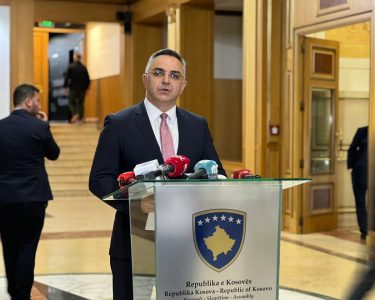
The Chair of the United Union of Education, Science, and Culture, Rrahman Jasharaj, told KosovaPress that implementing the 13th salary is a positive step, but its impact will be limited due to rising prices.
“It is good that it has finally been implemented. We had the 13th salary included in our collective contract, and we feel good that after so many years it is becoming a reality. However, at this time when prices are continuously rising, this will provide only small relief against rising prices. I believe it would be better to increase salaries, because that would be a permanent increase, whereas this is a one-time assistance. It will go to my colleagues, from kindergartens to universities, as well as the entire public sector, but it will be absorbed by rising costs, and its effect will be lost. In other words, it is assistance, but not very significant, because it will lose value against the continuously rising prices,” said Jasharaj.
Meanwhile, the Chair of the Firefighters’ Union, Muharrem Beka, says that this payment slightly eases the situation but is not sufficient to cover monthly expenses.
“The 13th salary will be paid with this month’s salary. It slightly eases the situation, but I do not know how satisfactory it will be, because we have seen high inflation recently, rising prices, and other expected increases after the global crisis. For firefighters, it is an addition, but it is not enough and not satisfactory, because firefighters’ salaries are minimal, and it is difficult to cover the monthly costs we all need,” said Beka.
The Independent Trade Unions of Kosovo also consider the additional payment welcome, but it does not solve the main problem.
The Chair of ITUK, Atdhe Hykolli, says that the long-term solution would be increasing the salary coefficient so that employees can better cope with the rising cost of living.
“This 13th salary is welcome because prices have risen. However, our concern as ITUK is significant because we also need to discuss the value of the coefficient, which is currently low. For these moments, the 13th salary is welcome, but it must be included in the general collective agreement. We need to meet and discuss the coefficient value as soon as possible. The coefficient should be increased to a level that offsets the current high inflation. This is staggering inflation, making it very difficult for employees in Kosovo to cover monthly expenses with their current salaries. The 13th salary is support, but we need to discuss the coefficient to provide long-term relief. In a one-year perspective, it is insufficient. For a month, it can provide some temporary relief. But we are talking about the ongoing price increases, while salaries remain insufficient for employees in Kosovo,” emphasized Hykolli.
The Harmonized Index of Consumer Prices (HICP) in Kosovo recorded an average increase of 6.0 percent in February 2026 compared to February 2025, while monthly inflation was 0.6 percent compared to January 2026, KosovaPress reports.
According to the Kosovo Agency of Statistics, the annual price increase was mainly driven by higher costs in several goods and service groups, including personal transport-related services (42.5%), flight tickets (39.0%), and water supply and other residential services (33.4%).
Regarding price increases, the Kosovar Electricity Supply Company (KESCO) has requested from the Energy Regulatory Office of Kosovo (ERO) an increase of over 20 percent in electricity tariffs for 2026, citing rising operating costs and the need to ensure stable electricity supply.
However, the ERO is expected to review this request and decide whether to approve it.
It is worth recalling that in May 2025, the ERO approved a tariff increase of 16.1 percent compared to 2024.
Meanwhile, due to the war between the U.S. and Israel with Iran, fuel prices have risen for more than two weeks to around €1.5 for diesel and €1.3 for gasoline.