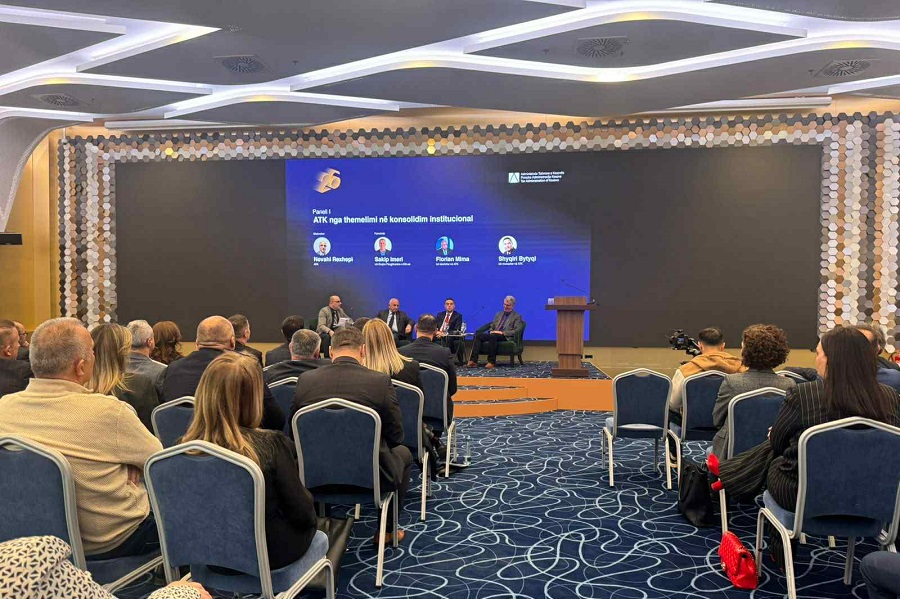
The Tax Administration of Kosovo (TAK) marks the 26th anniversary of its establishment, highlighting the institution’s crucial contribution to the country’s fiscal stability and economic development, KosovaPress reports.
At a press conference, Deputy Minister of Finance, Labor, and Transfers, Agon Dobruna, described TAK as a fundamental institution for the functioning of the state and for restoring the fiscal sovereignty of the Republic of Kosovo.
“We are marking the 26th anniversary of TAK, a fundamental institution for the functioning of the state and for restoring the fiscal sovereignty of the Republic of Kosovo. TAK was built alongside our state, from an administration created under difficult circumstances into a professional and reliable model institution. Its contribution has been decisive for fiscal stability, institution-building, and the country’s economic development. As the Government of the Republic of Kosovo, we consider TAK a key pillar of good governance and fiscal justice. The revenues collected are not merely budgetary figures, but resources for education, healthcare, social and economic development, and the improvement of citizens’ lives,” he said.
The Director General of TAK, Mentor Hyseni, spoke about the process of modernizing and digitizing the tax administration, emphasizing a more advisory rather than punitive approach toward taxpayers.
“First, I want to announce a new approach we have started to modernize TAK, primarily with a less punitive and more advisory approach. It is never easy to implement the law if the taxpayer lacks the willingness… The second factor is the digitization process that we are trying to implement. No fiscal or digital reform can succeed without qualified human resources. The second idea concerns reforming human resources, where we plan to recruit a large number of new staff, while the existing staff will have the ideal opportunity to focus on monitoring processes, knowledge transfer, and mentoring the young staff joining TAK,” he said.
Tax expert Shyqyri Bytyqi recalled the difficult beginnings of TAK in 2000, when laws and basic procedures were lacking, emphasizing the moral responsibility and determination of the first generation to build trust and Kosovo’s fiscal state.
“It was a very difficult time because everything was missing, starting with what was most important: the laws were undeveloped, procedures were lacking, and we didn’t even have an office where we could all work together. But we had something special—we had the will to build the state and the procedures, and the will to create trust. So, as a generation, it was a heavy burden on our shoulders. I’m talking about the year 2000, when we were waiting to start as the first inspectors going into the field, when Kosovo, as a state, would for the first time start collecting its own taxes. It was a mission, a moral responsibility,” he said.
The Tax Administration of Kosovo (TAK) marks the 26th anniversary of its establishment, highlighting the institution’s crucial contribution to the country’s fiscal stability and economic development, KosovaPress reports.
At a press conference, Deputy Minister of Finance, Labor, and Transfers, Agon Dobruna, described TAK as a fundamental institution for the functioning of the state and for restoring the fiscal sovereignty of the Republic of Kosovo.
“We are marking the 26th anniversary of TAK, a fundamental institution for the functioning of the state and for restoring the fiscal sovereignty of the Republic of Kosovo. TAK was built alongside our state, from an administration created under difficult circumstances into a professional and reliable model institution. Its contribution has been decisive for fiscal stability, institution-building, and the country’s economic development. As the Government of the Republic of Kosovo, we consider TAK a key pillar of good governance and fiscal justice. The revenues collected are not merely budgetary figures, but resources for education, healthcare, social and economic development, and the improvement of citizens’ lives,” he said.
The Director General of TAK, Mentor Hyseni, spoke about the process of modernizing and digitizing the tax administration, emphasizing a more advisory rather than punitive approach toward taxpayers.
“First, I want to announce a new approach we have started to modernize TAK, primarily with a less punitive and more advisory approach. It is never easy to implement the law if the taxpayer lacks the willingness… The second factor is the digitization process that we are trying to implement. No fiscal or digital reform can succeed without qualified human resources. The second idea concerns reforming human resources, where we plan to recruit a large number of new staff, while the existing staff will have the ideal opportunity to focus on monitoring processes, knowledge transfer, and mentoring the young staff joining TAK,” he said.
Tax expert Shyqyri Bytyqi recalled the difficult beginnings of TAK in 2000, when laws and basic procedures were lacking, emphasizing the moral responsibility and determination of the first generation to build trust and Kosovo’s fiscal state.
“It was a very difficult time because everything was missing, starting with what was most important: the laws were undeveloped, procedures were lacking, and we didn’t even have an office where we could all work together. But we had something special—we had the will to build the state and the procedures, and the will to create trust. So, as a generation, it was a heavy burden on our shoulders. I’m talking about the year 2000, when we were waiting to start as the first inspectors going into the field, when Kosovo, as a state, would for the first time start collecting its own taxes. It was a mission, a moral responsibility,” he said.