
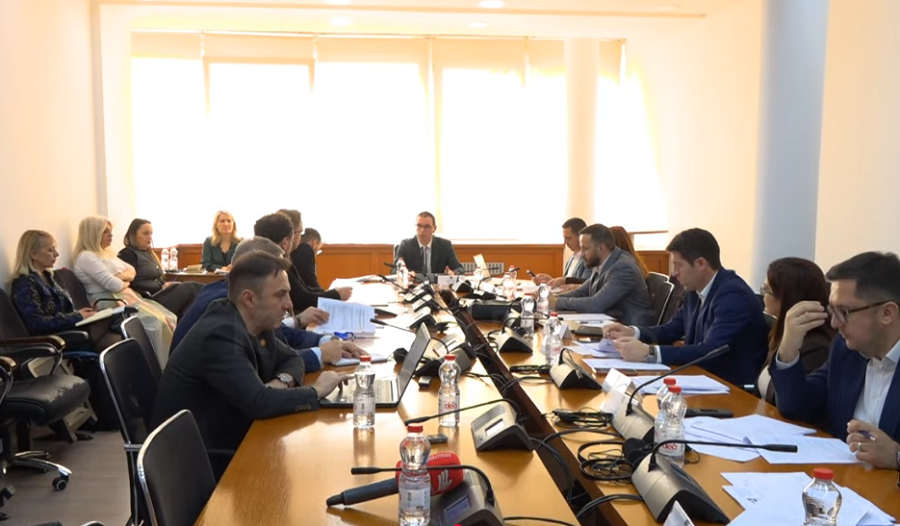
The parliamentary Committee on Budget on Wednesday approved the financial plan of Radio Television of Kosovo (RTK) for the first six months of 2026, with a budget of €4 million and €480 thousand allocated from the Kosovo budget, KosovaPress reports.
During the discussions, committee members highlighted the financial challenges RTK faced in 2025, including delays in salary payments, past debts, and the increase in the minimum wage. MPs also raised concerns about the management of the institution and the departure of several employees, while RTK’s leadership stated that all contracts had been handled in accordance with the law and internal regulations.
RTK’s Director of Finance, Gazmend Rexhepi, presented the financial plan for the first half of 2026.
“Regarding the planning for the first six months of 2026, based also on the law on budget appropriations for this year, Radio Television of Kosovo has foreseen revenues of €4 million and €480 thousand from the Kosovo budget, €610 thousand from own-source revenues, and €8,750 from donations. Total revenues for the first half amount to €5 million and €98 thousand and €750. As for expenditure planning, €3 million and €786 thousand and €743 are allocated for staff salaries, which in percentage terms represents 85% of the budget allocated by the Government of Kosovo,” he said.
The Acting Director General of RTK, Hysen Hundozi, said that 2025 had been a challenging year for RTK due to the non-functionality of the board and the lack of authority from the founder, the Assembly of Kosovo. He stressed that during the year there were two critical moments when the payment of employees’ salaries was at risk, a situation which, according to him, had never occurred before in RTK’s history.
“The year 2025 has been a very challenging year for Radio Television of Kosovo due to the non-functionality of the board and the founder of RTK, which is the Assembly. During the past year, financially, we faced two very difficult moments when regular salary payments to our employees were at risk, and there were even delays — something that has happened for the first time in RTK’s long history. This happened due to the absence of the Budget Committee, which is authorized to allocate funds, meaning to authorize the state treasury to execute such payments. As an emergency solution, at that time we requested a loan from the government, which was approved in the amount of €2 million and €540 thousand to finance one quarter, from July to September. However, due to the non-constitution and full non-functionality of the Assembly, the crisis was repeated in November, so salaries for November and October were also paid with delays until another government decision was taken from the reserve fund, providing a temporary financial solution,” Hundozi emphasized.
Hundozi also highlighted other challenges RTK faced.
“We have faced various challenges, including past debts, threats from enforcement agents regarding the settlement of these debts, price increases by economic operators, and most recently the increase in the minimum wage, which has implications for our budget, particularly regarding our employees whose contracts had to be amended to meet this legal obligation. Additionally, we had to adjust contracts with economic operators, who were required to increase their prices to pay their workers in physical security and cleaning services, which are services we receive from independent operators,” Hundozi added.
Meanwhile, Democratic Party of Kosovo MP Kujtim Gashi raised concerns about the management of RTK, highlighting the departure of several journalists and employees and asking whether this was related to performance or political beliefs.
“Another concern I want to raise is the management of RTK and the way it is being managed. We have dozens of private television stations in Kosovo that function normally, whereas RTK has a continuous problem, including in financial management. Recently, unfortunately, we are also seeing problems with journalists and employees working at RTK. Many of them are leaving their jobs, and as a committee we want to know why. Do they have issues with their work performance, or are they being targeted because of their political party beliefs, or where is the problem? It is concerning how RTK has been dismissing many journalists, especially in recent years,” he said.
Hundozi responded that during his tenure no employee had been dismissed in the sense of contract termination, and that the cases mentioned were related only to the expiration of fixed-term contracts, handled according to legal procedures and RTK regulations.
“During the time I have served as Acting Director General of RTK, no employee has been dismissed in the full sense of the word. The cases you mentioned concern two of our employees whose fixed-term employment contracts expired. Therefore, we are not dealing with termination of employment, but with the expiration of contracts. We also have an official report from the Labour Inspectorate, following a complaint filed by the employee in question, Edina, and according to this official report, RTK as an employer respected all legal procedures and its internal regulations, and there were no violations in this regard,” he said.
On the other hand, Vetëvendosje Movement member Valon Hoti asked why it was urgent to approve the report without sufficient time for full review. In response, Committee Chair Enver Haliti said the urgency was related to the possibility that the country could go to elections and RTK might be left without a budget, thus avoiding a repetition of last year’s crisis.“My request as committee chair was to include these items on the agenda. We invited RTK to be present, based on the parliamentary dynamics we have as the Assembly of the Republic. It is known that we are ahead of the session process for the president and no one knows what the outcome of that session will be. Therefore, I did not want to risk RTK being left without a budget and the same situation as last year being repeated, when we as a committee did not have the right to convene. That was the urgency,” Haliti said.